How Astra 19.2°E Shapes Everyday Television in Europe

Estimated reading time: 16 minutes.
Most viewers never think about orbital positions. They think about what appears on the screen. What works. What feels stable. What is easy to access. Astra 19.2°E shapes everyday television in Europe because it makes distribution feel normal. Not impressive. Not complicated. Normal. And in media, normal is the strongest form of success.
Quick Context
This article explains how one satellite position influences daily viewing habits at home. The focus is on routine, familiarity, and why stability often matters more than features.
- Infrastructure That Feels Invisible
- How 19.2°E Became the Default Home Setup
- Simplicity Creates Everyday Usage
- How Stability Builds Habit
- Shared Channels Create Shared Culture
- Seasonal Viewing and Familiar Schedules
- Satellite as the Quiet Fallback Layer
- How It Fits Modern Connected TV Life
- Reality Check
- Final Verdict
- Frequently Asked Questions
Infrastructure That Feels Invisible
The strongest infrastructure becomes invisible. When distribution works consistently, viewers stop noticing it. They notice only content.
Astra 19.2°E shaped European television by reaching this invisible state. The signal became a background certainty. Households built routines on top of it.
In daily life, this matters more than innovation. People rarely reward technology for being new. They reward it for being dependable.
The best television delivery is the one people forget exists.
How 19.2°E Became the Default Home Setup
Daily habits form around defaults. In many markets, installers and retailers treated Astra 19.2°E as the standard option. Standard options become cultural habits because they scale quickly.
When a new household moved into a building, the question was rarely which orbit to choose. The choice was already made by the local installation culture. This is how infrastructure becomes everyday life.
Over time, the default becomes self reinforcing. More homes use it. More installers specialize in it. More equipment is optimized for it.
Simplicity Creates Everyday Usage
People use what feels simple. If TV access requires constant adjustments, daily viewing declines.
Astra 19.2°E gained everyday relevance through simplicity. A stable reference point reduces confusion. It reduces support calls. It reduces hesitation.
Simplicity also shapes who watches. When access feels easy, more casual viewers participate. Casual participation expands the cultural footprint of television.
How Stability Builds Habit
Habit is built from repetition without friction. If a household can trust that TV will work at the same time every day, watching becomes natural.
This is one reason satellite still matters in many homes. It provides a consistent layer that does not depend on daily internet congestion patterns.
Stability also supports multi person viewing. Families do not want technical uncertainty when they sit together. They want content to begin immediately.
Shared Channels Create Shared Culture
When many households rely on similar distribution, they often share similar channel ecosystems. Shared ecosystems create shared references.
This influences everyday conversation. The same news formats. The same sports rhythms. The same familiar presentation styles.
Even when viewers watch different content, the underlying distribution normalizes the idea that television is always available. That expectation shapes media habits across generations.
Seasonal Viewing and Familiar Schedules
Television peaks during seasonal moments. Major sports periods. holiday programming. special events.
When distribution is stable, seasonal peaks feel effortless. Viewers do not worry about access. They focus on the event.
Over time, these repeated peaks build cultural habit. The household expects television to carry major moments. Astra 19.2°E helped make that expectation reliable.
Satellite as the Quiet Fallback Layer
In modern homes, media delivery is layered. Apps provide choice. On demand libraries provide flexibility. But a stable broadcast layer provides certainty.
Satellite often plays that quiet fallback role. When the internet is unstable or overloaded, broadcast remains steady. Viewers may not describe it this way, but their behavior shows it.
The presence of a fallback layer reduces anxiety. Reduced anxiety increases daily usage.
How It Fits Modern Connected TV Life
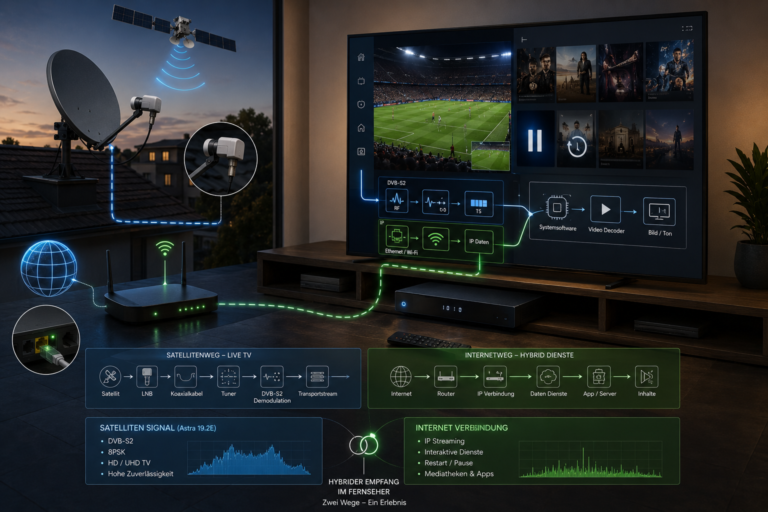
Connected TVs brought interface changes, not a complete replacement of distribution habits. Many households still combine stable broadcast viewing with app based consumption.
This hybrid routine reflects how people prefer to live. They want reliable daily channels and flexible extras. Astra 19.2°E supports the reliable base.
In that sense, the orbit shapes everyday television by anchoring the familiar layer. Familiar layers keep households comfortable. Comfort keeps television present.
Reality Check
Astra 19.2°E shapes everyday television through invisibility, stability, and default behavior. Most households do not choose it actively. They live inside a distribution habit that became normal through long term standardization.
Final Verdict
Final Verdict
Astra 19.2°E influences European media life because it makes television feel simple and dependable. By becoming the default installation choice and a stable base layer, it helps daily viewing turn into habit. In modern hybrid media homes, that stable habit remains a powerful advantage.
Frequently Asked Questions
| Question | Answer |
|---|---|
| How does Astra 19.2°E affect daily TV viewing? | It makes access feel stable and familiar. That stability reduces friction and turns viewing into a routine rather than a decision. |
| Why do households treat 19.2°E as the default? | Because installation culture and equipment support standardized around it over time. Defaults scale faster than optional choices. |
| Does satellite still matter if people stream content? | Yes. Many homes use a hybrid routine. Broadcast provides a stable base layer, while streaming provides flexible extras. |
| Is stability really more important than features? | For everyday habits, yes. Viewers rely on what works consistently, especially for shared household viewing. |