Inter-Satellite Links 2026: Faster Data Transmission
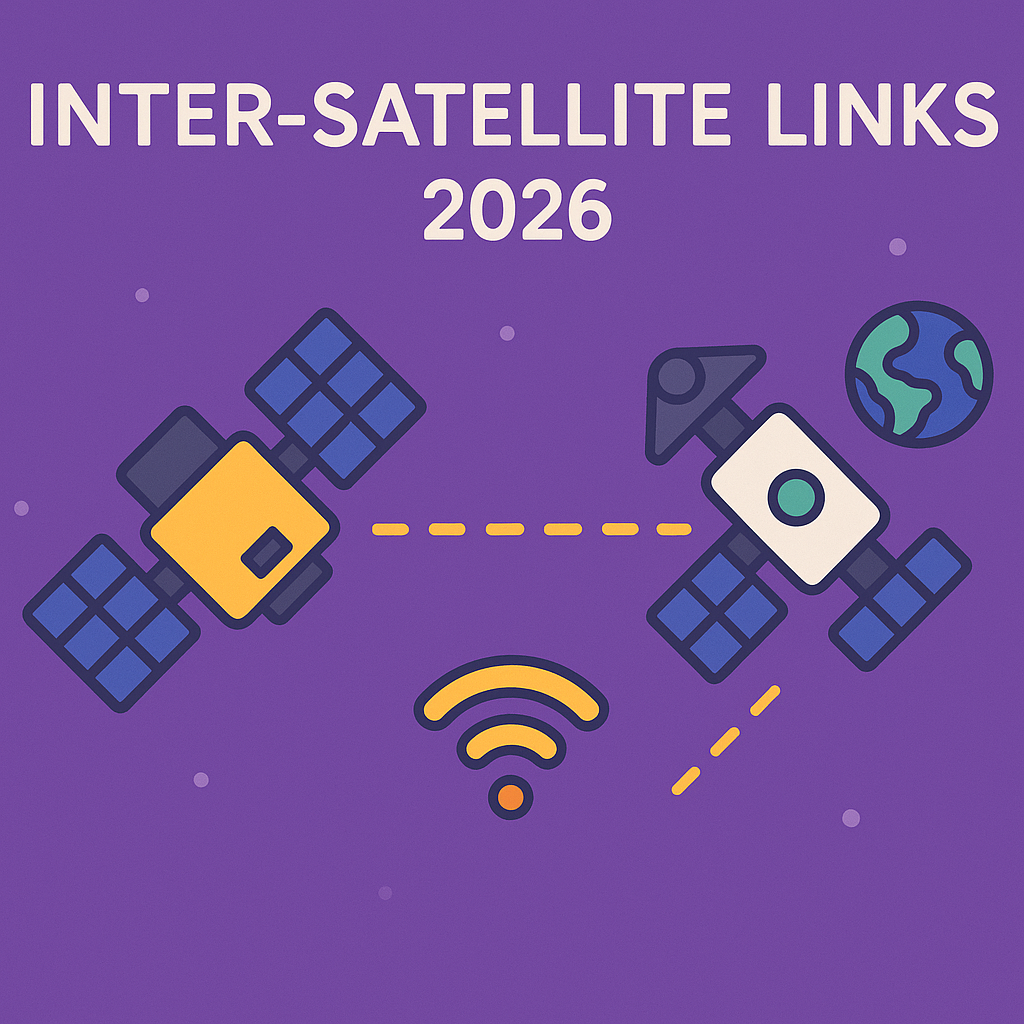
Inter-Satellite Links 2026: Faster Data Transmission
Estimated reading time: 8 minutes
The year 2026 is shaping up to be a milestone for global connectivity, with the rise of inter-satellite links (ISL) — advanced systems that allow satellites to communicate directly with one another using high-speed laser beams. These links are eliminating the need for constant ground-based relays, transforming how data flows through space.
By using optical laser connections instead of traditional radio frequencies, ISL technology enables near-instant transmission speeds, higher bandwidth, and unmatched data security for both commercial and defense applications.
💡 How Inter-Satellite Links Work
Each satellite in an ISL-equipped constellation carries a set of optical terminals capable of emitting and receiving narrow laser beams. When two satellites align, these lasers exchange data directly, creating a fast and resilient network above the Earth.
Unlike radio-based communication, laser signals are immune to atmospheric interference and can transmit at speeds exceeding 10 Gbps. This makes ISLs ideal for real-time data streaming, high-definition IPTV delivery, and global broadband services.
⚙️ Advantages Over Traditional Systems
- High Speed: Laser transmission is up to 100 times faster than conventional RF systems.
- Low Latency: Direct satellite-to-satellite routing removes the need for ground-based handovers.
- Enhanced Security: Narrow laser beams are almost impossible to intercept or jam.
- Reduced Ground Infrastructure: Fewer earth stations are required, cutting costs and carbon emissions.
The result is a fully connected orbital mesh capable of linking continents and oceans without interruption — a true “internet in space.”
📡 The Role of AI in Laser Communication
AI algorithms ensure optimal beam alignment between fast-moving satellites, compensating for orbital drift, vibration, and light distortion. Through machine learning prediction models, satellites can preemptively adjust their pointing mechanisms to maintain stable connections even at thousands of kilometers apart.
This automation makes ISLs reliable enough for critical applications like autonomous aircraft tracking, global navigation, and real-time IPTV broadcasting.
🌍 Global Adoption and Expansion
In 2026, networks such as Starlink, OneWeb, and Eutelsat Quantum are leading the deployment of laser-linked constellations. The European Space Agency (ESA) has also initiated the “OptiNet 2026” program, focused on standardizing optical terminals for universal compatibility.
This collaboration will enable satellites from different providers to share data seamlessly, ensuring consistent and high-quality service across multiple orbital systems.
🟨 Reality Check
Despite their advantages, inter-satellite links come with challenges. Precise optical alignment requires advanced sensors and stabilization systems, making the hardware more complex and expensive. Additionally, cloud cover or optical interference during ground-to-space communication can still affect overall efficiency.
However, continuous improvements in adaptive optics and AI calibration are expected to overcome these issues by late 2026, making laser-based data transfer the new global standard.
🚀 The Future of Space Data Transmission
By 2027, experts expect laser communication to replace radio frequency for 80% of satellite-to-satellite data exchange. The resulting space-wide fiber network will redefine global connectivity, supporting low-latency communication for millions of users on Earth.
As AI, quantum encryption, and laser precision evolve together, inter-satellite links will enable a new era of secure, instant, and intelligent broadcasting networks across the globe.
🟥 Final Verdict
Inter-Satellite Links 2026 mark the beginning of a truly interconnected orbital ecosystem. With laser-speed communication and AI-powered reliability, data will soon move across the skies as smoothly as light itself.
Faster, safer, and cleaner — these networks are the invisible threads weaving the future of global communication.