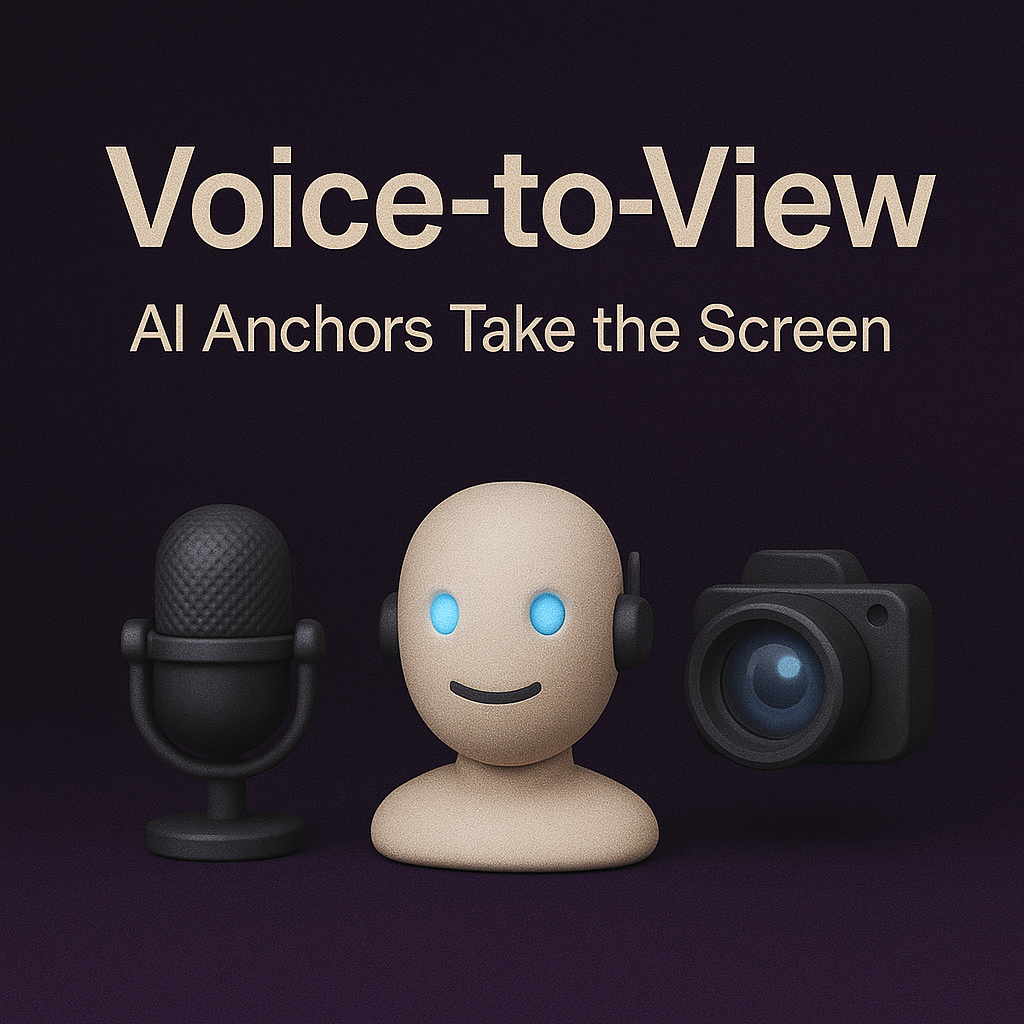
Voice-to-View: AI Anchors Take the Screen
AI in Broadcasting • Voice-to-View
📖 Estimated reading time: 8 minutes
Introduction
In 2026, Europe’s television landscape is facing a bold new reality — one where AI-generated news anchors deliver headlines flawlessly, never miss a cue, and can speak any language on demand. This evolution, known as Voice-to-View, merges voice synthesis, motion capture, and generative video models to create fully autonomous on-screen presenters.
Quick take: Europe’s first generation of digital anchors have arrived — lifelike, multilingual, and emotionally responsive avatars built entirely by AI, changing the face of modern broadcasting forever.
From Voices to Virtual Faces
The concept of synthetic anchors began with simple text-to-speech narration. But by 2026, AI has gone far beyond that — blending neural rendering and speech-emotion modeling to produce hyper-realistic avatars capable of maintaining eye contact, expressing emotion, and adjusting tone dynamically based on story content.
- Photorealistic avatars: Generated using diffusion models trained on licensed human datasets.
- Emotionally adaptive speech: AI voice engines modulate tone based on sentiment analysis of the script.
- Multilingual output: Automatic dubbing and lip-syncing for 30+ European languages.
- Script automation: GPT-powered news generators feed real-time updates into the anchor’s teleprompter AI.
Inside Europe’s Virtual Newsrooms
Leading broadcasters like DW Germany, RAI Italy, and France 24 are already experimenting with hybrid newsrooms — studios where human editors collaborate with AI avatars. These systems use real-time rendering engines to project virtual anchors directly into live studio environments or fully digital sets.
Each AI anchor is trained to mimic human micro-expressions and cultural gestures, allowing it to maintain authenticity with local audiences. In multilingual countries like Belgium and Switzerland, one avatar can deliver the same bulletin in multiple languages, complete with region-specific phrasing and intonation.
Technical Overview (Voice-to-View System)
| Component | Technology | Function |
|---|---|---|
| Voice Engine | Neural text-to-speech (TTS 4.0) | Creates natural, emotional vocal output |
| Avatar Generator | Diffusion & GAN hybrid | Builds lifelike digital presenters |
| Lip Sync Layer | AI phoneme-mapping | Ensures perfect speech synchronization |
| Language Model | Transformer-based NLP | Generates scripts and adapts to breaking news |
| Rendering Engine | Unreal Engine / Omniverse | Renders avatars in real-time broadcast quality |
The Rise of Synthetic Journalism
Voice-to-View technology is not just a novelty — it’s reshaping journalism economics. AI anchors can work 24/7, deliver consistent performance, and localize content instantly. This allows broadcasters to expand coverage without increasing operational costs, while ensuring accessibility across regions and languages.
Public Perception and Ethics
Despite their efficiency, AI anchors raise important ethical questions. Viewers are often unaware when a newsreader isn’t real. Regulators across Europe now require visual or verbal disclosure during AI-generated segments to preserve transparency and audience trust.
Reality Check
AI anchors can inform — but can they empathize? While Voice-to-View systems excel in accuracy and efficiency, they still struggle with human warmth and contextual sensitivity. Critics argue that over-reliance on synthetic presenters could erode emotional connection and public trust in journalism.
Final Verdict
Voice-to-View 2026 redefines what it means to present the news. Combining the precision of AI with the artistry of broadcasting, Europe’s virtual anchors are not replacing journalists — they’re extending their reach. The screen has learned to speak, and it speaks in every language.