Astra Dish Alignment Step by Step Guide
Estimated reading time: 23 minutes.
Dish alignment is the most important part of any satellite installation. You can buy a good receiver, use proper cables, and install a decent LNB, but if the dish is not pointing at the correct position, reception will always remain weak or unstable. For Astra reception, especially around the Astra 19.2 orbital position, even a small mistake in direction can make the difference between clean stable channels and a screen full of signal problems.
The good news is that dish alignment is not mysterious. It is a physical process based on direction, angle, and precision. Once you understand how azimuth, elevation, mast level, and LNB position work together, the whole installation becomes much easier to control. This guide explains Astra dish alignment step by step in a calm, practical way so you can understand not only what to adjust, but why each adjustment matters.
Quick Context
This guide explains how to align an Astra satellite dish step by step using correct mast leveling, azimuth adjustment, elevation tuning, LNB positioning, and signal quality checks for stable reception.
- Why precise dish alignment matters
- What to check before starting alignment
- Why the mast must be perfectly level
- Understanding azimuth for Astra alignment
- Understanding elevation angle
- LNB skew and focal position basics
- Step 1 preparing the installation point
- Step 2 setting the rough azimuth direction
- Step 3 setting the initial elevation
- Step 4 fine tuning using signal quality
- Step 5 locking the dish without losing signal
- Common alignment mistakes
- How to diagnose poor alignment after setup
- Typical alignment problems and causes
- Reality Check
- Final Verdict
- Frequently Asked Questions
Why precise dish alignment matters
A satellite dish works by reflecting a weak radio signal from space into a concentrated focal point where the LNB sits. The signal reaching the dish is not strong in the way many people imagine. It is usable only because the dish surface collects it and focuses it accurately.
This means alignment is not just about pointing the dish roughly in the right direction. The reflector must face the orbital position closely enough for the signal to fall exactly where the LNB can capture it efficiently.
If the alignment is only slightly off, the receiver may still show some signal strength, but signal quality will remain weak. This is why many installations look almost correct yet fail during rain, evening temperature changes, or channel changes across different transponders.
Good alignment creates margin. That margin is what keeps Astra channels stable under normal daily changes.
What to check before starting alignment
Before adjusting the dish itself, the installation must be physically ready. This part is often ignored, but it matters more than people think. If the support arm is loose, the mast is not level, or the cable is damaged, you can spend a long time aligning the dish and still get poor results.
The first thing to confirm is that the dish bracket is firmly attached to a stable surface. A weak wall anchor or flexible pole makes fine tuning almost impossible because the dish moves slightly every time pressure is applied.
Second, inspect the cable path and connectors. A damaged coaxial cable or poorly fitted connector can reduce usable signal and make the receiver meter misleading. Third, confirm that the receiver is already configured for Astra and that the LNB type matches the installation.
Alignment becomes much easier when the rest of the system is already healthy.
Why the mast must be perfectly level
Astra dish alignment depends heavily on the mounting pole or mast being vertical. This is not a minor detail. It is fundamental. The reason is simple. Elevation scales on most satellite dishes assume the mast is level. If the mast leans even slightly, the elevation reading becomes inaccurate.
That creates a chain reaction. You may set the correct elevation number on the dish bracket, but the actual dish angle in space will be wrong. Then you compensate by moving azimuth, and both angles become confusing.
In practical terms, a dish on an unlevel mast becomes harder to align because every adjustment influences the others more than it should. The installer starts chasing the signal instead of controlling it.
A simple spirit level used carefully at the mast stage can save a lot of time later in the alignment process.
Understanding azimuth for Astra alignment
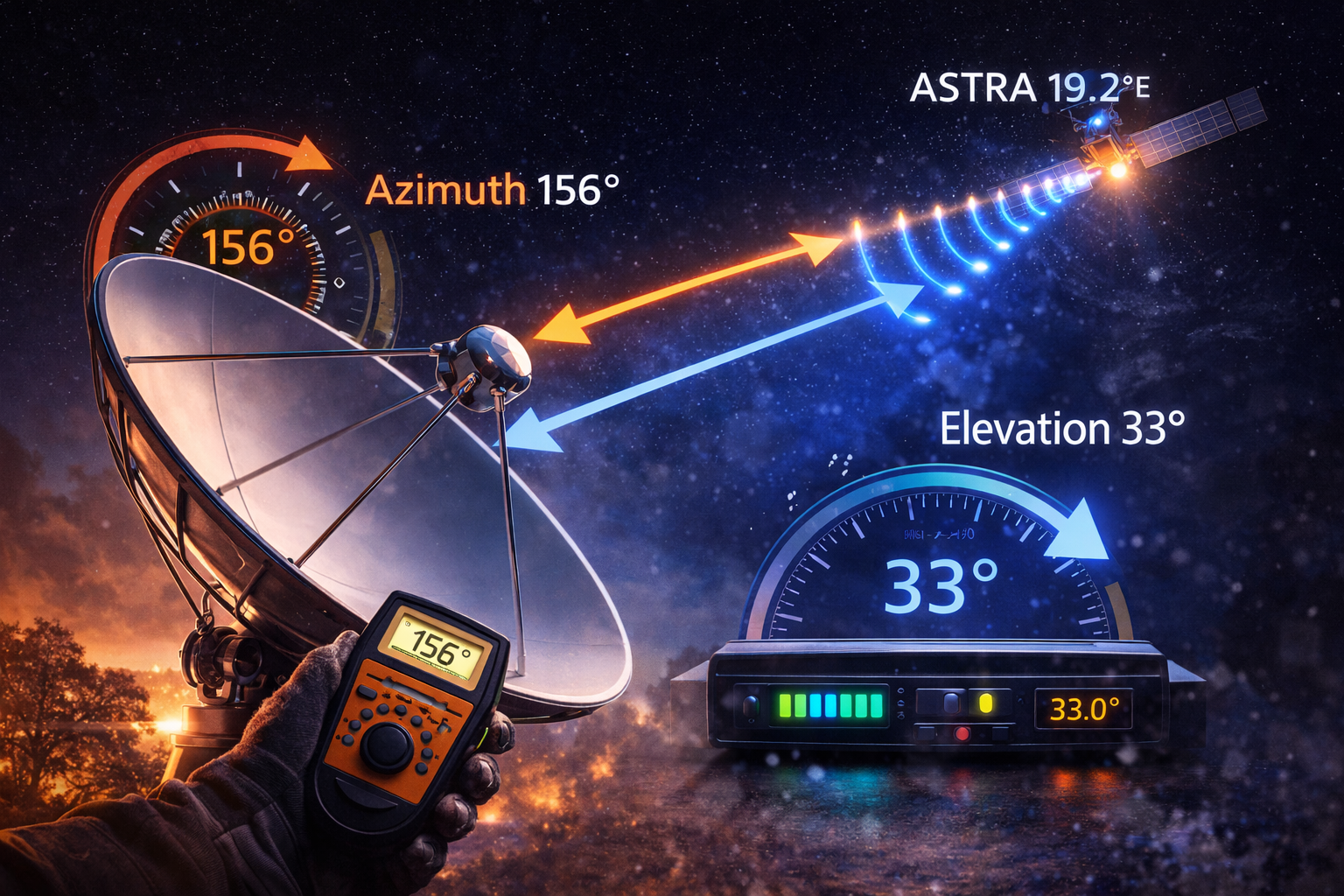
Azimuth is the horizontal direction in which the dish points. You can think of it as left and right movement. For Astra, the exact azimuth depends on your location, but the principle stays the same. The dish must rotate horizontally until it faces the orbital direction where Astra satellites appear from your position.
This movement should be treated with patience. Large turns are useful only in the rough search stage. Once you are near the correct direction, tiny movements matter much more than broad ones.
Many people lose the signal simply because they move too quickly. Satellite beams are narrow enough that a small horizontal change can shift the focal point away from the useful signal path.
When aligning Astra, azimuth should always be adjusted slowly and observed mainly through signal quality, not just signal strength.
Understanding elevation angle
Elevation is the vertical angle of the dish. It determines how high or low the reflector points above the horizon. Like azimuth, the correct elevation depends on where the installation is located.
Elevation matters because the satellite is not directly overhead. It appears at a specific angle in the sky depending on geography. If elevation is set too low, the dish points under the satellite. If it is too high, it points above it.
A dish may still show some meter activity when elevation is near the correct range, but only precise tuning creates stable quality. This is why rough elevation setting should be followed by careful fine tuning.
The best results usually come from moving elevation in very small increments once a usable Astra signal is found.
LNB skew and focal position basics
The LNB does not simply sit on the arm and collect signal in any position. It must be placed at the focal point designed by the dish, and its rotation, known as skew, must align with the polarization of the satellite signal.
If the LNB is rotated incorrectly, the dish can still lock onto Astra, but signal quality may remain lower than expected. Some transponders may appear more stable than others, which often confuses users who think the dish itself is aligned incorrectly.
Likewise, if the LNB sits too far forward or backward from the proper focal point, the reflected signal will not converge correctly. This can reduce quality even when azimuth and elevation look good.
LNB adjustment is often the final step that turns a usable signal into a strong and stable one.
Step 1 preparing the installation point
The first practical step is preparing the installation point so alignment can be done safely and accurately. The dish should be mounted on a secure bracket with all bolts fitted but not fully tightened where movement is still needed for adjustment.
Use a level to check the mast from at least two sides. If the mast is not vertical, correct that before doing anything else. This step saves time later because the dish angle scales become meaningful only when the mast is correct.
Next, confirm that the dish has a clear line of sight. Look in the general direction where Astra should be. Trees, balcony edges, nearby buildings, roof corners, and even decorative structures can interfere. Remember that a signal path can be blocked even when the obstacle looks slightly off from your eye line because the dish is looking at a precise angle.
Once the location, mast, and physical stability are confirmed, the system is ready for rough alignment.
Step 2 setting the rough azimuth direction
Now the dish should be pointed roughly toward the Astra direction for your area. This is the coarse search stage. The goal here is not perfect signal but reaching the correct sector of the sky so fine tuning becomes possible.
Move the dish horizontally until it is approximately facing the expected orbital direction. At this stage, large movements are acceptable because you are only narrowing the search area.
Once you are close, reduce movement dramatically. Rotate the dish slowly a few millimeters at a time, then pause and watch the receiver meter. Do not rely on instant reaction only. Some meters update with slight delay.
If a signal appears, avoid moving too fast. It may not yet be Astra, especially if other satellites are nearby in the sky path. Confirm by checking expected transponders or channel groups after a usable lock is found.
Step 3 setting the initial elevation
After rough azimuth, set the dish elevation according to the approximate angle required for your area. Most dish brackets include an elevation scale, but treat it as a starting point rather than a final answer.
If the mast is level, the scale should place you near the correct range. Raise or lower the dish until the receiver begins to show better quality. The trick here is patience. A very small elevation change can have a major impact.
The best method is to move elevation slightly upward, pause, check quality, then move slightly downward if needed. Once the signal improves, continue narrowing the movement until you find the point of highest quality.
At this stage, signal quality should begin to rise in a predictable way if you are truly on Astra and not an adjacent orbital position.
Step 4 fine tuning using signal quality
This is the most important stage. Once the dish finds Astra in a usable way, stop focusing on raw signal strength and concentrate on quality. Signal strength can remain fairly high even when alignment is still imperfect, but signal quality reveals how accurately the dish is tuned.
Start by moving azimuth in very small increments left and right while watching the quality reading. Find the highest quality point. Then do the same with elevation. After that, return to azimuth again because the two adjustments influence each other slightly.
This back and forth fine tuning process is normal. It is not wasted motion. It is how the best alignment point is found. Once the dish peaks in both directions, move to the LNB skew and check whether rotating the LNB slightly improves quality further.
In strong installations, the difference between acceptable quality and truly optimized quality is often found during this stage.
Step 5 locking the dish without losing signal
After reaching the best quality point, the dish must be tightened carefully. This step is more important than it looks because many installers accidentally lose alignment while tightening bolts.
Tighten gradually and evenly. Do not force one side fully first. As bolts are tightened, the dish can shift slightly. Watch the meter during the process if possible. If quality drops, loosen slightly and correct the angle before locking again.
Once the mount is secure, recheck several Astra transponders or channels. A proper alignment should not only lock one strong transponder. It should provide stable reception across the Astra group you intend to receive.
Final tightening should preserve the best alignment point, not simply freeze the dish somewhere close to it.
Common alignment mistakes
One common mistake is aligning by strength only. This often leads to a signal that looks present but is not clean enough for stable decoding. Another mistake is moving the dish too quickly, which causes the installer to pass the signal point without noticing.
A third mistake is ignoring the mast level. Many difficult alignment jobs are difficult only because the mast was not vertical from the start. Another frequent issue is tightening the dish too early before true peak quality is found.
Some users also confuse nearby satellites with Astra because the receiver meter reacts to a signal, but the channels or transponders do not match expected Astra content. This creates the illusion of successful alignment when the dish is actually on the wrong orbital position.
Careful confirmation after lock is just as important as the alignment process itself.
How to diagnose poor alignment after setup
If the dish appears aligned but channels still fail during rain or at certain times, the system may be operating with too little margin. That usually means alignment is usable but not optimized. Revisit fine tuning and focus on increasing quality, not just obtaining lock.
If only some transponders are unstable, check LNB skew and focal position. If all channels are weak, inspect mast stability, dish direction, and cable integrity. If the signal disappears after tightening, the dish likely moved during locking.
Night time instability can also indicate that the installation is near the edge of acceptable alignment and reacts badly to temperature related mechanical movement. In those cases, re-peaking alignment often solves the issue.
A good Astra alignment should remain stable across normal daily variation, not only in ideal conditions.
Typical alignment problems and causes
| Problem | Likely cause | Recommended check |
|---|---|---|
| Signal strength present but poor picture stability | Dish not peaked for best quality | Fine tune azimuth and elevation using quality meter |
| Good channels in clear weather but loss in rain | Low signal margin | Recheck alignment and LNB skew for higher quality |
| Only some transponders unstable | LNB skew or focal position issue | Adjust LNB rotation and verify feed position |
| Signal changed after tightening bolts | Dish shifted while locking | Loosen slightly and re-peak before tightening evenly |
Reality Check
Astra dish alignment is not difficult because the theory is complex. It becomes difficult when the mast is not level, movements are too large, or signal quality is ignored. In most cases, stable reception comes from patience and precision rather than force.
Final Verdict
Final Verdict
Astra dish alignment is a precise but manageable process when approached in the correct order. Start with a level mast, set rough azimuth and elevation, then fine tune slowly using signal quality as the main reference. After that, confirm LNB skew, tighten the dish carefully, and verify reception across multiple Astra transponders. When each step is done properly, the result is not just a working signal but a stable installation with enough margin to remain reliable under everyday conditions.
Frequently Asked Questions
| Question | Answer |
|---|---|
| Should I use signal strength or signal quality for alignment | Signal quality is the better reference because it shows how well the receiver can actually decode the Astra signal. |
| Why is mast level so important | Because dish elevation scales only work correctly when the mast is vertical. |
| Can I align Astra with rough direction only | You can find the general position that way, but stable reception requires careful fine tuning. |
| Why do channels fail after I tighten the dish | The dish may shift slightly while bolts are being tightened, so it should be locked gradually and checked during the process. |