Best Dish Setup for Astra 19.2 and 28.2
Estimated reading time: 16 minutes.
At first, Astra 19.2E and Astra 28.2E seem very close in the sky. The difference is only a few degrees. Many users assume this means the dish alignment is almost the same. But in practice, this small difference creates a completely different alignment behavior and affects reception significantly.
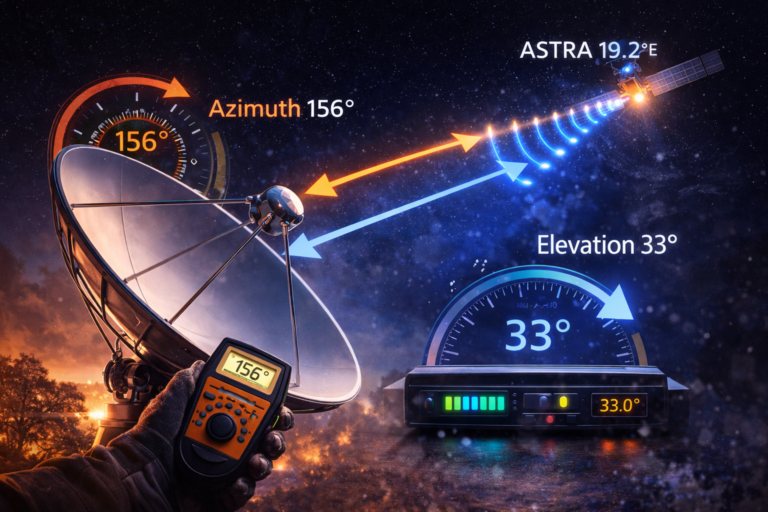
Dish alignment is not only about pointing in the right direction. It involves azimuth, elevation, and LNB skew working together. When switching between Astra 19.2E and Astra 28.2E, even small changes in these angles can determine whether the signal is stable or completely lost.
Astra 19.2E and Astra 28.2E require different azimuth and slightly different elevation angles. Astra 28.2E also needs more precise alignment due to its focused beam design.
- Understanding dish alignment basics
- Azimuth difference between 19.2E and 28.2E
- Elevation angle differences
- LNB skew impact on alignment
- Dual satellite alignment challenges
- Beam design and alignment sensitivity
- Real world alignment behavior
- Analytical alignment comparison table
- Practical alignment tips
- FAQ
Understanding dish alignment basics
Satellite dish alignment depends on three main parameters. Azimuth, elevation, and LNB skew.
Azimuth controls the horizontal direction of the dish. Elevation controls the vertical angle. LNB skew adjusts the polarization angle of the signal.
All three must be correct for stable signal reception. Small errors in any of them can reduce signal quality.
Azimuth difference between 19.2E and 28.2E
The most noticeable difference between Astra 19.2E and Astra 28.2E is the azimuth angle.
Astra 28.2E is located further east in the orbital arc. This means the dish must be rotated slightly more toward the east compared to Astra 19.2E.
This horizontal shift is small in degrees but significant in terms of signal alignment. A small error in azimuth can completely miss the satellite.
Elevation angle differences
Elevation differences between the two satellites are usually small but still important.
Depending on your location, Astra 28.2E may require a slightly different elevation angle compared to Astra 19.2E.
Even a small elevation change can affect signal quality, especially for weak or focused beams.
LNB skew impact on alignment
LNB skew adjusts the polarization of the signal. This is critical for separating horizontal and vertical signals.
The required skew angle changes depending on satellite position. Astra 19.2E and Astra 28.2E require slightly different skew settings.
Incorrect skew reduces signal quality and can affect specific transponders.
Dual satellite alignment challenges
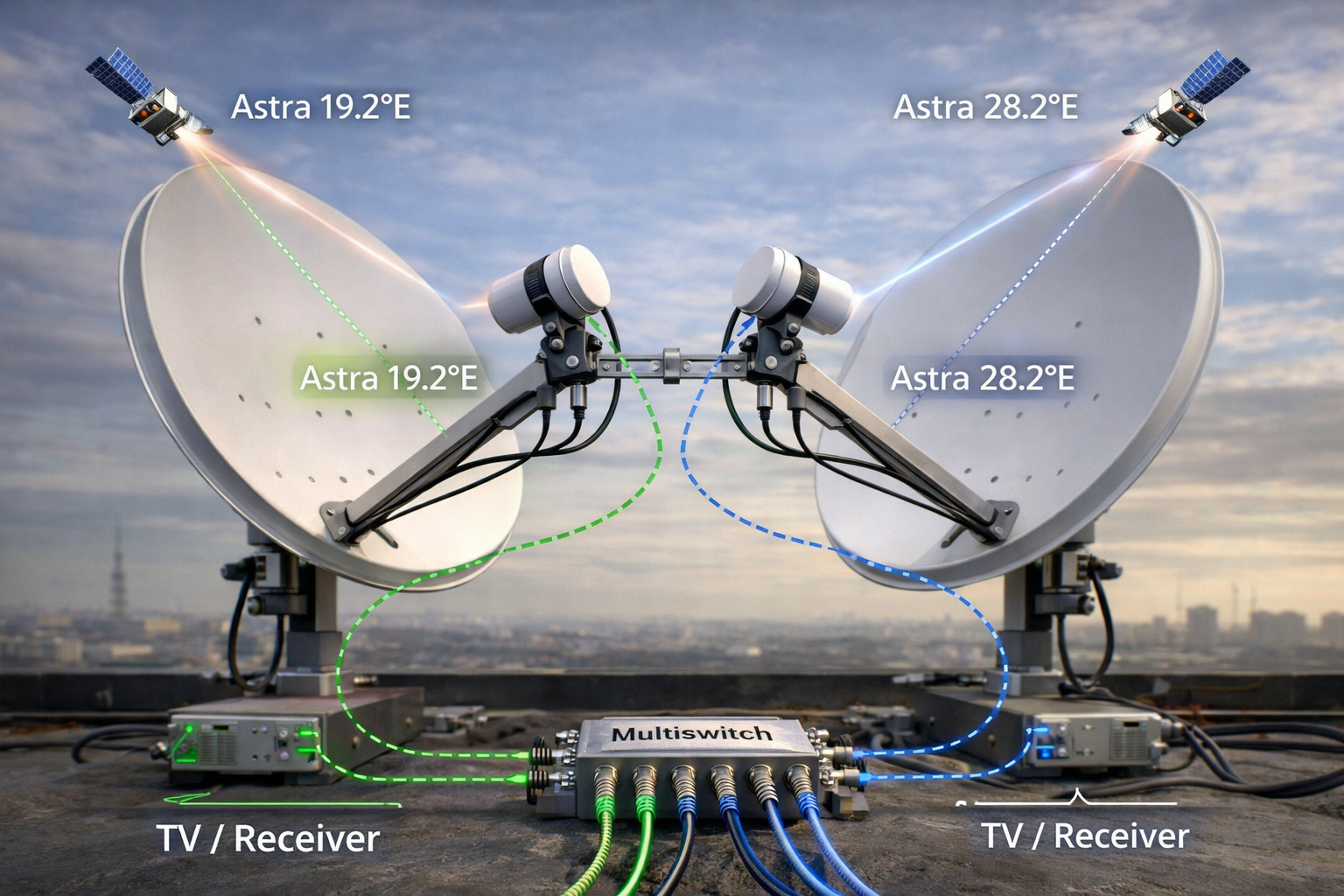
Receiving both Astra 19.2E and Astra 28.2E with one dish requires a multi LNB setup.
In this setup, one LNB is aligned perfectly while the other is slightly offset. This creates a compromise where both satellites are received but not perfectly aligned.
The closer the satellites are, the easier this setup becomes, but precision is still required.
Beam design and alignment sensitivity
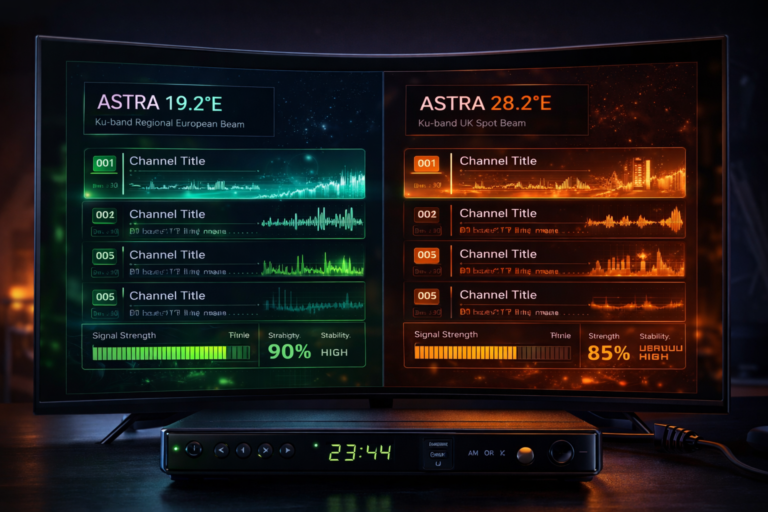
Astra 19.2E uses wide beams, making it more tolerant to small alignment errors.
Astra 28.2E uses focused beams, especially for UK channels. This makes alignment more critical.
Small deviations that do not affect Astra 19.2E may cause signal loss on Astra 28.2E.
Real world alignment behavior
In practice, many users align their dish for Astra 19.2E and then try to receive Astra 28.2E with a second LNB.
This works well in some regions but becomes difficult outside the UK where Astra 28.2E signals are weaker.
This explains why alignment accuracy becomes more important when working with Astra 28.2E.
Analytical alignment comparison table
| Parameter | Astra 19.2E | Astra 28.2E |
|---|---|---|
| Azimuth | More west | More east |
| Elevation | Standard | Slight variation |
| LNB skew | Moderate adjustment | Different angle required |
| Alignment tolerance | Higher tolerance | Lower tolerance |
| Reception sensitivity | Moderate | High outside UK |
Practical alignment tips
Start by aligning the dish for Astra 19.2E using maximum signal quality.
Then adjust the second LNB position to receive Astra 28.2E.
Fine tune azimuth and elevation for the best compromise between both satellites.
Adjust LNB skew carefully to improve signal quality.
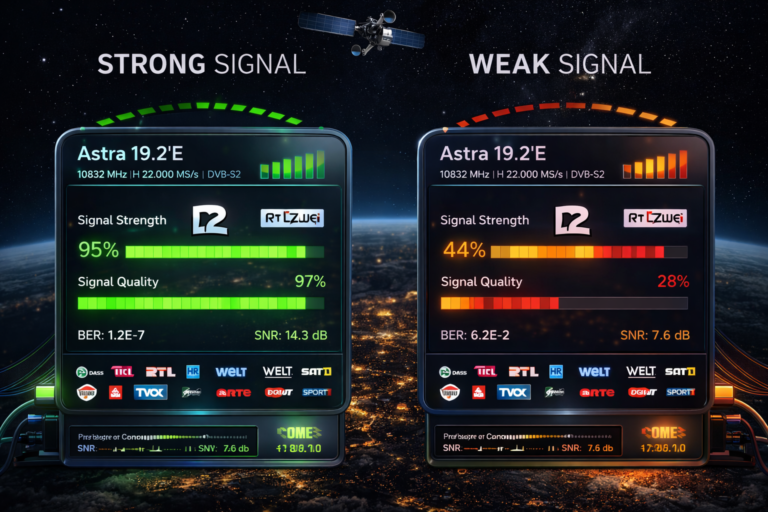
Use a signal meter to monitor quality rather than strength.
The difference between Astra 19.2E and Astra 28.2E alignment may look small, but it has a major impact on signal quality and stability.
Astra 19.2E and Astra 28.2E require different alignment angles and precision levels. Astra 19.2E is more forgiving, while Astra 28.2E demands accurate positioning due to its focused beam. Understanding these differences is essential for achieving stable reception.
FAQ
| Question | Answer |
|---|---|
| Is the alignment difference between 19.2E and 28.2E large | No but it is important for signal accuracy. |
| Which satellite is easier to align | Astra 19.2E is more forgiving. |
| Why is Astra 28.2E harder to align | Because of its focused beam design. |
| Can one dish receive both satellites | Yes using multi LNB setup. |
| Does LNB skew matter | Yes it affects signal quality significantly. |