Best Dish Setup for Astra 19.2 Germany
Estimated reading time: 16 minutes.
Setting up a satellite dish for Astra 19.2 is one of the most common ways households in Germany receive television channels. The satellite position at 19.2 degrees east broadcasts a large number of German networks including public broadcasters private entertainment channels and regional television stations.
Although many people assume satellite installation is complicated the reality is much simpler. With proper dish positioning stable mounting and correct receiver configuration viewers can achieve reliable reception with minimal technical adjustments.
Quick Context
This guide explains the best dish setup for Astra 19.2 satellite reception in Germany including dish alignment LNB positioning signal stability and receiver scanning procedures.
- Why Astra 19.2 is important for German satellite TV
- Choosing the correct dish size
- Dish mounting and positioning
- Azimuth and elevation alignment
- LNB positioning and skew angle
- Receiver configuration
- Improving signal strength
- Typical Astra 19.2 installation setup
- Reality Check
- Final Verdict
- Frequently Asked Questions
Why Astra 19.2 is important for German satellite TV
The Astra satellite system located at 19.2 degrees east is the primary broadcast platform for German television. Broadcasters distribute their channels through this satellite because it offers wide coverage across Europe.
Households in Germany rely on Astra because it delivers strong signal quality and a large variety of channels. A single dish aligned to Astra can provide dozens of free to air channels without requiring cable or terrestrial broadcasting networks.
For this reason most satellite installations in Germany are designed specifically for Astra 19.2 reception.
Choosing the correct dish size
Dish size plays a key role in signal stability. In most parts of Germany a dish between sixty and eighty centimeters is sufficient to receive Astra signals reliably.
Larger dishes are sometimes used in regions with weaker coverage or in installations that require extremely stable reception during heavy rain or snow.
The larger the dish surface the more signal it can collect from the satellite. This improves signal strength and reduces the chance of reception interruptions.
However in typical residential installations medium sized dishes provide more than enough signal quality.
Dish mounting and positioning
A stable mounting location is essential for satellite reception. The dish should be installed where it has a clear view of the southern sky without obstacles such as buildings or trees.
Rooftops balconies and exterior walls are the most common installation locations.
The mounting bracket must hold the dish firmly in place because even small movements caused by wind can affect signal alignment.
Installers usually ensure the mounting pole is perfectly vertical because incorrect pole alignment can make dish adjustment more difficult.
Azimuth and elevation alignment
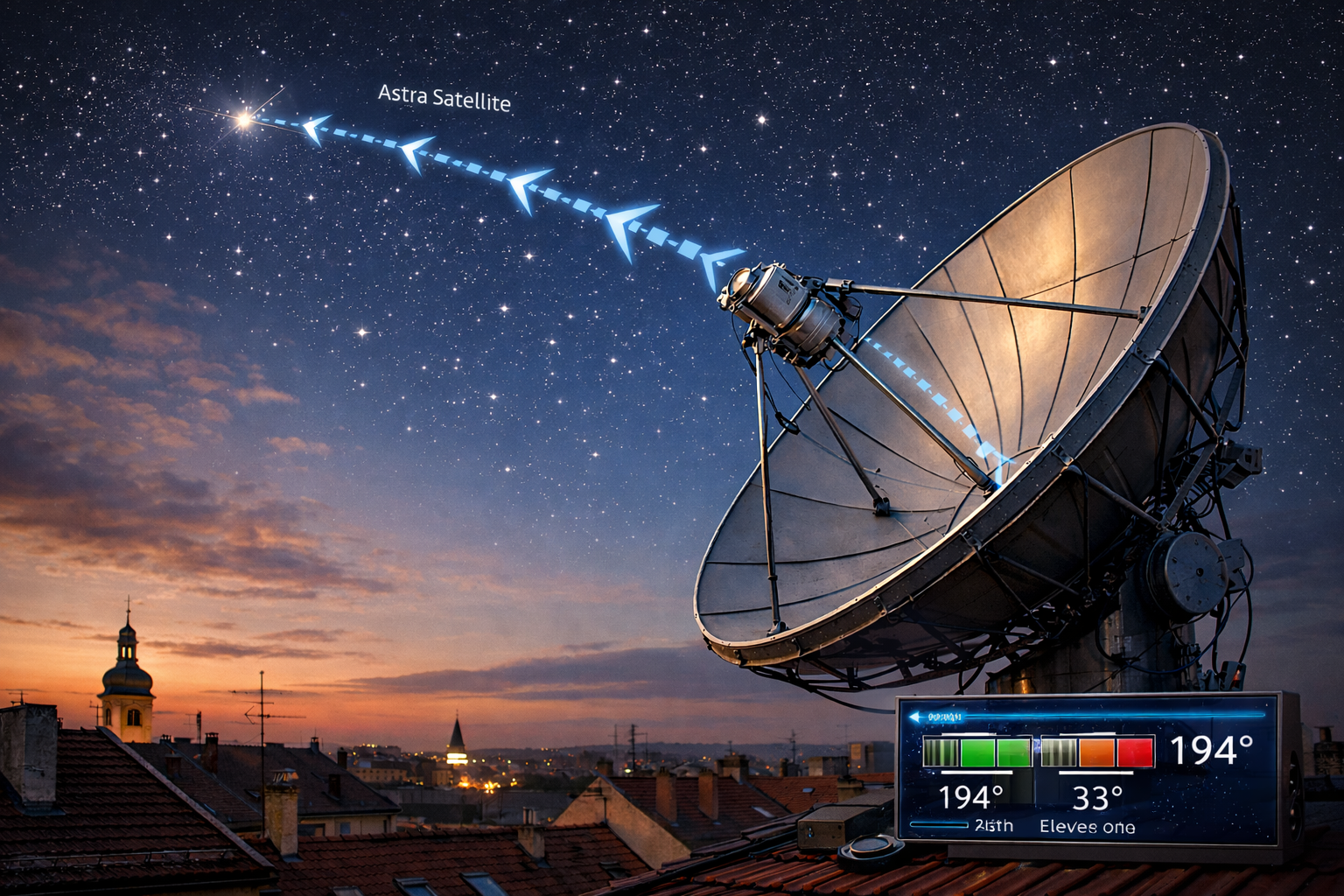
Satellite dish alignment relies on two main angles. The first is azimuth which controls the horizontal direction of the dish. The second is elevation which determines the vertical angle toward the satellite.
For Astra 19.2 the dish must be directed toward the southeastern sky when installed in Germany. Exact angles vary slightly depending on the geographic location.
Installers typically use signal meters or receiver indicators to fine tune the dish until maximum signal strength is achieved.
Once the correct alignment is found the mounting bolts are tightened to secure the dish in place.
LNB positioning and skew angle
The LNB sits at the focal point of the dish where the reflected satellite signal is concentrated. Correct positioning ensures the receiver receives the strongest possible signal.
In addition to placement the LNB must be rotated slightly to match the polarization of the satellite signal. This rotation is known as the skew angle.
Adjusting the skew angle correctly improves signal quality and reduces interference between horizontal and vertical transponders.
Most modern installations require only minor skew adjustments to achieve optimal reception.
Receiver configuration
After the dish and LNB are aligned the satellite receiver must scan the Astra satellite frequencies. During scanning the receiver identifies active transponders and loads the available channel list.
Modern receivers automatically detect the satellite parameters and build the channel list within a few minutes.
Viewers can then organize channels according to their preferences using the receiver menu.
Occasionally broadcasters update frequencies or add new channels. Running a fresh scan ensures the receiver stays updated.
Improving signal strength
Several factors influence satellite signal strength. Dish size alignment accuracy cable quality and weather conditions all affect reception.
Using high quality coaxial cables helps reduce signal loss between the dish and receiver.
Ensuring connectors are properly installed also prevents interference and signal leakage.
Regularly checking the dish for physical movement or obstruction helps maintain consistent reception quality.
Typical Astra 19.2 installation setup
| Component | Purpose | Installation role |
|---|---|---|
| Satellite dish | Signal reflection | Collects satellite signals |
| LNB unit | Signal conversion | Converts satellite frequencies |
| Mounting bracket | Structural support | Keeps dish stable |
| Coaxial cable | Signal transfer | Connects dish to receiver |
| Satellite receiver | Signal decoding | Displays channels on television |
Reality Check
Most Astra reception problems occur because of small dish alignment errors or poor cable connections. Once the installation is adjusted correctly satellite reception usually remains stable for years.
Final Verdict
Final Verdict
The best dish setup for Astra 19.2 in Germany combines correct dish size precise alignment and proper receiver configuration. With these elements in place viewers can reliably receive a wide range of German television channels through satellite broadcasting.
Frequently Asked Questions
| Question | Answer |
|---|---|
| What dish size is best for Astra 19.2 | Most households in Germany use dishes between sixty and eighty centimeters for reliable reception. |
| Do I need a special receiver for Astra | Any standard DVB S or DVB S2 satellite receiver can receive Astra signals. |
| Why does the signal drop during storms | Heavy rain or snow can temporarily reduce satellite signal strength. |
| How often should I scan channels | Running a scan occasionally helps update the receiver with new channels and frequency changes. |