Why Your LNB Matters More Than You Think
Estimated Reading Time: 12 minutes
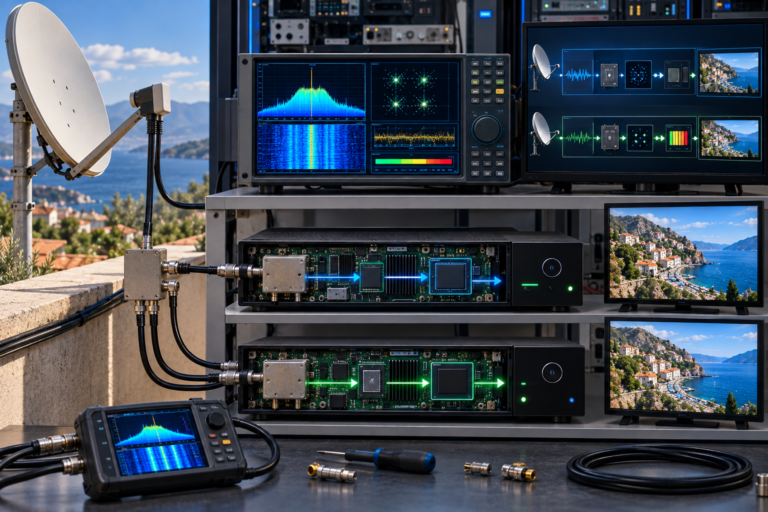
The LNB is one of the smallest components in a satellite television installation, yet it sits at one of the most critical points in the entire receiving chain. The signal arriving from a geostationary satellite is extremely weak, and the LNB is the first active electronic device that processes it. Whatever happens at this stage affects everything the receiver must do later.
A good LNB does far more than make the signal stronger. It must amplify the wanted microwave carrier while adding very little noise, convert Ku-band frequencies accurately, maintain a stable local oscillator, separate polarizations correctly, respond to receiver control signals, and deliver a clean intermediate-frequency signal through the coaxial cable. If the LNB damages signal quality here, the receiver cannot recreate information that has already been lost.
The LNB is the first active RF stage in a domestic satellite system. Dish alignment determines how much microwave energy reaches the feedhorn, but the LNB determines how cleanly that energy is amplified and converted before it enters the coaxial cable. Noise figure, oscillator stability, phase noise, skew, gain, temperature, and component condition can all affect MER, BER, and the final DVB-S2 signal margin.
- What an LNB Actually Does
- Why the Satellite Signal Is So Weak
- The Feedhorn and the First RF Stage
- Why Low Noise Matters More Than High Gain
- How Frequency Conversion Works
- Why the Local Oscillator Must Be Stable
- Universal LNB Frequencies Explained
- How the Receiver Controls the LNB
- Why LNB Skew Changes Signal Quality
- Phase Noise and DVB-S2 Reception
- Temperature and Oscillator Drift
- Why an Aging LNB Can Create Intermittent Problems
- How Water and Weather Damage an LNB
- Why a High-Gain LNB Is Not Automatically Better
- How an LNB Affects MER and BER
- How to Diagnose an LNB Problem
- Reality Check
- Final Verdict
- FAQ
What an LNB Actually Does
LNB stands for Low Noise Block downconverter. Its name describes its two most important jobs.
First, it amplifies an extremely weak microwave signal arriving from the satellite while attempting to introduce as little additional noise as possible. Second, it converts that high-frequency signal into a lower intermediate-frequency range that can travel through ordinary 75-ohm coaxial cable to the receiver.
Without frequency conversion, carrying a signal around 11 or 12 GHz through a long domestic coaxial cable would produce very high losses. The LNB moves the information to a much lower frequency range where distribution becomes practical.
It performs this processing before the DVB-S2 tuner sees the carrier, which makes the quality of the LNB fundamental to everything that follows.
Why the Satellite Signal Is So Weak
A geostationary television satellite operates roughly 35,786 kilometres above the equator. By the time its transmitted energy reaches a domestic antenna, the signal has experienced enormous free-space path loss.
The parabolic reflector provides antenna gain by collecting energy over its surface and concentrating it toward the feedhorn. Even after this gain, the received microwave power remains extremely small.
The first amplification stage must therefore have very good noise performance. Noise added at the beginning of a receiving system is particularly damaging because every later stage amplifies both the wanted signal and the noise already introduced.
This is why the first amplifier is located directly at the dish rather than inside the receiver at the end of a long cable.
The Feedhorn and the First RF Stage
The feedhorn collects microwave energy reflected from the dish and couples it into the internal LNB circuitry.
Inside the unit, polarization probes or equivalent structures respond to the electric-field orientation of the incoming signal. A low-noise amplifier then increases the level of the selected RF energy.
The relationship between the dish and feedhorn is important. If the LNB holder is bent, the feed is positioned incorrectly, or the reflector is distorted, less useful energy enters this first RF stage.
The LNB cannot compensate fully for poor antenna geometry. Its performance begins with whatever signal the dish successfully delivers to it.
Why Low Noise Matters More Than High Gain
Satellite LNB advertisements often emphasize gain, but gain alone does not describe reception quality.
The LNB must amplify the wanted carrier without introducing excessive additional noise. Noise figure is one way of describing how much the device degrades the signal-to-noise relationship during amplification.
A lower practical noise contribution helps preserve the carrier quality delivered by the antenna. Excessive internal noise reduces the margin available to the DVB-S2 receiver.
Very high gain does not repair poor signal quality. If an LNB amplifies a noisy input by 60 dB, the wanted carrier and much of the unwanted noise are both amplified.
The objective is therefore clean low-noise amplification, sufficient output level, and good linearity rather than maximum gain alone.
How Frequency Conversion Works
The LNB uses a mixer and local oscillator to translate the received Ku-band carrier into a lower intermediate frequency.
For a simplified example, if the satellite transponder is received at 11.500 GHz and the LNB uses a 9.750 GHz local oscillator, the output difference frequency is approximately 1.750 GHz.
The information contained in the modulation remains present after conversion. QPSK or 8PSK symbols, symbol rate, Forward Error Correction information, and DVB-S2 framing are not turned into video by the LNB.
The LNB only translates the RF signal into a frequency range that the satellite tuner can process.
Actual demodulation and DVB-S2 decoding happen inside the receiver.
Why the Local Oscillator Must Be Stable
The conversion process depends on the accuracy of the LNB’s local oscillator.
If the oscillator frequency drifts, the converted transponder also moves in frequency. Satellite tuners are designed with carrier acquisition and tracking systems that can compensate for normal frequency error, but there are practical limits.
A stable oscillator makes carrier acquisition easier and reduces the tracking burden inside the demodulator.
Excessive drift can make weak or narrow-margin signals difficult to lock, especially when combined with low MER, interference, or poor dish alignment.
The oscillator also produces phase noise. This short-term instability is different from a simple frequency offset and can directly disturb the phase accuracy of digitally modulated symbols.
| LNB Characteristic | What It Influences | Possible Reception Effect |
|---|---|---|
| Noise performance | Carrier quality entering the receiver | Poor performance reduces usable signal margin |
| Gain | IF level delivered through the coaxial cable | Too little can expose cable loss, excessive gain can overload later stages |
| Oscillator accuracy | Converted transponder frequency | Large drift can make carrier acquisition more difficult |
| Phase noise | Constellation phase accuracy | Can reduce MER and increase BER |
| Skew | Polarization isolation | Incorrect rotation increases cross-polarization interference |
| Weather sealing | Long-term electrical stability | Moisture can cause intermittent or permanent faults |
Universal LNB Frequencies Explained
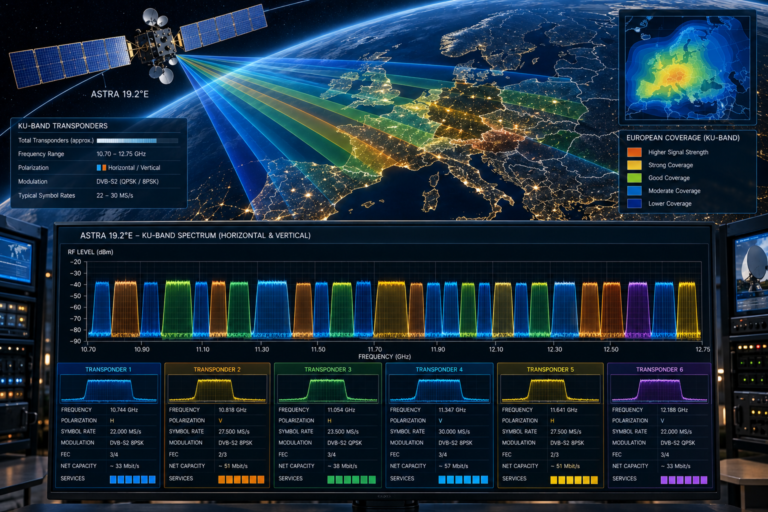
A common Universal Ku-band LNB uses two local oscillator frequencies to cover the full satellite television band.
The low band commonly uses a 9.750 GHz local oscillator, while the high band commonly uses a 10.600 GHz oscillator.
The receiver selects the required band using a 22 kHz control tone sent through the same coaxial cable that carries the satellite IF signal.
This arrangement allows a relatively wide Ku-band range to fit within the tuner input range.
If the oscillator switching circuit develops a fault, the receiver may lose only low-band or high-band transponders while other channels continue working normally.
How the Receiver Controls the LNB
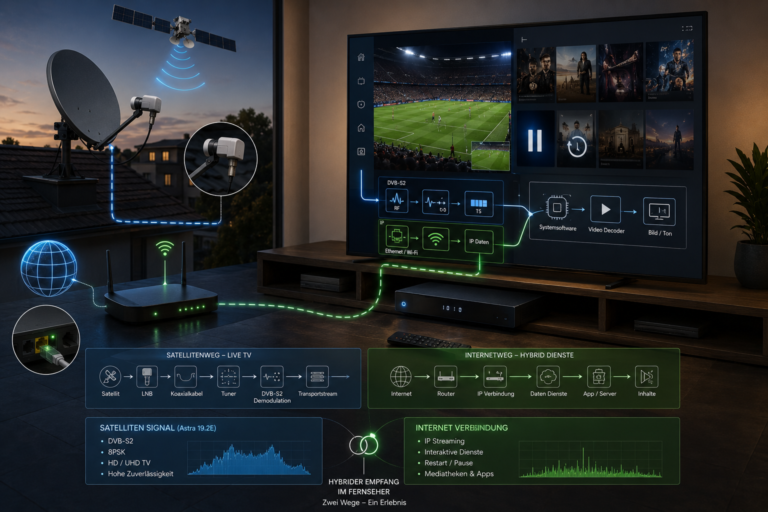
The coaxial cable carries more than the received satellite signal. It also delivers DC power and control information from the receiver to the LNB.
In a typical Universal LNB system, approximately 13 volts selects one polarization state and approximately 18 volts selects the other. A 22 kHz tone selects the high or low frequency band.
DiSEqC control messages can also travel through the same path when switches, motors, or more complex distribution systems are present.
A voltage problem in the receiver, cable, connector, or switch can therefore look like an LNB failure.
For example, if the voltage cannot rise correctly, channels on one polarization may disappear while the opposite polarization continues working.
Why LNB Skew Changes Signal Quality
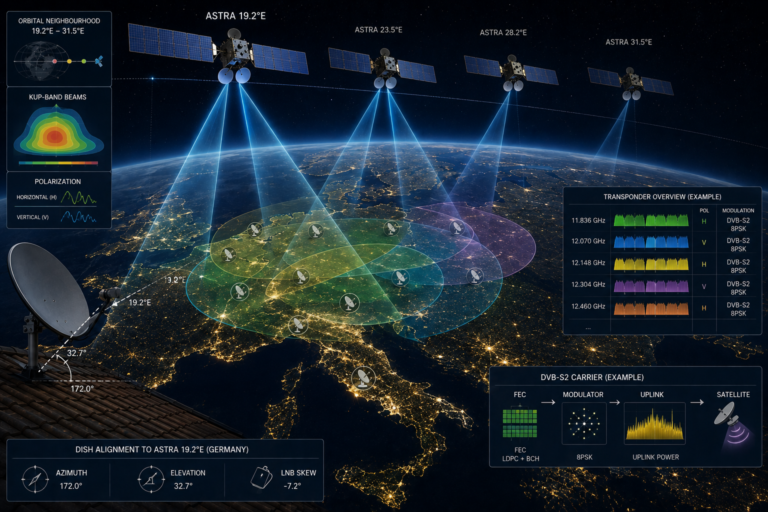
Satellite capacity is reused by transmitting signals on different polarizations. Correct LNB rotation helps separate the wanted polarization from the opposite one.
If the LNB is rotated incorrectly, more cross-polarized energy enters the receiving path.
This unwanted energy behaves as interference. Signal strength may remain high because the tuner is receiving substantial RF power, but MER can deteriorate because some of that power belongs to another transmission.
The receiver then makes more uncertain symbol decisions and BER can increase.
Skew should therefore be optimized using quality, MER, or BER rather than signal strength alone.
Phase Noise and DVB-S2 Reception
DVB-S2 modulation depends on accurate recognition of symbol amplitude and phase.
QPSK has relatively widely separated phase states. 8PSK places more valid phase positions around the constellation and therefore requires more accurate symbol discrimination.
Phase noise from the LNB oscillator spreads symbol positions around their ideal locations. This can reduce MER even when the displayed signal level remains almost unchanged.
The effect becomes particularly important when the system already operates close to its decoding threshold.
A marginal LNB may therefore appear perfectly acceptable on robust transponders while more demanding DVB-S2 services experience instability.
Temperature and Oscillator Drift
Outdoor LNBs operate through large temperature changes. A unit can be cool during the night and exposed to intense solar heating during the afternoon.
Electronic oscillators naturally change slightly with temperature. Modern LNB designs limit this drift to levels that ordinary satellite receivers can normally track.
However, ageing components or lower-quality designs can become less stable.
This may create a system that works better under one temperature condition than another, especially if dish alignment and signal margin are already poor.
Temperature should therefore be considered one possible contributor to intermittent reception rather than assumed to be the primary cause immediately.
Why an Aging LNB Can Create Intermittent Problems
LNB failure is not always an instant transition from working to dead.
Internal semiconductors, oscillators, regulators, seals, solder joints, and switching circuits can deteriorate gradually.
One polarization may become unreliable. The high band may fail while the low band remains normal. Frequency drift may increase after the unit becomes hot. Internal noise may rise slowly and reduce margin on weaker transponders.
These failures can make troubleshooting difficult because the installation still receives many channels successfully.
Comparing affected frequencies, bands, polarizations, and temperature conditions can reveal patterns consistent with an LNB problem.
How Water and Weather Damage an LNB
An outdoor LNB is designed to resist normal weather, but physical damage and ageing can compromise its seals.
A cracked feed cap can allow moisture into the feed structure. Water inside the LNB or connector area can alter RF performance and eventually cause corrosion.
Moisture inside an F-connector is also dangerous because it can increase attenuation, damage shielding, and create intermittent electrical contact.
These symptoms often appear during rain, which can make atmospheric rain fade look responsible when the actual fault is local water ingress.
If reception remains poor after clear weather returns, connectors, feed caps, and the LNB itself should be inspected carefully.
Why a High-Gain LNB Is Not Automatically Better
More gain can be useful when long coaxial runs or distribution losses must be overcome, but excessive gain can create new problems.
Receiver tuners and multiswitches are designed for a particular input range. If an LNB produces excessive output on strong transponders, later stages can approach overload or nonlinear operation.
Distortion can then reduce MER even though signal strength looks excellent.
The ideal LNB provides enough gain to overcome downstream losses while maintaining low noise, good linearity, stable oscillators, and appropriate output levels.
Selecting an LNB from one marketing number alone is therefore poor engineering practice.
How an LNB Affects MER and BER
MER summarizes how accurately received modulation symbols match their ideal positions. BER measures the resulting bit errors.
Poor LNB noise performance makes the constellation less distinct. Phase noise spreads symbol positions. Incorrect skew adds cross-polarization interference. Oscillator instability increases tracking error.
All of these effects can reduce MER and cause the demodulator to make more incorrect symbol decisions.
Forward Error Correction initially repairs those errors, but the available signal margin becomes smaller.
When conditions deteriorate further, the receiver reaches its decoding threshold and visible pixelation or loss of lock begins.
How to Diagnose an LNB Problem
Do not replace the LNB simply because reception is weak. Dish alignment, cable condition, connectors, receiver configuration, switches, and environmental obstruction can create similar symptoms.
Begin by identifying the pattern of failure. Determine whether the problem affects all transponders or only one frequency band, polarization, satellite position, or temperature condition.
Test several known transponders using MER, BER, and quality readings rather than strength alone.
Inspect the LNB feed cap, holder, F-connector, coaxial cable, and weather sealing. Confirm that the receiver is producing the correct polarization voltage and 22 kHz band-control signal.
A known-good replacement LNB can be a useful diagnostic test after mechanical and cabling faults have been excluded.
The LNB also depends on the dish continuing to place the microwave focus correctly at its feedhorn. Our guide explaining why satellite dishes lose alignment over time shows how small mechanical changes can reduce the quality delivered to the LNB even when the electronics themselves remain healthy.
Replacing an LNB is not a universal cure for poor satellite reception. Many problems blamed on the LNB are actually caused by dish misalignment, incorrect skew, damaged connectors, poor coaxial cable, unsuitable switches, receiver voltage problems, or insufficient signal margin.
Noise figure and gain specifications should also be interpreted carefully. The best real-world LNB is not automatically the one with the most aggressive marketing numbers. Stability, linearity, phase noise, manufacturing quality, polarization performance, and suitability for the installation all matter.
The LNB matters because it handles the satellite carrier before any other active receiving stage. It must amplify an extremely weak microwave signal without adding excessive noise, convert frequency accurately, maintain stable phase and frequency behavior, separate polarizations, and provide the correct IF level to the receiver.
A poor or failing LNB can reduce MER, increase BER, remove weather margin, destabilize demanding DVB-S2 transponders, or cause entire frequency bands and polarizations to disappear.
The receiver cannot reconstruct RF quality that was already destroyed at the first amplification and conversion stage. Reliable satellite reception therefore depends on a correctly positioned, correctly skewed, electrically stable, weatherproof LNB working together with accurate dish alignment and a clean coaxial distribution path.
| Question | Answer |
|---|---|
| What does an LNB do? | It amplifies the weak satellite microwave signal and converts it to a lower intermediate frequency that can travel through coaxial cable to the receiver. |
| Does an LNB decode DVB-S2? | No. The LNB performs RF amplification and frequency conversion. DVB-S2 demodulation and decoding happen inside the receiver. |
| Is higher LNB gain always better? | No. Excessive gain can overload downstream equipment. Low noise, stable oscillators, linearity, and correct output level are also important. |
| What does LNB noise figure mean? | It describes how much additional noise the device introduces during amplification. Lower practical noise contribution helps preserve the received carrier quality. |
| Why does LNB skew matter? | Correct skew improves polarization isolation. Incorrect rotation allows unwanted cross-polarized signals to interfere with the wanted transponder. |
| Can an LNB cause high signal strength but poor quality? | Yes. Phase noise, oscillator instability, incorrect skew, distortion, or excessive internal noise can reduce MER even when output power remains high. |
| Can temperature affect an LNB? | Yes. Oscillator frequency and electronic behavior change slightly with temperature. Healthy units are designed to tolerate this, but ageing or marginal LNBs may become unstable. |
| Why do only high-band channels disappear? | A fault in the 22 kHz switching function, high-band local oscillator, cable path, receiver control, or LNB circuitry can affect only the high band. |
| Why does only one polarization fail? | Possible causes include LNB switching problems, incorrect receiver voltage, cable voltage drop, connector faults, or internal LNB failure. |
| Can water damage an LNB? | Yes. Damaged seals, cracked feed caps, and wet connectors can cause RF degradation, corrosion, and intermittent reception. |
| Should I replace the LNB before realigning the dish? | Not automatically. Dish alignment, skew, cabling, connectors, receiver control voltage, and switches should be checked as part of a logical diagnosis. |
| Can a better LNB stop rain fade? | It cannot remove atmospheric attenuation, but better noise and stability performance can preserve more of the available reception margin. |