Why a 60cm Dish Works for Astra in Some Countries
A compact 60cm satellite dish can receive Astra 19.2E reliably in one part of Europe, while a considerably larger antenna may be needed somewhere else. The satellite is still located at the same orbital position, and both installations may use modern Ku-band LNBs. So why does the required dish diameter change with location?
The answer lies in satellite beam coverage, received power and the margin available for reliable decoding. A dish does not need to collect a fixed amount of signal everywhere. It needs to provide enough antenna gain for the particular satellite beam, transponder and local reception conditions. That distinction explains why a 60cm dish can be entirely adequate in a strong coverage area but unsuitable for dependable reception farther away.
A 60cm dish may be sufficient for Astra 19.2E where the selected satellite beam provides strong coverage and the receiving system has adequate margin. Required dish size depends on local EIRP, antenna efficiency, receiver performance, modulation and coding, weather conditions and the desired level of reliability. Country borders alone cannot determine the correct dish diameter.
Why Dish Size Depends on Location
A satellite dish collects electromagnetic energy arriving from a satellite and concentrates it toward the receiving feed.
The amount of usable signal available at the LNB depends partly on how much power reaches the installation from the satellite.
That received power is not identical everywhere.
Communication satellites use directional antennas to distribute their transmitted energy over selected geographic regions.
Within a strong part of a beam, a relatively small receiving antenna may provide enough gain for reliable operation.
Farther away, the same beam may deliver less power.
The receiving installation then needs additional antenna gain, better noise performance or more favorable operating conditions to achieve comparable reliability.
For this reason, dish diameter cannot be selected solely by knowing that the target orbital position is Astra 19.2E.
You also need to know which beam carries the desired transponder and how that beam performs at the receiving location.
What Astra 19.2E Footprints Actually Show
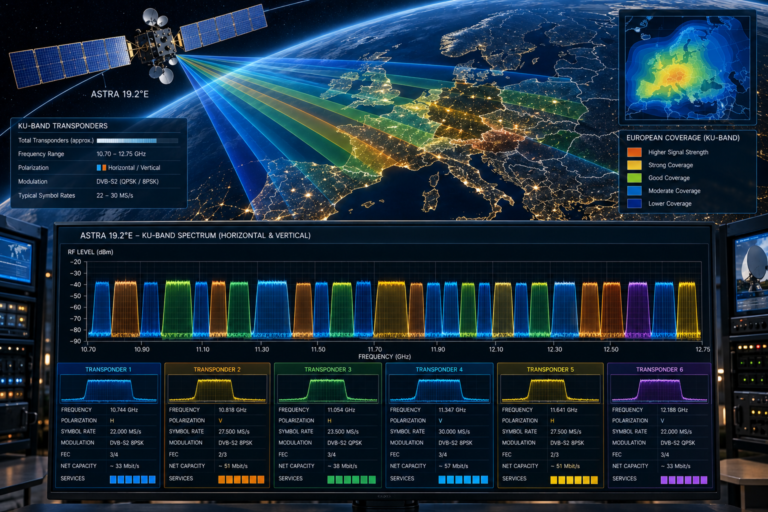
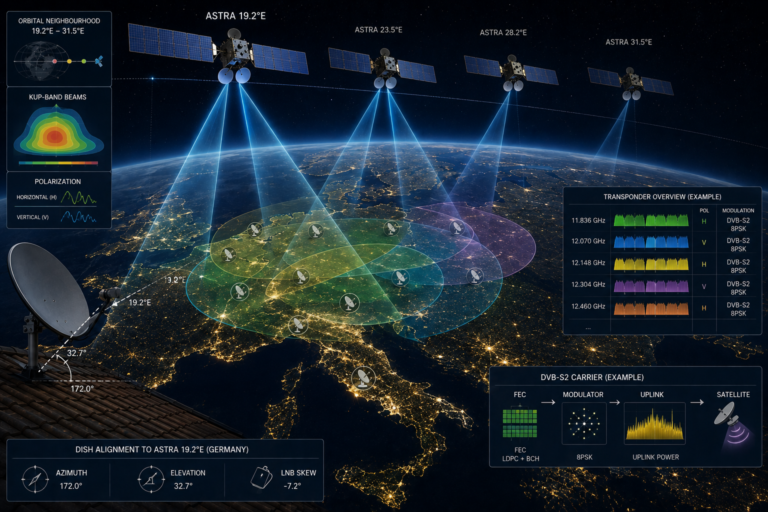
A satellite footprint is a representation of the geographic region illuminated by a satellite antenna beam.
Footprint maps commonly use contours to show expected signal levels across different locations.
Those contours are often expressed in terms of Effective Isotropic Radiated Power, or EIRP.
The map may also provide indicative receiving antenna sizes for specified reception assumptions.
However, a footprint map should not be interpreted as a guarantee that every television channel at an orbital position will work with the same dish.
Astra 19.2E is an orbital location, not a single uniform radio-frequency transmission.
Different satellites, beams and transponders can have different coverage characteristics.
Even within the same country, a particular beam may deliver different expected power levels at different locations.
Coverage maps are planning tools, and their predictions depend on the underlying assumptions.
They do not account for every individual installation problem, such as inaccurate pointing, damaged cables, poor LNB performance or local obstructions.
How EIRP Affects Reception
Effective Isotropic Radiated Power (EIRP) combines transmitter output power and transmitting antenna gain, referenced to an ideal isotropic radiator.
In satellite communications, EIRP is commonly expressed in dBW.
A higher EIRP at a particular location generally means more transmitted power is available in that direction.
All else being equal, this improves the receiving system’s link budget.
However, EIRP alone does not determine whether a television service will decode reliably.
The complete link budget also includes propagation loss, receiving antenna gain, system noise temperature, modulation and coding requirements, and other impairments.
A small antenna in a strong EIRP region may achieve adequate carrier-to-noise performance.
The same antenna in a weaker coverage region may operate too close to the demodulator’s decoding threshold.
This is the central reason that the required dish size changes geographically.
Important: A footprint contour showing a particular EIRP value does not automatically correspond to one universally correct dish diameter. Any antenna-size recommendation must also specify assumptions about receiving equipment, transmission parameters and required service availability.
How Dish Diameter Changes Antenna Gain
Increasing dish diameter increases the effective collecting area of the antenna.
For a parabolic reflector, antenna gain can be approximated by:
G = η(πD/λ)²
Where:
- G is antenna gain as a linear power ratio.
- η is aperture efficiency.
- D is reflector diameter.
- λ is wavelength.
This is a standard idealized aperture-gain relationship. Actual antenna performance depends on construction, illumination, efficiency and operating conditions.
For antennas operating at the same frequency and with comparable efficiency, the gain difference between two dish diameters can be estimated using:
Gain difference (dB) ≈ 20 log₁₀(D₂ / D₁)
For example, increasing the reflector diameter from 60cm to 80cm gives an idealized gain increase of approximately 2.5 dB when efficiency and frequency remain comparable.
Increasing from 60cm to 90cm gives approximately 3.5 dB.
These values describe theoretical antenna-gain differences, not guaranteed improvements in a receiver’s displayed quality percentage.
Actual results depend on reflector efficiency, feed matching, alignment and the complete receiving system.
Nevertheless, the relationship explains why even a moderate increase in dish diameter can provide valuable additional reception margin.
Why a 60cm Dish Can Work Reliably
In a strong coverage region, the satellite beam may provide enough received power for a compact antenna to achieve reliable decoding.
If the receiving system has adequate carrier-to-noise performance and sufficient fade margin, a 60cm dish may work consistently across the required transponders.
Several conditions help make this possible:
- Strong coverage from the selected satellite beam
- Accurate dish alignment
- Appropriate LNB noise performance
- Correct polarization alignment
- Low-loss and properly terminated coaxial cabling
- Compatible DVB-S or DVB-S2 reception hardware
- Sufficient margin for expected weather conditions
A 60cm dish should therefore be understood as a possible engineering solution for suitable coverage conditions, not as a universal Astra requirement.
In some locations, it may offer comfortable margin.
In others, it may work only during favorable weather or fail to receive certain beams.
The fact that a compact dish receives one Astra service does not prove it can receive every desired transponder with equal reliability.
Why Country Borders Do Not Define Coverage
Satellite beams do not follow political borders.
They are shaped by the transmitting antenna’s radiation pattern and the satellite system’s coverage design.
As a result, two locations within the same country may have different expected EIRP values for a particular beam.
Likewise, locations in neighboring countries may experience very similar reception conditions.
This makes simple country-based dish-size tables potentially misleading.
A statement such as “Astra requires a 60cm dish in one country and an 80cm dish in another” leaves out essential technical information.
It does not identify the satellite beam, receiving location, modulation requirements or weather availability target.
A more useful recommendation begins with the actual location and desired services.
It then uses the relevant coverage information to estimate the antenna gain required.
Only after that should the dish diameter be selected.
Why Different Astra Beams Matter
Astra 19.2E carries services using different transponders and satellite beam configurations.
Two carriers received from the same orbital position may therefore have different link budgets at the same location.
One may be carried on a beam providing stronger local coverage.
Another may use a beam that delivers less power at the receiving site.
The two carriers may also use different modulation and coding parameters, which affect the required decoding conditions.
Consequently, a 60cm dish might receive one group of channels reliably while another group has insufficient margin.
This does not necessarily mean the dish is misaligned.
It may reflect real differences in beam coverage and transmission requirements.
To understand how these differences appear in receiver measurements, read Why Astra Signal Quality Changes Across Frequencies.
Rain Fade and Reception Availability
Ku-band satellite reception is affected by attenuation from rain and other atmospheric conditions.
Rain droplets absorb and scatter part of the radio-frequency energy traveling through the atmosphere.
The resulting attenuation reduces the available carrier-to-noise margin.
A receiving system with substantial clear-sky margin may continue working during moderate rain.
A system operating close to its decoding threshold may fail much sooner.
This is why a dish that works perfectly on a clear day is not necessarily large enough for dependable year-round reception.
The required antenna diameter depends partly on the desired availability target.
For example, a household that accepts occasional interruptions during severe weather may tolerate a smaller fade margin than an installation designed for higher service availability.
However, availability calculations require local rainfall statistics, propagation models and the relevant link parameters.
There is no universal rain-margin value that guarantees reliable Astra reception everywhere.
For a detailed explanation, see Why One Astra Transponder Breaks Up in the Rain.
Elevation Angle and Local Conditions
The satellite’s apparent elevation angle changes with the receiving location.
A lower elevation angle generally means the signal travels through a longer slant path in the atmosphere.
That can increase atmospheric attenuation under some conditions.
Low-elevation reception can also make the installation more vulnerable to local obstructions.
Buildings, trees and terrain may partially block the required line of sight.
These effects are separate from the satellite footprint itself.
A location may fall within a favorable EIRP contour but still have poor reception because the antenna does not have an unobstructed view of the satellite.
Likewise, an incorrectly mounted or unstable dish can lose alignment in wind.
Before increasing dish size, confirm that the existing antenna has a clear line of sight and a mechanically stable mounting system.
Dish Efficiency, LNB Noise and Receiver Performance
Two dishes with the same nominal diameter do not necessarily provide identical performance.
Reflector shape, surface accuracy, feed illumination and manufacturing quality all influence aperture efficiency.
A poorly manufactured or distorted reflector may deliver less gain than a properly designed antenna of the same size.
The LNB also affects the system noise performance.
Its contribution should be considered together with the antenna, feed and other losses ahead of the low-noise amplifier.
Receiver sensitivity and demodulator performance can influence how close a system can operate to its decoding threshold.
However, an advertised LNB gain figure or noise-figure claim should not be treated as a complete measure of reception quality.
Higher conversion gain cannot compensate for every limitation in the received carrier-to-noise ratio.
Similarly, a receiver with a generous signal-strength percentage is not necessarily receiving a clean digital signal.
For a broader explanation, see Why Signal Quality Matters More Than Signal Strength.
Why Some Transponders Need More Margin
Even when several transponders use the same satellite beam, they may not have identical decoding requirements.
Digital satellite systems use modulation and forward error correction to balance data capacity and robustness.
Different modulation and coding combinations require different signal conditions for reliable operation.
For example, a more spectrally efficient transmission mode may require a better carrier-to-noise environment than a more robust mode.
The exact threshold depends on the selected parameters and receiver implementation.
Therefore, a 60cm dish may provide enough margin for one carrier but insufficient margin for another.
This does not mean the smaller dish is incapable of receiving Astra 19.2E as an orbital position.
It means the installation may not meet the requirements of every desired carrier under the expected operating conditions.
Dish-size planning should therefore consider the most demanding relevant services rather than only the easiest transponder to receive.
How to Estimate the Right Dish Size
Selecting an appropriate dish begins with a few practical questions.
Step 1: Identify the Required Services
Determine which Astra 19.2E television or radio services must be received.
Do not assume all services use the same satellite beam or transmission parameters.
Step 2: Identify the Relevant Beam
Consult current satellite operator information or reliable technical coverage data for the transponders involved.
Use the coverage map corresponding to the actual beam, not merely a generic Astra 19.2E map.
Step 3: Determine the Receiving Location
Use the installation’s geographic location to evaluate the expected beam coverage and satellite elevation.
Check for local obstacles that could affect line of sight.
Step 4: Evaluate Expected Signal Conditions
Consider the relevant EIRP, receiving antenna gain, noise performance and transmission requirements.
A proper link-budget calculation is more reliable than selecting a dish diameter from a general country list.
Step 5: Include Weather Margin
Determine the level of service availability required.
For installations where interruptions must be minimized, additional fade margin may be necessary.
Step 6: Account for Real Antenna Efficiency
Use realistic manufacturer specifications rather than assuming all dishes of the same diameter perform identically.
Step 7: Verify the Installation
After installation, measure representative transponders using suitable equipment.
Where possible, compare MER, carrier-to-noise performance and error measurements rather than relying only on receiver percentages.
The final dish choice should provide adequate margin on the required services under expected conditions.
When a Larger Dish Is the Right Solution
A larger reflector can improve reception when insufficient antenna gain is the limiting factor.
Increasing dish diameter generally increases collecting area and gain, provided the antenna is correctly designed and aligned.
That additional gain can improve the receiving system’s carrier-to-noise performance when the system is dominated by received satellite signal and noise conditions.
However, a larger dish is not a universal repair.
It will not automatically fix:
- Incorrect satellite selection
- Wrong DiSEqC configuration
- Defective polarization switching
- Incorrect LNB oscillator settings
- Damaged coaxial connectors
- Unsupported receiver transmission formats
- Severe local interference
- Obstructed line of sight
A larger dish also has a narrower beamwidth, which can make accurate pointing and mechanical stability more important.
Before replacing a 60cm antenna, confirm that the current system is correctly configured and aligned.
If the receiving installation is healthy but the available margin remains insufficient, increasing antenna gain may be justified.
Dish Size Comparison
The following table illustrates how antenna gain changes with reflector diameter when frequency and efficiency are assumed to remain comparable.
| Dish Diameter | Approximate Gain Difference vs 60cm | Practical Interpretation |
|---|---|---|
| 60cm | Reference | May be adequate in suitable strong coverage conditions |
| 75cm | +1.9 dB | Provides additional theoretical antenna gain |
| 80cm | +2.5 dB | Can offer useful additional reception margin |
| 90cm | +3.5 dB | Provides more collecting area where additional gain is needed |
| 100cm | +4.4 dB | May be appropriate for more demanding reception conditions |
Values are rounded theoretical gain differences calculated from dish diameter ratios. They are not measured performance figures, country-specific recommendations or guarantees of Astra reception.
The table demonstrates why a larger antenna can provide more gain, but it does not establish which diameter is required for a particular location.
That decision still depends on the relevant beam, local EIRP, equipment performance and desired availability.
Reality Check
A 60cm dish is not universally sufficient or universally inadequate for Astra 19.2E.
Its suitability depends on the actual satellite beam, receiving location, transmission parameters and available link margin.
Country borders are not satellite coverage boundaries, and one orbital position can contain multiple beams with different geographic characteristics.
Likewise, successful reception in clear weather does not prove that the installation has enough margin for reliable operation during rain.
A larger dish can provide more antenna gain, but it cannot repair incorrect switching, damaged cables, unsupported receiver formats or blocked line of sight.
The correct antenna diameter is an engineering decision based on the complete receiving system, not a fixed rule attached to a country name.
Final Verdict
A 60cm dish works for Astra 19.2E in some countries because the selected satellite beams provide enough received power for a compact antenna to achieve reliable decoding.
Where coverage is weaker, the same antenna may provide insufficient carrier-to-noise margin, particularly during unfavorable weather.
Dish diameter influences antenna gain, but the final reception result also depends on EIRP, reflector efficiency, LNB performance, transmission requirements, alignment and local conditions.
The most reliable approach is to identify the desired services, consult the appropriate satellite beam coverage data, estimate the required link margin and choose an antenna with suitable performance.
A 60cm dish can be the correct solution where the available margin supports it. A larger dish becomes justified when the receiving system needs additional gain to meet its reliability target.
The goal is not to install the largest possible antenna. It is to install an antenna that provides dependable reception for the actual location and services.
Frequently Asked Questions
| Question | Answer |
|---|---|
| Is a 60cm dish enough for Astra 19.2E? | It can be sufficient in strong coverage areas, but suitability depends on the specific beam, location, equipment and required weather margin. |
| Why does a 60cm dish work in one country but not another? | Satellite beam power varies geographically. Different locations may require different antenna gain to achieve reliable reception. |
| Does every Astra 19.2E channel need the same dish size? | No. Different transponders may use different beams and transmission parameters, resulting in different reception margins. |
| Does a larger dish always improve reception? | A larger properly aligned dish generally provides more antenna gain, but it does not fix configuration errors, interference or defective equipment. |
| How much more gain does an 80cm dish provide than a 60cm dish? | Approximately 2.5 dB under comparable frequency and efficiency assumptions. Actual performance varies. |
| Can a 60cm dish work in clear weather but fail during rain? | Yes. A system with limited clear-sky margin may lose reception when rain attenuation increases. |
| Do Astra footprint maps guarantee reception? | No. They describe expected coverage under specified assumptions and cannot account for every local installation condition. |
| Does LNB quality matter when using a small dish? | Yes. LNB noise performance, correct installation and receiver characteristics contribute to the overall receiving system. |
| Can dish alignment make a 60cm antenna perform better? | Correct alignment helps the antenna achieve its available gain. It cannot exceed the antenna’s physical performance limits. |
| How should I choose the right Astra dish size? | Identify the required services and beams, evaluate coverage at the receiving location, include weather margin and verify the complete installation. |