Why HD Channels Fail Before SD Channels
Estimated Reading Time: 12 minutes
A common satellite television problem appears when standard-definition channels continue working while high-definition channels begin to pixelate, freeze, or disappear completely. This often leads viewers to assume that HD pictures simply require a stronger signal because they contain more pixels.
The real explanation is more technical. HD and SD services may use different transponders, transmission standards, modulation formats, coding rates, frequencies, compression systems, and receiver hardware. In many installations, the HD channel is not failing because of its screen resolution alone. It is failing because the complete transmission carrying that channel requires cleaner reception or different decoding capabilities.
An HD channel does not automatically require a stronger satellite signal merely because its picture has more detail. However, many HD services are transmitted using DVB-S2, 8PSK, higher data capacity, newer codecs, or less robust modulation and coding combinations. These choices can reduce the available reception margin compared with an older SD service using DVB-S and QPSK.
- Why the Simple Resolution Explanation Is Incomplete
- HD and SD Channels May Use Different Transponders
- DVB-S Versus DVB-S2
- Why 8PSK Can Be More Demanding Than QPSK
- How FEC Changes Reception Requirements
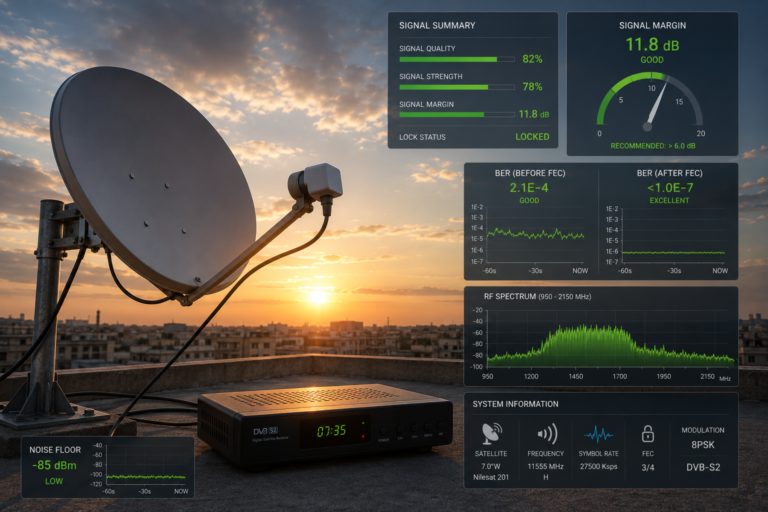
- The Importance of Signal Margin
- Why HD Channels Often Reveal Dish Misalignment First
- How LNB Skew Affects HD Transponders
- Why Higher Frequencies Can Suffer More Cable Loss
- Video Bitrate and Satellite Reception
- MPEG-2, H.264, and HEVC Compatibility
- Why One HD Channel Works While Another Fails
- How Receiver Hardware Causes HD Problems
- How to Separate an RF Fault From a Codec Fault
- How to Troubleshoot HD Channels Correctly
- Reality Check
- Final Verdict
- FAQ
Why the Simple Resolution Explanation Is Incomplete
HD video contains more picture information than SD video. That usually means the broadcaster must allocate more data capacity or use a more efficient compression system. However, the number of pixels displayed on the television does not directly determine whether the satellite tuner can lock onto the RF carrier.
The tuner does not initially know whether the carrier contains an SD programme, an HD programme, radio services, or data. It first receives and demodulates the complete satellite transponder. Only after the transport stream has been recovered does the receiver separate and decode the individual services.
An HD channel can therefore fail for two fundamentally different reasons. The receiver may be unable to demodulate the satellite carrier, or it may successfully receive the transport stream but lack the codec or processing power required to decode the HD programme.
Understanding which stage is failing is essential. Improving dish alignment will not solve an unsupported HEVC codec, while replacing the receiver will not solve severe rain attenuation or incorrect LNB skew.
HD and SD Channels May Use Different Transponders
The most important fact is that an HD channel and its SD equivalent are often not transmitted on the same transponder.
They may use different frequencies, polarizations, symbol rates, beams, modulation systems, and FEC settings. One transponder can arrive strongly at a particular location while another operates much closer to the reception threshold.
This means that the labels HD and SD may not be the direct cause of the different behaviour. The SD channel may simply be carried on a stronger or more robust transponder.
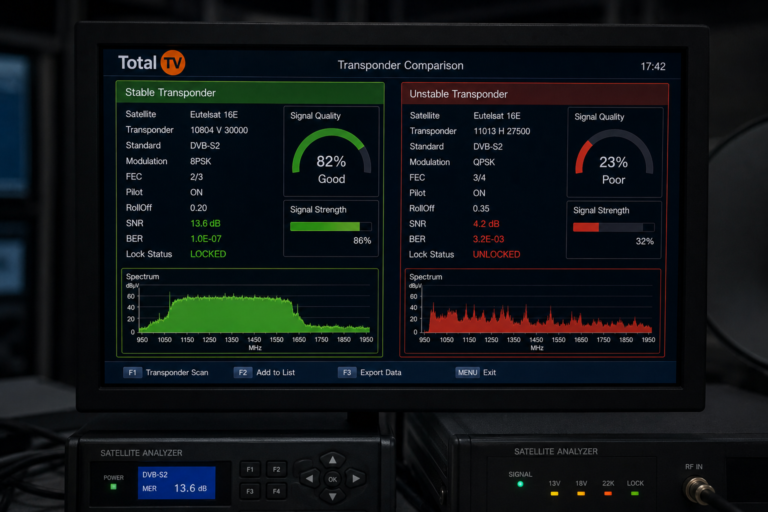
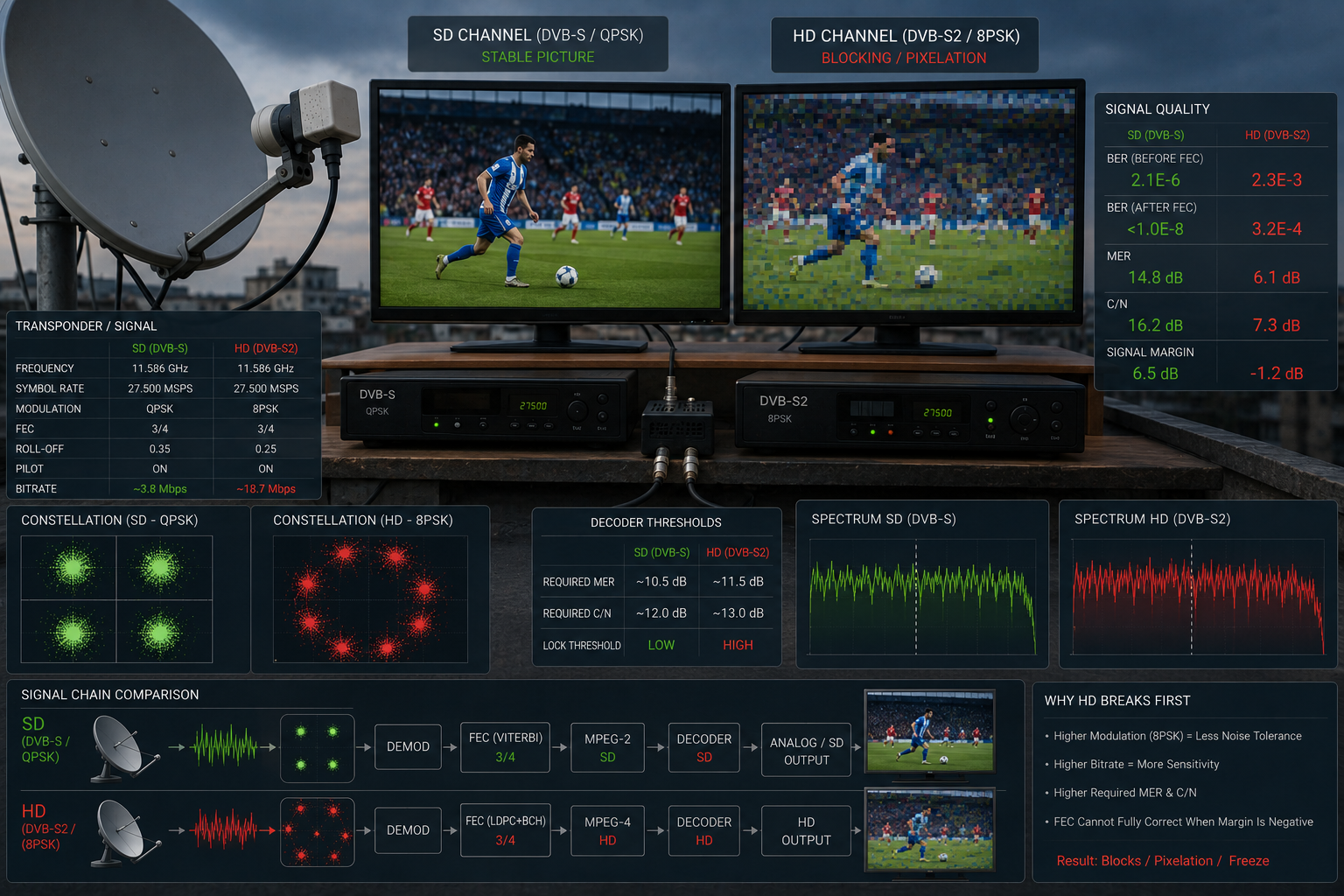
For example, an SD service transmitted using DVB-S, QPSK, and strong error protection may remain stable during light rain. Its HD replacement might use DVB-S2 and 8PSK on a different frequency with less reception margin. When conditions deteriorate, the HD transponder crosses its decoding threshold first.
The reverse can also happen. A well-powered HD transponder can remain stable while an older SD service on a weaker beam begins to fail. HD does not always lose reception first.
DVB-S Versus DVB-S2
Many older SD services were originally transmitted using DVB-S. Modern HD services are commonly delivered using DVB-S2 because it uses satellite capacity more efficiently and supports more advanced modulation and error-correction configurations.
DVB-S2 can provide greater data capacity within the same amount of satellite spectrum. It achieves this through improved framing, stronger error correction, and flexible modulation and coding options.
However, DVB-S2 is not automatically harder to receive in every configuration. A robust DVB-S2 transmission can perform extremely well under weak-signal conditions. The actual reception requirement depends on the selected modulation and coding combination.
The compatibility issue is more straightforward. A receiver designed only for DVB-S may detect RF power from a DVB-S2 transponder but cannot demodulate it. The signal-strength bar may appear active while quality remains at zero.
This behaviour can make a receiver fault look like a dish problem, even though the real issue is that the tuner does not support the newer transmission standard.
Why 8PSK Can Be More Demanding Than QPSK
QPSK uses four principal symbol positions. Each symbol can represent two bits of information. The constellation points are widely separated, which gives the receiver relatively generous decision regions.
8PSK uses eight symbol positions and can represent three bits per symbol. It carries more information during the same symbol period, increasing spectral efficiency.
The disadvantage is that the constellation points are closer together. Noise, interference, phase error, or distortion can move a received symbol across a decision boundary more easily.
For this reason, an 8PSK transmission generally requires a cleaner signal than a comparable QPSK transmission when other important parameters are similar.
Many HD transponders use DVB-S2 with 8PSK to increase capacity. Meanwhile, older SD services may continue using DVB-S with QPSK. This common difference helps explain why the HD group can fail first during marginal reception.
| Transmission Factor | Typical SD Service | Typical HD Service | Possible Reception Effect |
|---|---|---|---|
| Broadcast standard | DVB-S | DVB-S2 | An older receiver may support SD but not the HD transponder |
| Modulation | Often QPSK | Often 8PSK | 8PSK may require cleaner symbol separation |
| Video codec | Often MPEG-2 | Often H.264 or HEVC | The tuner may lock while video decoding still fails |
| Data capacity | Usually lower per programme | Usually higher or more efficiently compressed | The broadcaster may choose a more capacity-efficient transmission mode |
| Receiver requirement | Older hardware may be sufficient | Newer tuner and decoder may be required | Compatibility problems can affect HD only |
| Reception margin | Can be relatively robust | Depends strongly on modulation and FEC | A marginal HD transponder may cross the digital cliff first |
How FEC Changes Reception Requirements
Forward Error Correction adds controlled redundancy to the transmitted data so the receiver can repair errors introduced during the satellite path.
A stronger protection mode allocates a greater proportion of the transmission to error correction. This reduces the net payload capacity but allows the receiver to recover data under poorer signal conditions.
A higher coding rate allocates more capacity to useful data and less to redundancy. This improves efficiency but may require a cleaner carrier.
The modulation and FEC must therefore be considered together. An 8PSK transponder using a demanding coding rate can require substantially better reception than a robust QPSK service with stronger error protection.
It is inaccurate to say that all DVB-S2 or all HD services require the same minimum quality. Every modulation and coding combination has its own operating threshold.
The Importance of Signal Margin
Signal margin is the distance between the current reception condition and the minimum threshold required for reliable decoding.
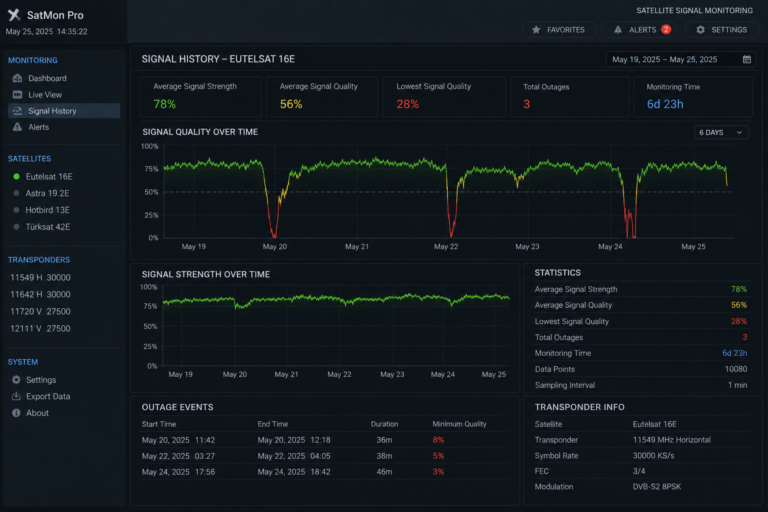
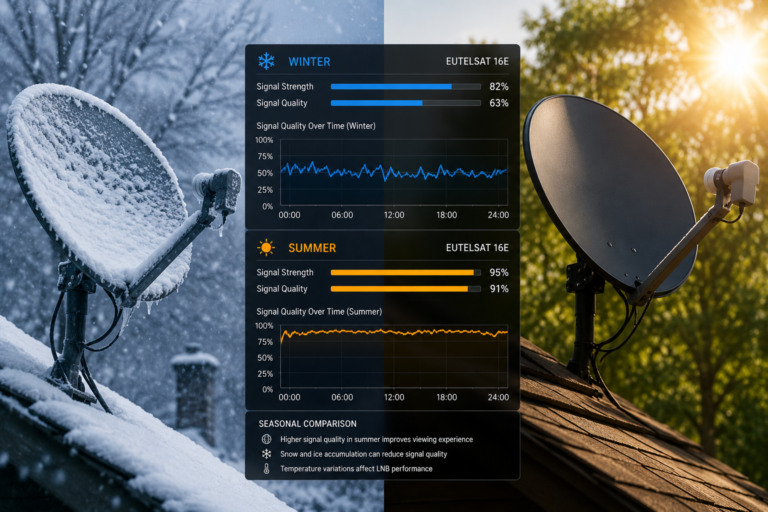
A receiver with comfortable margin can tolerate rain attenuation, small mechanical movement, cable ageing, temperature-related LNB drift, and moderate interference without losing lock.
A receiver operating just above threshold can produce a perfect picture in dry conditions. A very small deterioration may then cause rapid pixelation or complete loss of the HD service.
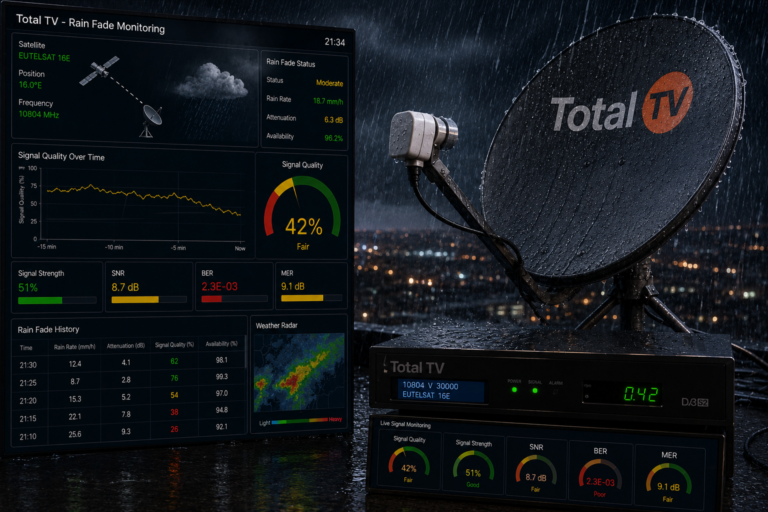
An SD transponder with more margin may continue operating during the same conditions. The user sees SD working and HD failing, even though both channels looked equally perfect before the weather changed.
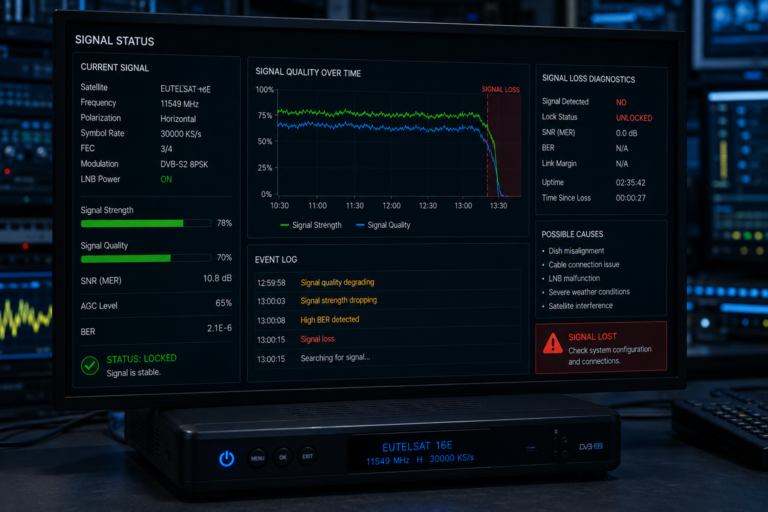
This is the digital cliff effect. Reception does not always deteriorate gradually. Error correction can conceal the rising error rate until the decoder can no longer reconstruct the transport stream reliably.
Why HD Channels Often Reveal Dish Misalignment First
A slightly misaligned dish can still receive powerful and robust transponders. The installation may appear correct because several SD channels work without visible problems.
More demanding transponders expose the missing margin. Small azimuth or elevation errors reduce the wanted carrier and can increase the relative influence of noise or adjacent-satellite interference.
An HD service carried by 8PSK may begin showing blocks even though the strength percentage remains high. The strength bar indicates that RF power is present, but the modulation quality has fallen too close to the decoding threshold.
Fine dish adjustment should therefore use MER, BER, carrier-to-noise ratio, or a reliable quality measurement. Maximising raw signal strength alone may not place the dish at the point of best digital performance.
How LNB Skew Affects HD Transponders
Satellite systems reuse frequencies through horizontal and vertical polarization. Correct LNB rotation helps isolate the wanted polarization from the opposite one.
Incorrect skew allows cross-polarized energy to enter the receiving path. The additional energy behaves as interference and reduces modulation quality.
A robust QPSK transponder may continue working despite this interference. A more demanding 8PSK transponder may suffer increased BER and fail first.
The effect can be confusing because signal strength may remain unchanged or even increase. The receiver is detecting RF energy, but a larger share of that energy now belongs to the unwanted polarization.
LNB skew should be adjusted for maximum stable quality or MER rather than maximum signal strength.
Why Higher Frequencies Can Suffer More Cable Loss
The LNB converts the satellite downlink into an intermediate-frequency signal that travels through coaxial cable. Cable attenuation normally increases towards the upper end of the satellite IF range.
If the HD transponder is converted to a higher intermediate frequency than the working SD transponder, it may suffer more loss through a long or poor-quality cable.
This can create a situation where lower-frequency services remain stable while higher-frequency services break up or disappear.
The fault may be caused by excessive cable length, damaged shielding, poor connectors, unsuitable wall plates, low-quality splitters, or ageing distribution equipment.
An amplifier can compensate for predictable distribution loss when correctly designed into the system. It cannot repair symbol errors already caused by poor dish alignment, noise, interference, or an unstable LNB.
Video Bitrate and Satellite Reception
HD video commonly requires more data than SD video when both use similar compression technology. Broadcasters therefore need additional transponder capacity or a more efficient codec.
However, bitrate does not directly determine the RF threshold. The satellite receiver demodulates the complete carrier before it knows which programme uses a high or low video bitrate.
A high-bitrate HD programme does not automatically require more signal strength than a lower-bitrate programme carried within the same transport stream. If both programmes occupy the same transponder, they share the same RF reception condition.
Bitrate becomes indirectly relevant because the broadcaster may select a more capacity-efficient modulation and coding mode to accommodate more data. That transmission configuration, rather than the picture bitrate itself, can make reception more demanding.
MPEG-2, H.264, and HEVC Compatibility
A receiver can lock perfectly onto an HD transponder and still fail to display the channel if it does not support the video codec.
Older SD channels commonly use MPEG-2. Many HD services use H.264, also known as AVC. Newer HD and Ultra HD services increasingly use HEVC because it can provide similar picture quality at a lower bitrate than older codecs.
A DVB-S2 tuner is not proof that the receiver supports every video format. Tuner compatibility and codec compatibility are separate requirements.
An older DVB-S2 receiver may identify the service name, display programme information, and reproduce audio while showing a black screen because the video decoder does not support HEVC.
In this case, real signal quality may be excellent. Dish adjustment will not solve the problem. A compatible receiver or television module is required.
Why One HD Channel Works While Another Fails
The term HD describes picture resolution, not one universal satellite transmission method.
Two HD channels may be carried on different satellites, beams, transponders, polarizations, frequencies, and modulation configurations. They may also use different codecs and encryption systems.
One HD channel might use QPSK with strong error protection on a high-power European beam. Another might use 8PSK on a weaker regional beam with less margin at the receiving location.
The first can remain stable while the second repeatedly pixelates. The fact that both are HD does not mean they should have identical reception performance.
Troubleshooting should therefore begin with the exact transponder parameters rather than comparing channels only by resolution.
How Receiver Hardware Causes HD Problems
HD decoding requires more processing capability and memory bandwidth than traditional SD decoding. A receiver may support the correct tuner standard but struggle with the programme format.
Possible hardware limitations include unsupported codecs, insufficient processing power, limited memory, outdated demultiplexer support, or an HDMI output that cannot handle the selected video mode correctly.
Software also matters. Receiver firmware contains transponder tables, codec components, conditional-access functions, and decoder logic. Bugs or outdated firmware can affect some HD services while leaving SD channels unchanged.
Heat can expose marginal receiver hardware. A device may operate correctly when cold but freeze after prolonged HD decoding because its processor or power supply becomes unstable.
When signal-quality readings remain healthy during the fault, receiver hardware and software should be investigated before the dish is moved.
How to Separate an RF Fault From a Codec Fault
An RF reception fault usually affects transponder lock or transport stream stability. Signal quality may fall, BER may rise, and several services on the same transponder may pixelate together.
A codec fault occurs after successful reception. The receiver may show stable signal quality, correct channel information, and working audio but no video.
Testing another service on the same transponder can provide useful evidence. If every programme on that transponder breaks up simultaneously, the cause is probably within the RF or transport path.
If only one video service fails while the remaining services are stable, the problem is more likely to involve the service codec, receiver software, conditional access, or programme configuration.
| Observed Symptom | More Likely Cause | Recommended Check |
|---|---|---|
| Quality falls and several channels pixelate together | RF reception or transponder problem | Check dish alignment, BER, MER, weather, LNB, and cable |
| High strength but zero quality on all HD transponders | Unsupported DVB-S2 tuner or incorrect parameters | Confirm receiver standard, modulation, symbol rate, and FEC |
| Stable quality, audio works, but video is black | Unsupported video codec | Confirm H.264 or HEVC compatibility |
| Only high-band frequencies fail | LNB switching, cable, connector, or 22 kHz control problem | Test high-band operation and inspect the distribution path |
| HD fails during rain but SD remains stable | Different transponder margins or modulation requirements | Improve dish alignment, skew, dish size, and system margin |
| HD fails after the receiver becomes hot | Hardware, cooling, or power-supply instability | Test ventilation, firmware, and receiver condition |
How to Troubleshoot HD Channels Correctly
Begin by identifying the exact transponder carrying the failed HD channel. Record its frequency, polarization, symbol rate, broadcast standard, modulation, and FEC.
Compare these parameters with a working SD channel. If the channels use different transponders, their behaviour cannot be judged from resolution alone.
Confirm that the receiver supports DVB-S2 and the required modulation. Next, verify support for the programme’s video codec, such as H.264 or HEVC.
Observe signal quality, BER, and MER rather than relying only on strength. Check whether every channel on the same HD transponder fails at the same time.
Test representative frequencies in the low band and high band, along with both polarizations. This can expose LNB switching, skew, cable, connector, multiswitch, or control-voltage problems.
Fine-tune dish azimuth, elevation, and LNB skew using the weakest important transponders. The objective is to create adequate margin across the required satellite package rather than maximising one powerful frequency.
If HD reception deteriorates while SD remains stable, the deeper technical issue is often visible in the modulation measurement. Our guide to what MER means and why installers care about it explains how constellation errors reveal problems that a basic signal-strength bar can miss.
HD channels do not always fail before SD channels. Some HD transponders use robust DVB-S2 configurations and strong satellite beams, while some SD services operate with limited coverage or weak reception margin.
Picture resolution alone does not determine the RF requirement. The critical factors are the transponder, beam, frequency, polarization, modulation, FEC, signal margin, receiver tuner, and codec support.
A receiver percentage also cannot reveal every fault. High signal strength may coexist with poor MER, rising BER, an unsupported codec, or an incompatible DVB-S2 transmission.
HD channels often fail before SD channels because they are commonly delivered through different and sometimes more demanding transmission chains. DVB-S2, 8PSK, higher coding efficiency, weaker transponder margin, newer video codecs, and stricter receiver requirements can all contribute.
The additional picture resolution is not usually the direct RF cause. The real cause is more often the way the HD service is transmitted and decoded.
Correct troubleshooting must separate satellite lock from video decoding. Check the exact transponder, modulation, FEC, BER, MER, dish alignment, LNB skew, cable path, receiver standard, and codec support before deciding which component is responsible.
| Question | Answer |
|---|---|
| Why do SD channels work while HD channels show no signal? | The HD channels may use a different DVB-S2 transponder, modulation mode, frequency, polarization, or beam that requires better reception or newer tuner hardware. |
| Does HD resolution require more satellite signal strength? | Not directly. The RF requirement depends on the transponder’s modulation and coding configuration rather than the number of pixels in the programme. |
| Why is 8PSK more sensitive than QPSK? | 8PSK places more symbol positions within the constellation, leaving less separation between them and requiring cleaner symbol recovery. |
| Can a DVB-S receiver receive HD channels? | It cannot demodulate HD services transmitted using DVB-S2. Some HD services can theoretically use DVB-S, but the receiver must also support the video codec and resolution. |
| Why does the receiver show strength but no quality on HD channels? | It may detect RF power but be unable to lock because of unsupported DVB-S2 or 8PSK, incorrect tuning parameters, poor signal quality, or the wrong satellite. |
| Can an old DVB-S2 receiver fail on modern HD channels? | Yes. It may support the transponder but lack HEVC decoding or sufficient hardware capability for the programme format. |
| Why do HD channels fail during rain first? | Their transponder may have less reception margin or use a modulation and coding combination that crosses its decoding threshold sooner. |
| Can poor LNB skew affect HD more than SD? | Yes. Cross-polarization interference may be tolerated by a robust SD transponder but cause a marginal HD transponder to fail. |
| Why does only one group of HD channels fail? | Channels within that group may share one transponder affected by weak coverage, interference, incorrect skew, cable loss, or a specific receiver compatibility problem. |
| Can cable quality affect HD channels only? | It can appear that way when the HD transponders occupy frequencies suffering greater cable loss or when the SD services have more reception margin. |
| Will a larger dish improve HD reception? | It can improve carrier quality and weather margin when the problem is weak or marginal RF reception. It will not fix an unsupported tuner or video codec. |
| How can I tell whether the problem is the signal or the codec? | Falling quality, rising BER, and several channels failing together suggest an RF problem. Stable lock with audio but no picture suggests a codec or receiver-decoding problem. |