Why Some Total TV Channels Need Perfect Signal
Estimated reading time: 9 minutes.
- Not every Total TV transponder has the same decoding requirements.
- Signal quality is more important than signal strength.
- DVB-S2 transmissions often require cleaner reception.
- Signal margin determines long-term stability.
- BER affects HD decoding performance.
- Receiver synchronization varies between transponders.
- A properly aligned dish should perform well across every frequency.
- Why Channels Behave Differently
- Different Modulation Requires Different Signal Quality
- Signal Margin Determines Which Channels Survive
- BER Explains Random Channel Loss
- Dish Alignment Affects Difficult Channels First
- LNB Quality Matters More Than Expected
- Receiver Sensitivity Is Part Of The Equation
- Technical Comparison
- How To Receive Every Total TV Channel Reliably
- Reality Check
- Final Verdict
- FAQ
Why Channels Behave Differently
Although all Total TV channels arrive from the same satellite position, they are not transmitted under identical technical conditions.
Each television service belongs to a transponder. Every transponder can use different symbol rates, modulation methods, forward error correction settings, and overall transmission parameters.
These differences determine how tolerant each channel is to small reception problems.
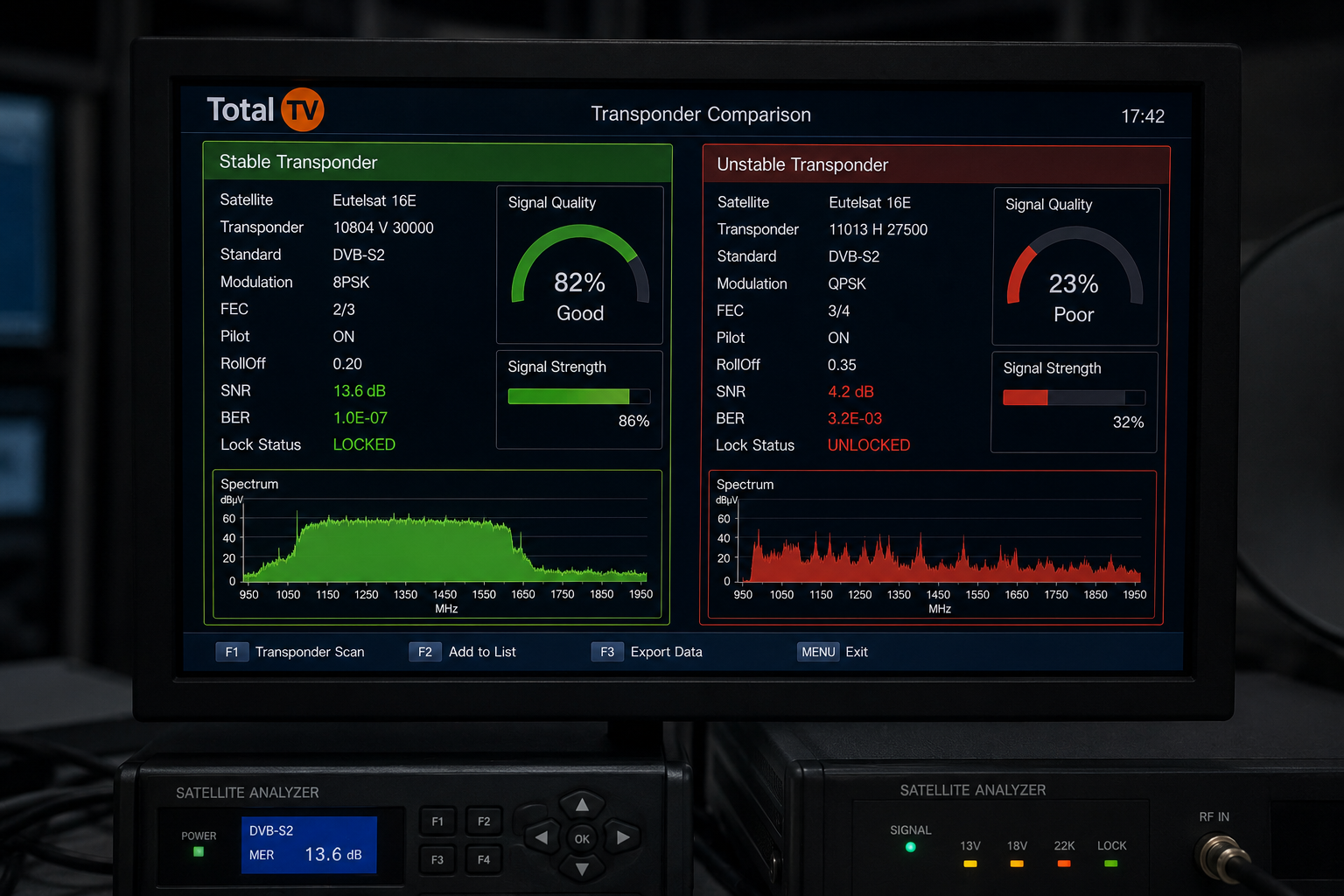
Some transponders continue working even when signal quality drops noticeably. Others begin freezing after only a small reduction in decoding quality.
This explains why one HD sports channel may disappear while dozens of other channels continue working normally.
Different Modulation Requires Different Signal Quality
Modern Total TV services are typically transmitted using DVB-S2 technology.
Compared with older DVB-S systems, DVB-S2 is more spectrum efficient and supports higher data rates.
However, improved efficiency comes with a requirement for cleaner reception.
Higher-order modulation schemes carry more information inside each transmitted symbol.
That also means they tolerate less noise before decoding errors begin appearing.
A channel using more demanding modulation may therefore require what users describe as a “perfect signal,” while another channel on a different transponder continues working comfortably.
Signal Margin Determines Which Channels Survive
Signal margin is often the hidden difference between stable and unstable reception.
Think of it as a safety reserve.
When signal margin is high, the receiver continues decoding correctly even if weather changes or small interference appears.
When signal margin is low, there is almost no reserve.
The most demanding Total TV channels usually consume that reserve first.
As a result, they begin freezing while easier transponders continue operating normally.
The satellite has not changed. The installation simply reached the decoding limit for that particular transmission.
BER Explains Random Channel Loss
Bit Error Rate is one of the most useful indicators of reception quality.
Every digital transmission contains small errors.
Modern receivers automatically repair many of them.
When BER remains low, viewers never notice those corrections.
When BER rises, error correction becomes more difficult.
Eventually certain transponders exceed the receiver’s correction capability.
Channels begin freezing, audio becomes distorted, or the receiver loses lock completely.
Because difficult channels operate closer to their decoding threshold, they are usually affected first.
Dish Alignment Affects Difficult Channels First
Many installations appear perfectly aligned because most channels work.
In reality, alignment may still be slightly inaccurate.
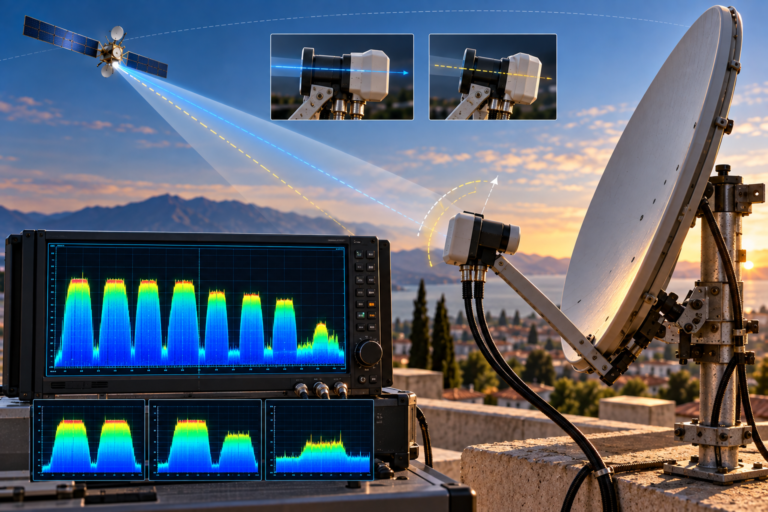
Even a tiny pointing error reduces signal quality across the entire satellite.
The strongest transponders often hide this weakness.
The weakest or most demanding Total TV channels expose it immediately.
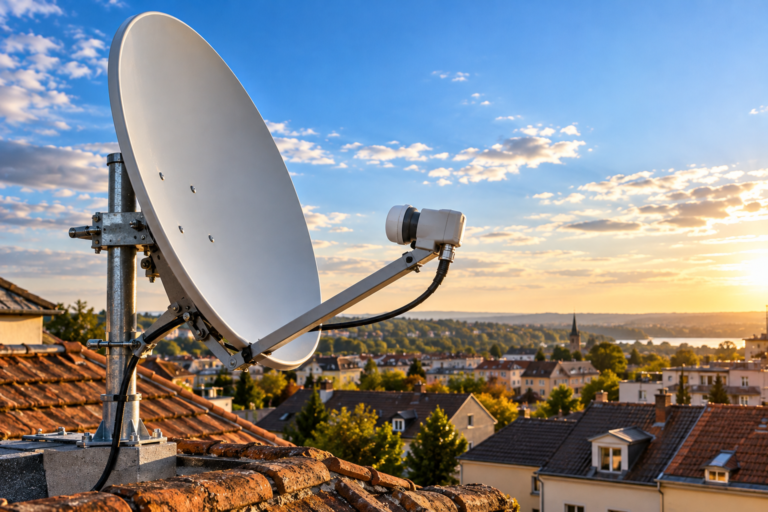
Professional installers therefore optimize dish position using the most difficult transponder rather than the easiest one.
If the weakest channel becomes stable, stronger channels usually improve automatically.
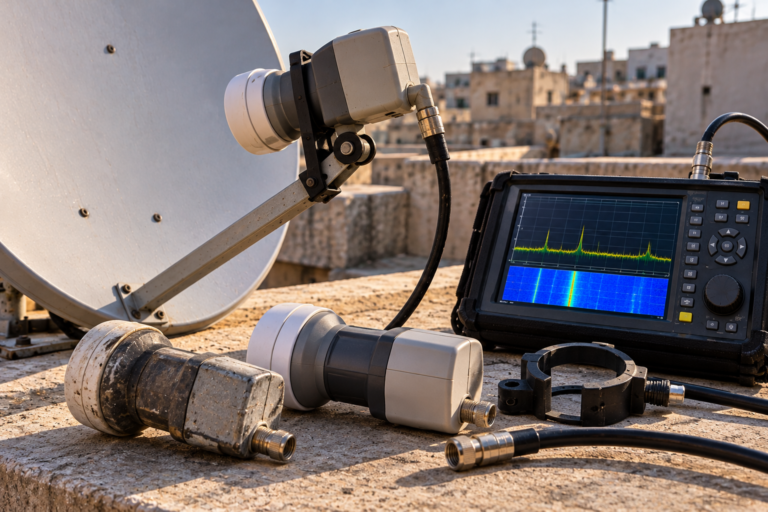
LNB Quality Matters More Than Expected
The LNB is responsible for converting satellite frequencies into signals the receiver can process.
Poor oscillator stability, excessive internal noise, or aging electronic components reduce overall reception quality.
Strong transponders often remain unaffected.
Demanding HD channels reveal the weakness first.
Replacing an aging LNB frequently improves only a handful of difficult channels while the rest appear unchanged.
That observation often surprises users, but it perfectly matches how digital satellite reception behaves.
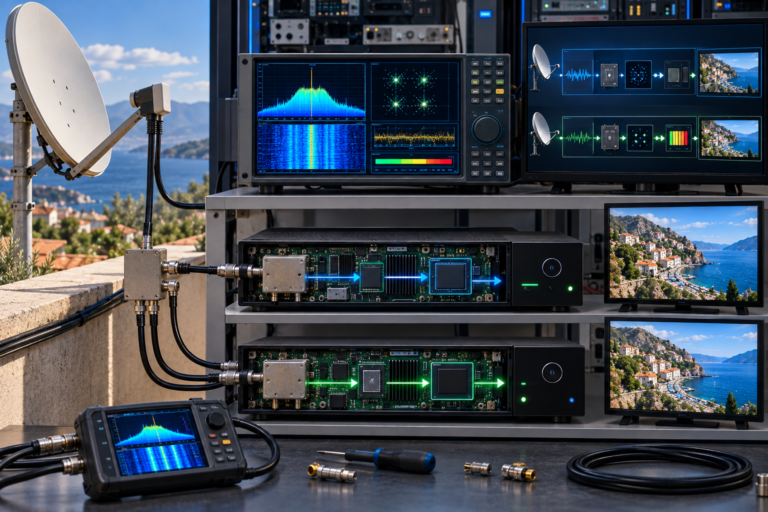
Receiver Sensitivity Is Part Of The Equation
Different receivers do not always perform identically.
Some tuners maintain synchronization more effectively under weak signal conditions.
Others require slightly cleaner reception before locking successfully.
Firmware also influences scanning accuracy, synchronization speed, and transport stream recovery.
Although the receiver is rarely the primary cause, its performance can determine whether borderline channels remain watchable.
Technical Comparison
| Factor | Easier Channels | Demanding Channels |
|---|---|---|
| Required Signal Quality | Lower | Higher |
| BER Tolerance | Greater | Lower |
| Sensitivity To Alignment | Moderate | High |
| LNB Stability Requirement | Normal | Very High |
| Weather Resistance | Better | Reduced |
| Risk Of Freezing | Lower | Higher |
How To Receive Every Total TV Channel Reliably
Instead of optimizing your dish using the strongest channel, monitor the weakest HD transponder while making adjustments.
Carefully optimize dish azimuth, elevation, and LNB skew.
Inspect every outdoor connector for corrosion or moisture.
Replace low-quality coaxial cable if signal loss is suspected.
Use a stable, low-noise LNB from a reputable manufacturer.
The objective is not simply receiving channels.
The goal is increasing signal margin so even the most demanding Total TV transponders remain comfortably above the decoding threshold.
Some Total TV channels do not actually require a “perfect” signal. They simply require cleaner reception than other transponders. If your installation has limited signal margin, those channels reveal the weakness first while stronger services continue working normally.
The reason some Total TV channels appear to need perfect signal is that they operate with more demanding transmission characteristics and therefore require lower BER, stronger signal quality, and greater decoding margin. Improving alignment, LNB stability, and overall reception quality increases system reserve and allows every channel to remain stable under changing conditions.
FAQ
| Question | Answer |
|---|---|
| Why do only some Total TV channels freeze? | Those channels often require cleaner reception than other transponders. |
| Does strong signal strength guarantee stable HD reception? | No. Signal quality and BER are much more important. |
| Can poor alignment affect only a few channels? | Yes. Difficult transponders usually reveal alignment errors first. |
| Will replacing the LNB improve weak channels? | If the existing LNB has poor stability or high noise, replacing it can improve demanding channels. |
| Why do HD channels disappear during rain before SD channels? | HD services often require higher decoding quality and have less tolerance for signal degradation. |
| What is the best way to improve Total TV stability? | Increase signal margin through accurate alignment, proper LNB skew, good cable quality, and a stable low-noise LNB. |