Why Rain Affects Total TV More Than Expected
Estimated reading time: 9 minutes.
- Rain weakens microwave signals through atmospheric attenuation.
- Signal margin determines how much rain your installation can tolerate.
- HD channels are usually affected before SD channels.
- Dish alignment becomes more important during rainfall.
- LNB condition influences overall reception stability.
- Large dishes generally provide greater weather resistance.
- Most rain-related failures expose existing installation weaknesses.
- What Rain Fade Really Means
- How Rain Weakens Satellite Signals
- Signal Margin Determines Weather Resistance
- Why HD Channels Fail First
- Dish Alignment Becomes Critical During Rain
- The Role Of The LNB During Bad Weather
- Why Reception Returns Quickly After Rain
- Technical Comparison
- How To Improve Total TV Reception During Rain
- Reality Check
- Final Verdict
- FAQ
What Rain Fade Really Means
Rain fade is the gradual reduction of satellite signal strength and quality caused by precipitation between the satellite and the receiving dish.
Unlike terrestrial television, satellite signals travel thousands of kilometers through the atmosphere before reaching your antenna.
Along this path they pass through clouds, humidity, and eventually rainfall.
Each raindrop absorbs and scatters a tiny amount of microwave energy.
Individually the effect is almost insignificant.
Collectively millions of raindrops reduce the amount of usable signal reaching the LNB.
The receiver therefore has less information available for reliable decoding.
How Rain Weakens Satellite Signals
Satellite television uses microwave frequencies that are particularly sensitive to atmospheric attenuation.
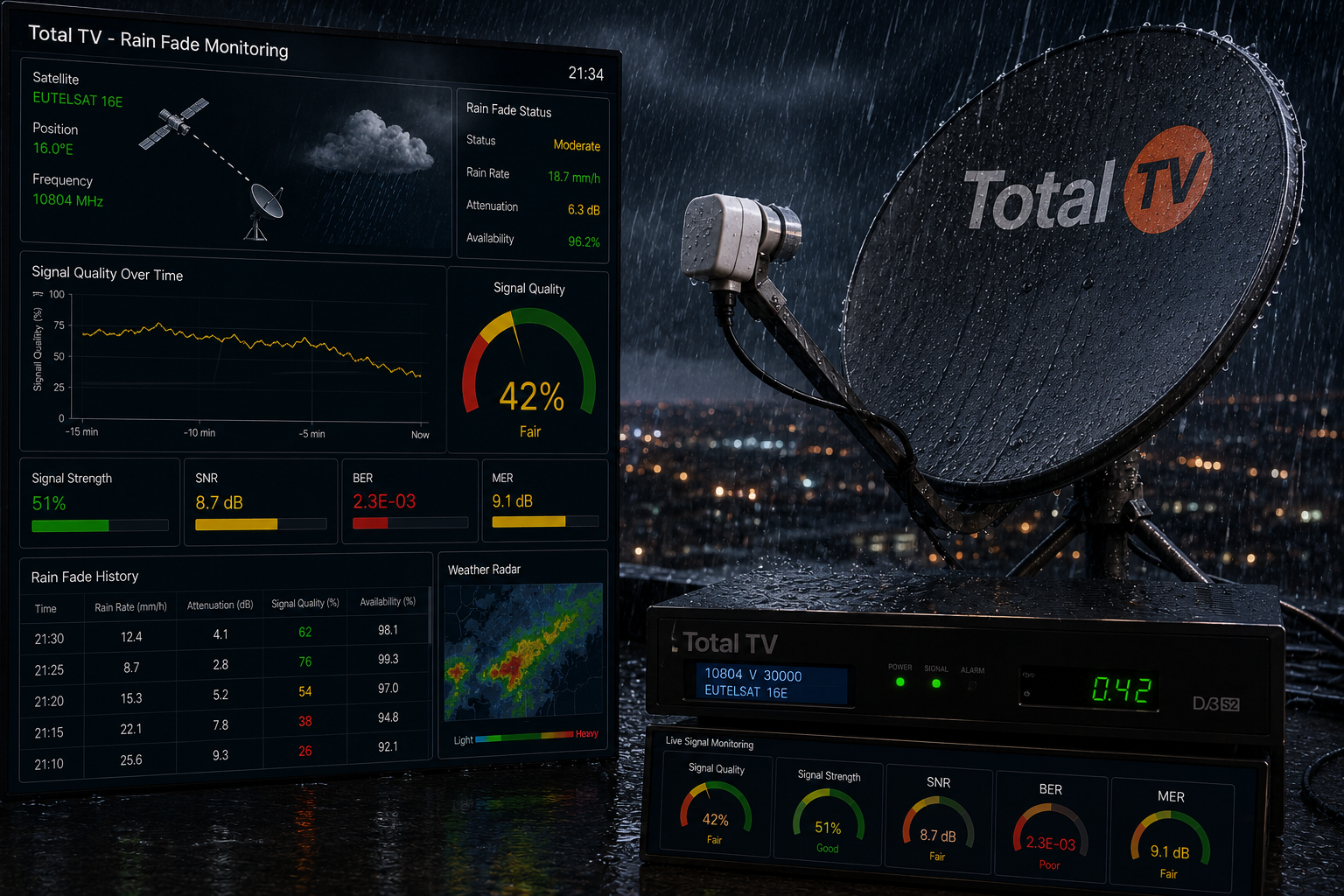
As rain intensity increases, more microwave energy is absorbed and scattered before it reaches the dish.
This process reduces carrier strength and lowers signal quality.
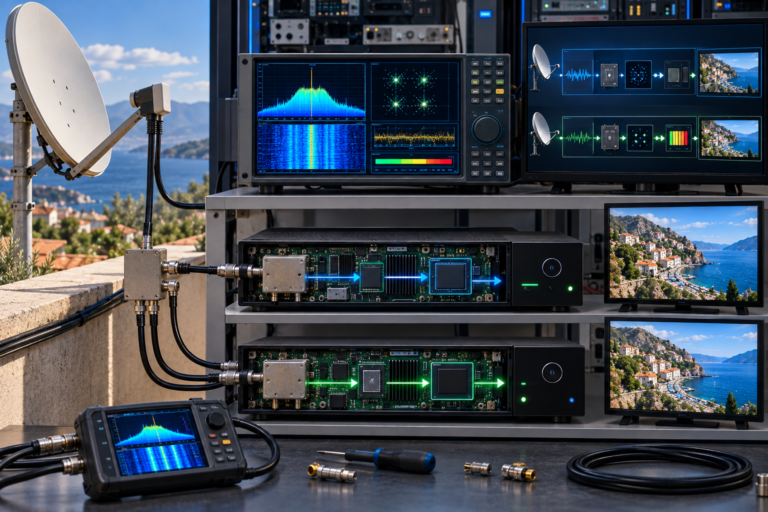
The receiver must perform additional error correction as BER increases.
If attenuation becomes stronger than the available signal margin, the receiver loses stable decoding.
Viewers then experience freezing, pixelation, missing audio, or complete loss of picture.
Signal Margin Determines Weather Resistance
Signal margin is the reserve between your current reception quality and the minimum level required for reliable decoding.
A well-installed Total TV system may have several decibels of reserve.
A marginal installation may operate only slightly above the decoding threshold.
When rain introduces additional attenuation, the stronger installation continues working while the weaker installation fails.
This explains why neighbors using the same satellite sometimes experience completely different results during the same storm.
The weather is identical.
The available signal margin is not.
Why HD Channels Fail First
Most Total TV HD channels use DVB-S2 transmission.
These services provide excellent picture quality and efficient bandwidth usage.
However, they also require cleaner reception than many standard-definition channels.
As rain gradually reduces signal quality, HD channels usually reach the decoding threshold first.
This is why viewers often lose only HD channels during moderate rainfall while SD services continue operating.
It is not because HD channels are weaker.
They simply require better reception conditions.
Dish Alignment Becomes Critical During Rain
Many dishes appear perfectly aligned because reception remains stable under clear skies.
Rain quickly exposes hidden alignment errors.
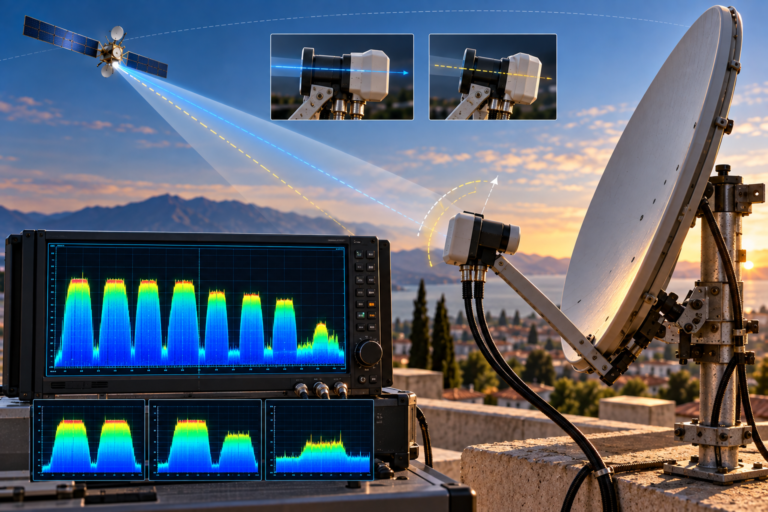
Even a very small pointing error reduces available signal margin.
During normal weather this reduction may not be visible.
When rain adds extra attenuation, the missing reserve suddenly becomes important.
Professional installers therefore optimize alignment for maximum signal quality rather than accepting reception that merely works on sunny days.
The Role Of The LNB During Bad Weather
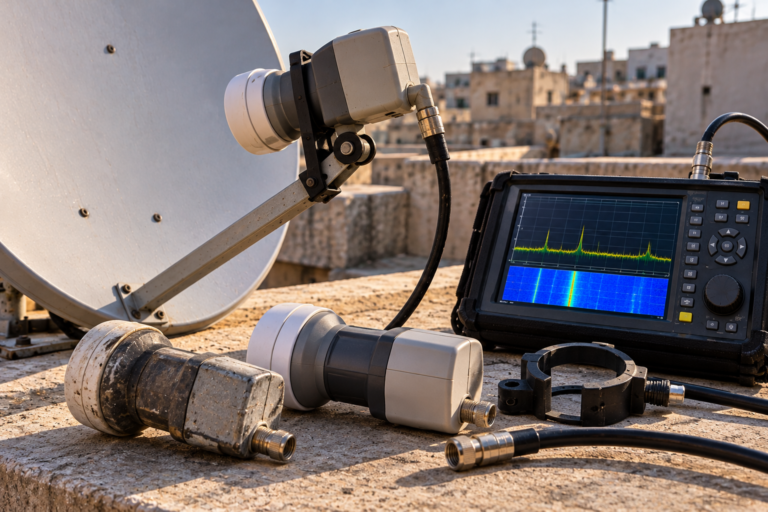
The LNB is responsible for receiving and amplifying extremely weak satellite signals.
A modern low-noise LNB preserves more of the available signal before sending it to the receiver.
An aging or lower-quality LNB introduces more internal noise and reduces effective signal quality.
During clear weather this difference may remain unnoticed.
During rain, however, every fraction of available signal becomes valuable.
Replacing an older LNB often improves weather resistance without changing the dish itself.
Why Reception Returns Quickly After Rain
Many viewers notice that Total TV channels recover almost immediately once rainfall weakens.
This happens because the satellite transmission never stopped.
Only the atmospheric attenuation changed.
As rain intensity decreases, more microwave energy reaches the dish again.
Signal quality improves.
BER falls.
The receiver regains synchronization and normal playback resumes without requiring manual adjustment.
Technical Comparison
| Condition | Strong Installation | Marginal Installation |
|---|---|---|
| Signal Margin | Large reserve | Small reserve |
| Light Rain | No visible effect | Occasional pixelation |
| Heavy Rain | Minor quality reduction | Frequent freezing |
| BER | Remains low | Rises quickly |
| HD Reception | Mostly stable | Fails first |
| Recovery | Immediate | Depends on available margin |
How To Improve Total TV Reception During Rain
Begin by maximizing signal quality under clear weather conditions.
Carefully optimize dish azimuth, elevation, and LNB skew.
Inspect every outdoor connector for moisture and corrosion.
Replace damaged coaxial cable if shielding has deteriorated.
Install a modern low-noise LNB if the existing unit has aged significantly.
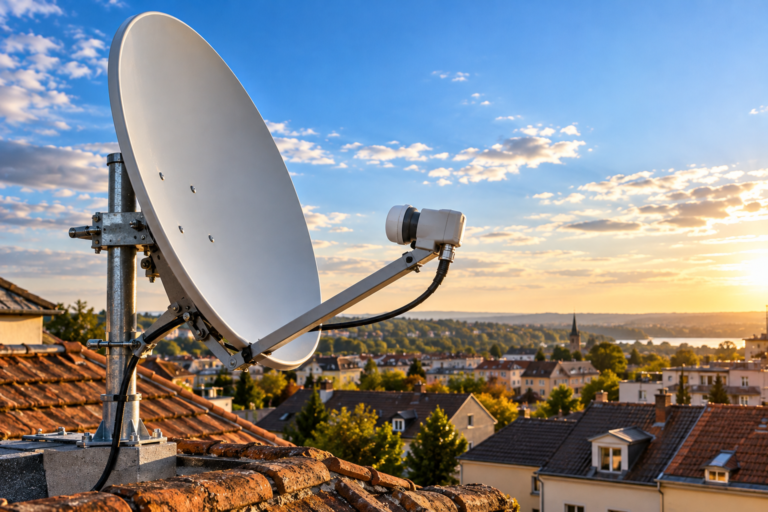
In locations with frequent heavy rainfall, a slightly larger dish may provide additional signal margin and noticeably improve weather resistance.
If some Total TV channels already require unusually clean reception, improving overall signal margin before the rainy season is especially important. For more detail, read Why Some Total TV Channels Need Perfect Signal.
Rain does not switch off the Total TV satellite. Instead, it gradually weakens the microwave signal traveling through the atmosphere. Installations with sufficient signal margin usually continue working, while marginal systems quickly reveal freezing, pixelation, or complete signal loss. Most rain-related problems are therefore symptoms of limited reception reserve rather than faults in the broadcast itself.
Rain affects Total TV more than many viewers expect because microwave signals naturally lose strength while passing through heavy precipitation. The severity of the problem depends much more on your installation than on the satellite itself. Accurate dish alignment, a stable low-noise LNB, healthy cabling, and generous signal margin allow the receiver to withstand weather-related attenuation and maintain reliable HD reception even when conditions become challenging.
FAQ
| Question | Answer |
|---|---|
| Why does rain affect Total TV reception? | Rain weakens microwave signals before they reach the satellite dish. |
| Why do HD channels disappear before SD channels? | HD channels usually require cleaner signal quality and lower BER for reliable decoding. |
| Can better alignment improve rain resistance? | Yes. Accurate alignment increases signal margin and helps the receiver tolerate attenuation. |
| Does replacing the LNB help? | A modern low-noise LNB can improve reception quality and weather performance. |
| Would a larger dish reduce rain fade? | In many situations, yes. A larger dish collects more signal and increases available margin. |
| Does rain damage the satellite signal permanently? | No. Reception normally returns as soon as atmospheric attenuation decreases. |