How HD+ Uses Both Satellite and Internet
Estimated Reading Time: 12 minutes
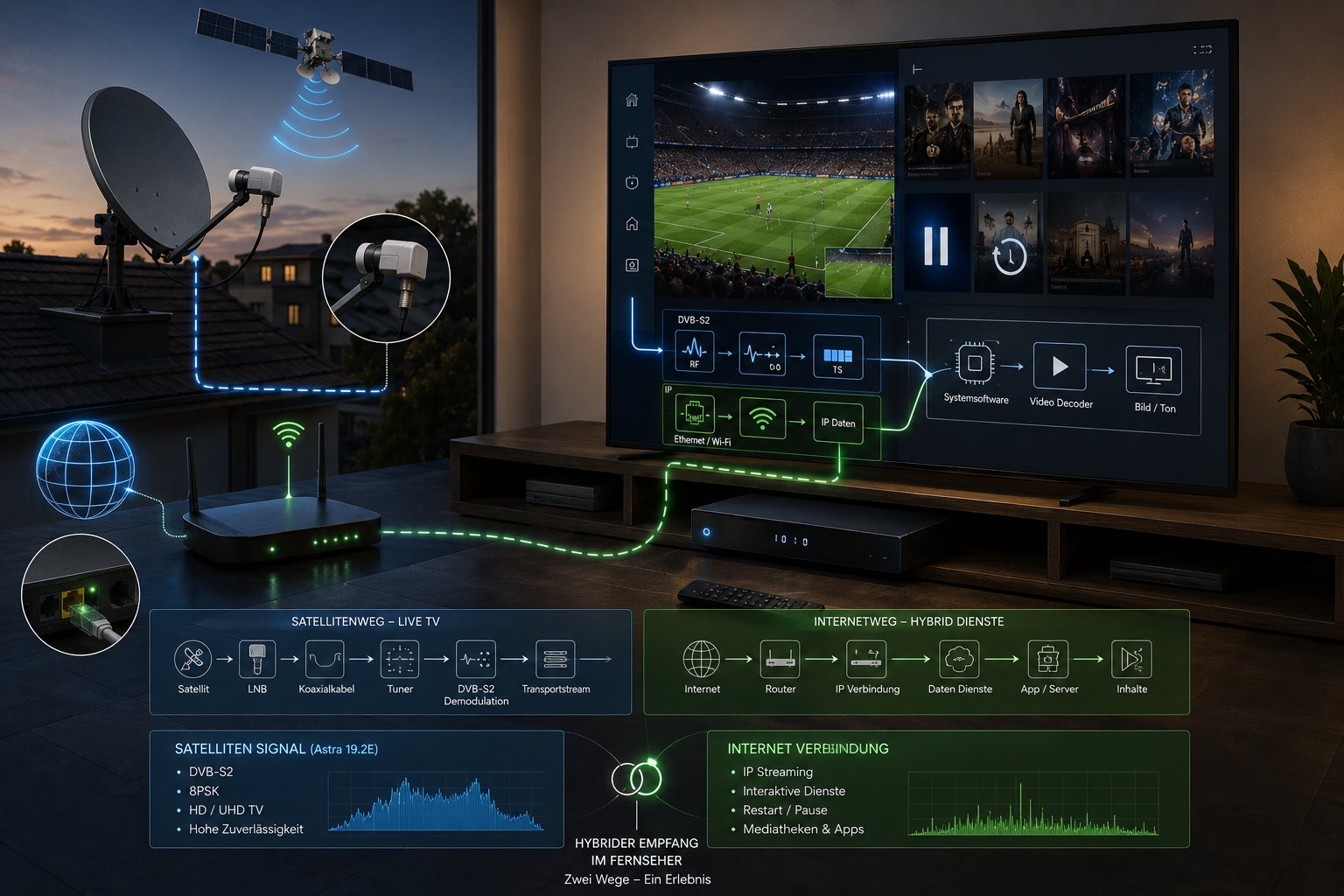
HD+ is a useful example of how modern television no longer has to choose between satellite and internet delivery. In a compatible German satellite household, the live television signal can arrive through Astra 19.2E while the television’s network connection provides additional functions such as programme restart, pause, media-library access, application data, and other interactive features. The two paths meet inside the television, but they are performing different technical jobs.
This distinction is important when troubleshooting. A perfect broadband connection cannot restore a DVB-S2 carrier lost because of poor dish alignment, and excellent Astra reception cannot load an internet-based media library when the television has lost network access. Understanding which data travels over satellite and which data depends on IP makes the complete HD+ system much easier to diagnose.
HD+ uses a hybrid television architecture on compatible devices. The satellite path remains highly efficient for linear broadcasting because one DVB-S2 transmission can reach a very large audience simultaneously. Internet connectivity adds functions that benefit from two-way communication, on-demand retrieval, application updates, metadata, and individualized user interaction. HD+ expanded this model further in May 2026 with HD+ Free, which combines satellite television with the HD+ TV-App, media-library content, pause, restart, and an electronic programme guide on compatible Smart TVs.
- Satellite and Internet Perform Different Jobs
- How the Live Satellite Path Works
- Why Astra 19.2E Is Ideal for Linear Television
- What DVB-S2 Does Before the Picture Appears
- What the Internet Connection Adds
- How Restart Works in a Hybrid System
- Why Pause Is Different From Satellite Transmission
- How Media Libraries Reach the Television
- Why the HD+ TV-App Needs Connectivity
- What HD+ Free Changed in 2026
- Why Satellite Does Not Buffer Like Internet Video
- How Internet Buffering Is Different
- Ethernet Versus Wi-Fi for Connected Functions
- What Happens When the Internet Fails
- What Happens When the Satellite Signal Fails
- How to Diagnose Hybrid HD+ Problems
- Reality Check
- Final Verdict
- FAQ
Satellite and Internet Perform Different Jobs
Satellite and broadband are both capable of delivering video, but their network architectures are fundamentally different.
A satellite transponder broadcasts the same RF carrier across a large geographic footprint. Every compatible dish within that footprint can receive the transmission at the same time.
Internet delivery is normally based on IP networking. The television requests data through a broadband connection, and network infrastructure delivers the requested content back to that device.
HD+ can use these technologies together because each has strengths suited to different parts of the television experience.
Satellite is extremely efficient for mass distribution of linear television. Internet connectivity is naturally suited to interactive requests, media libraries, personalized interfaces, and content that viewers choose at different times.
How the Live Satellite Path Works
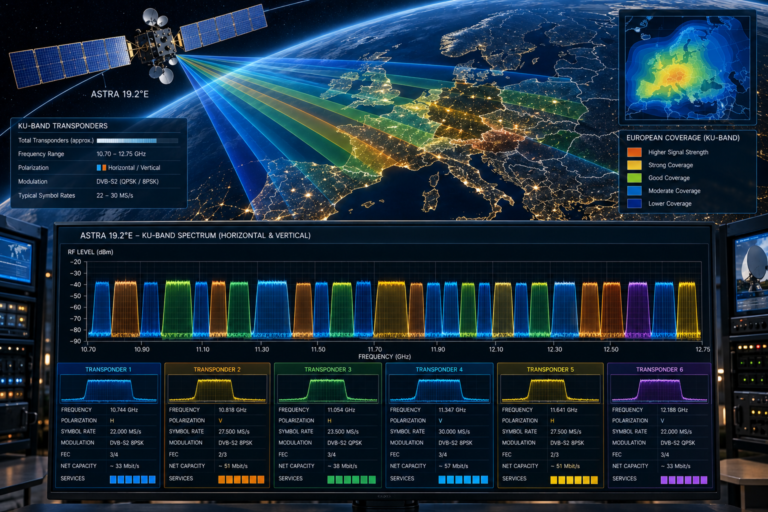
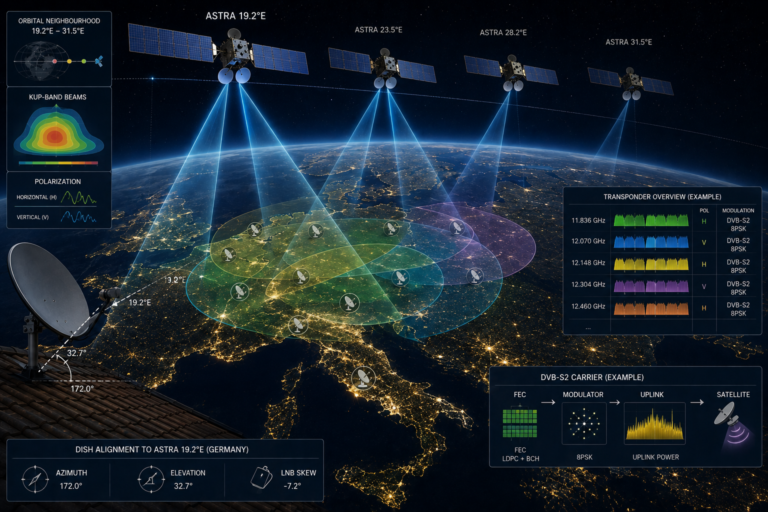
For satellite reception, the live television journey begins with a broadcast uplink and Astra’s geostationary satellite infrastructure at 19.2E.
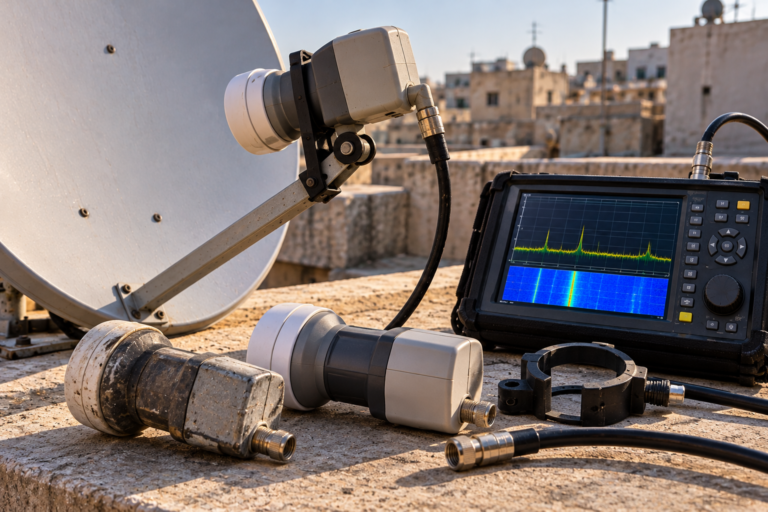
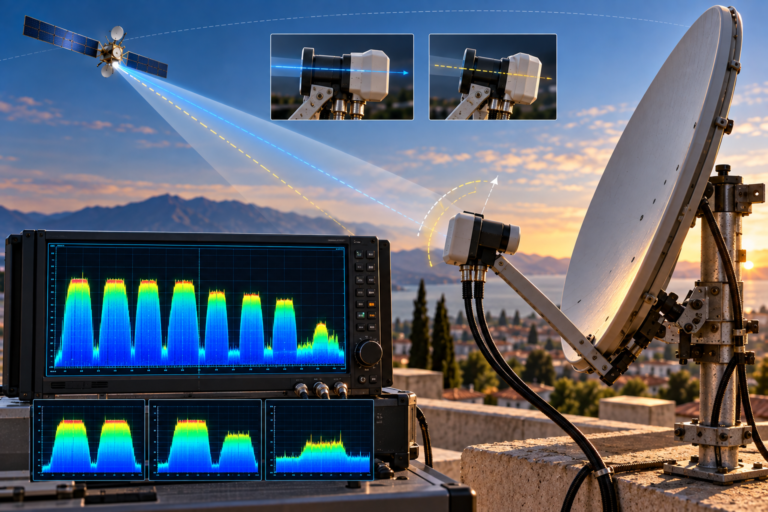
The satellite retransmits DVB-S2 carriers toward its coverage area. A household dish collects the weak Ku-band microwave energy and concentrates it onto the LNB feedhorn.
The LNB amplifies the signal and converts it to a lower intermediate frequency suitable for coaxial cable.
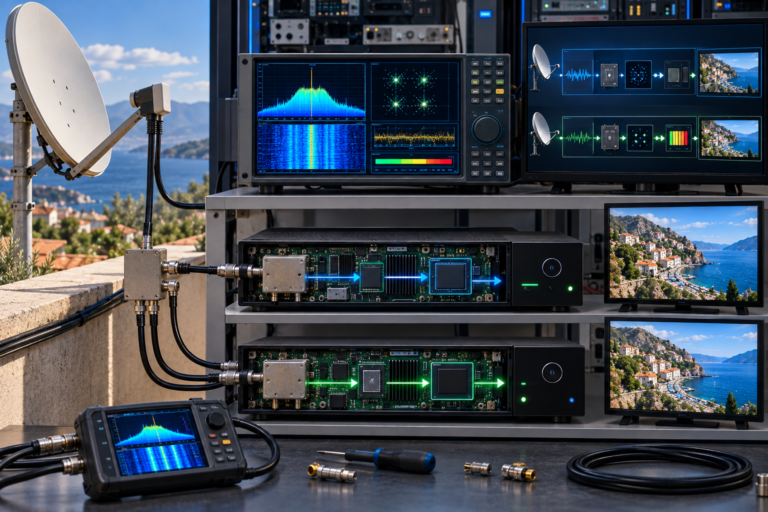
Inside the television or receiver, the tuner selects the required transponder. Carrier and symbol synchronization recover the transmitted modulation, while Forward Error Correction repairs errors introduced during the RF journey.
Only after the DVB-S2 layer has been recovered can the device extract and process the television service carried inside the broadcast data.
Why Astra 19.2E Is Ideal for Linear Television
Linear television sends the same programme to every viewer at approximately the same time.
This is where satellite broadcasting has a major architectural advantage. One satellite carrier can be received simultaneously by a very large number of households without the satellite creating a separate stream for every television.
Whether ten thousand or several million households are watching a major programme, the same RF transmission is already present across the coverage area.
This makes satellite particularly effective for national television channels, live events, and other high-audience linear broadcasts.
What DVB-S2 Does Before the Picture Appears
DVB-S2 is the physical satellite transmission system used to carry digital information through the RF link.
The receiver first has to synchronize with the carrier and identify the transmitted symbol stream. Depending on the transponder configuration, modulation can include QPSK or 8PSK.
The receiver then processes the DVB-S2 Forward Error Correction chain, including LDPC and BCH coding.
MER indicates how accurately the modulation is being received, while BER reveals how many bit errors are occurring.
If MER becomes too low and the resulting BER exceeds the correction capability, the television may pixelate, freeze, or lose the satellite service completely. Internet connectivity does not repair this RF failure because the problem occurs before the linear broadcast has been recovered.
What the Internet Connection Adds
The internet path can add information and content that does not need to be transmitted continuously to every household through the satellite transponder.
A connected television can communicate with online services, request application information, retrieve programme metadata, browse media libraries, and request individual pieces of video content.
This creates a hybrid system in which the viewer can move between a conventional live broadcast and connected television functions without thinking about which physical network is currently carrying the data.
From an engineering perspective, however, the distinction remains important because the two paths can fail independently.
How Restart Works in a Hybrid System
Restart functionality illustrates why the internet complements satellite broadcasting so effectively.
Suppose a viewer switches to a programme that started twenty minutes earlier. The live satellite carrier contains what is being broadcast now. It does not individually send the first twenty minutes again to one household.
A connected television can instead request an available version of the programme from an online service and begin playback from the beginning.
The interface can make this transition feel almost seamless, but technically the delivery method has changed from a one-to-many linear RF broadcast to individually requested IP content.
This is why restart functionality can fail even when the live satellite channel continues working perfectly.
Why Pause Is Different From Satellite Transmission
A satellite cannot stop transmitting a television channel because one viewer presses pause. The same live carrier continues toward every receiving household.
Pause must therefore be implemented at the receiving or connected-service level.
Depending on the platform design, temporary content handling and connected functionality allow the television experience to be stopped and resumed without affecting the underlying satellite transmission.
This distinction demonstrates an important principle of hybrid television: interactive viewing commands happen locally or through IP services while the satellite broadcast itself remains continuous.
| Function | Main Delivery Path | What Happens if That Path Fails |
|---|---|---|
| Linear satellite television | Astra 19.2E and DVB-S2 | Channel may pixelate, freeze, or lose lock |
| Satellite RF synchronization | Dish, LNB, tuner, DVB-S2 decoder | Internet cannot restore the missing RF carrier |
| Media-library access | Internet connection | On-demand content may fail while satellite TV remains available |
| Restart | Hybrid connected function | Live channel can remain working while restart becomes unavailable |
| Application information | Internet | App interface or online data may not load correctly |
| Programme guide enhancements | Can include connected data | Additional information may disappear without affecting RF lock |
How Media Libraries Reach the Television
A media library is fundamentally different from a linear satellite multiplex.
Instead of transmitting every available programme continuously over Astra, the service keeps content available for individual retrieval.
When the viewer selects an item, the television requests the relevant data through its internet connection.
This allows an enormous catalogue to exist without consuming continuous satellite transponder capacity for every programme.
HD+ stated when launching HD+ Free on May 21, 2026 that the platform provided access to around 80,000 media-library items alongside satellite television on compatible Smart TVs. The same launch highlighted pause and restart functions as part of the hybrid experience. Information about the current offer is available directly from the official HD+ announcement.
Why the HD+ TV-App Needs Connectivity
The HD+ TV-App is more than a simple graphical replacement for a satellite channel list.
On supported television configurations, it integrates satellite reception with connected platform functions. The application can provide navigation, connected content, interactive functionality, and service processing around the linear television experience.
HD+ support documentation for compatible satellite Smart TVs specifies both Astra 19.2E satellite reception and a persistent internet connection as requirements for use of the HD+ TV-App.
This does not mean that the internet has somehow replaced the satellite RF carrier. It means that the application environment and satellite receiver are working together inside the television.
What HD+ Free Changed in 2026
HD+ expanded its hybrid strategy significantly in May 2026 with the introduction of HD+ Free.
The offer was designed for compatible Smart TVs in satellite households using the HD+ TV-App. HD+ described it as combining free television reception through Astra satellite with the capabilities of a modern hybrid television platform.
The launch included a broad channel environment, access to around 80,000 media-library items, restart and pause functions for many channels, and an integrated electronic programme guide.
From an engineering perspective, the significance is not simply the addition of more content. It demonstrates how a satellite platform can retain the efficiency of broadcast RF while layering IP-based interaction and on-demand delivery on top.
Why Satellite Does Not Buffer Like Internet Video
The word buffering is often used loosely, but satellite and internet delivery behave differently.
A DVB-S2 satellite carrier arrives continuously at the receiving antenna. Once the receiver is synchronized, transport data flows continuously at the rate defined by the transponder.
There is no broadband server deciding whether enough network capacity exists to send the next few seconds of the live satellite carrier to your household.
If satellite RF quality becomes too poor, the usual symptoms are rising BER, macroblocking, freezing, and loss of synchronization rather than the familiar loading circle associated with an internet video stream.
The receiver still uses internal buffers for decoding and timing, but these are not the same as network buffering caused by varying internet throughput.
How Internet Buffering Is Different
Internet video normally arrives as data through a packet-switched network whose available throughput can change over time.
The player stores a portion of upcoming content in memory so short network variations do not immediately interrupt playback.
If data arrives more slowly than it is consumed, the buffer eventually becomes empty. Playback can pause while the application waits for additional content.
Adaptive streaming systems may also reduce video bitrate when available bandwidth falls.
These behaviours are completely different from a DVB-S2 carrier crossing its RF decoding threshold.
Ethernet Versus Wi-Fi for Connected Functions
Both Ethernet and Wi-Fi can provide the broadband connection required by connected television functions, but their physical behavior differs.
Ethernet uses a wired link and is normally isolated from radio interference, walls, channel congestion, and changing wireless signal conditions.
Wi-Fi can provide excellent performance when coverage is strong, but throughput and latency can change with distance, interference, router placement, neighbouring networks, and building construction.
For media-library playback and other high-data-rate connected functions, a stable network path helps maintain consistent delivery.
This has no direct effect on the MER or BER of the Astra satellite carrier. Network stability and satellite RF quality are separate measurements.
What Happens When the Internet Fails
The visible result depends on which HD+ function the viewer is using.
Connected media libraries may stop loading. Restart functions may become unavailable. Application data can fail to refresh, and other online features may report a network error.
The DVB-S2 satellite signal itself can remain completely healthy because it reaches the television through the dish, LNB, and coaxial cable rather than through the router.
This separation is one of the most useful troubleshooting clues. If normal live satellite reception has healthy signal quality while only connected features fail, adjusting the dish is unlikely to solve the problem.
What Happens When the Satellite Signal Fails
A satellite failure produces a different chain of symptoms.
Rain attenuation, poor alignment, LNB faults, cable problems, or interference can reduce MER and increase BER.
Forward Error Correction initially hides many errors. Once the available signal margin becomes too small, the live channel can pixelate or freeze.
If synchronization is lost completely, the receiver can no longer recover the DVB-S2 transponder.
A fast internet connection cannot compensate for this RF failure unless the specific television service is separately available through an IP delivery mode and the platform intentionally switches to it. Satellite lock itself must still be repaired through the RF receiving system.
How to Diagnose Hybrid HD+ Problems
Start by asking whether normal live satellite channels are working.
If live channels show zero quality, pixelation, or loss of lock, investigate the dish, LNB, cabling, switches, BER, MER, and satellite signal margin.
If live satellite reception is stable but media-library content, restart, or another connected feature fails, test the television’s internet connection instead.
Check whether the TV has a valid network address, whether other internet applications work, and whether Ethernet or Wi-Fi is stable.
If both paths appear healthy but the HD+ interface behaves incorrectly, software, application state, compatibility, or service configuration becomes more likely.
This layered diagnosis is also useful when individual HD+ services fail. Our guide to why HD+ channels sometimes stop working explains how RF reception, DVB-S2 decoding, service authorization, device compatibility, software, and connected features can produce different symptoms.
HD+ should not be described as either purely satellite television or purely internet television when discussing its modern hybrid functions.
The satellite and broadband paths can coexist inside the same television experience while carrying different types of data. Linear television can depend on Astra RF reception while connected functions depend on IP connectivity.
The exact behaviour also depends on the compatible television, HD+ product, software version, and feature being used. A network connection should not be assumed to repair a satellite signal fault, and a perfect satellite signal should not be assumed to guarantee every online feature.
HD+ combines satellite and internet because the two technologies solve different broadcast problems efficiently.
Astra 19.2E provides a powerful one-to-many path for linear television. One DVB-S2 carrier can reach a very large number of German satellite households simultaneously without creating a separate RF stream for every viewer.
Internet connectivity adds the two-way and on-demand functions that broadcast satellite was never designed to provide individually. Media libraries, restart, connected programme information, app services, and other interactive functions can therefore sit alongside the satellite television signal.
The result is a hybrid architecture rather than one technology replacing the other. For troubleshooting, the key is always to identify which path the failed function uses. MER, BER, dish alignment, LNB performance, and signal margin belong to the satellite side. Broadband throughput, Wi-Fi or Ethernet stability, application connectivity, and online content delivery belong to the IP side.
| Question | Answer |
|---|---|
| Does HD+ use satellite or internet? | Modern HD+ solutions can use both. Astra satellite provides linear television while internet connectivity supports connected and on-demand functions. |
| What does Astra 19.2E deliver? | It provides the RF path for a large part of the German linear satellite television ecosystem, including HD+ related television services. |
| Why does the HD+ TV-App need internet connectivity? | The app integrates connected platform functions, online content, metadata, and interactive services with the satellite television environment. |
| Does restart come directly from the live satellite carrier? | The live carrier continues broadcasting the current programme. Hybrid restart functionality can retrieve an available earlier programme position through connected platform infrastructure. |
| Can satellite TV work when the internet is down? | The satellite RF path is physically independent of broadband, although specific HD+ application functions or receiving configurations may require internet connectivity to operate fully. |
| Can internet features work if my dish has poor reception? | Some connected functions may still have network connectivity, but broadband cannot restore a DVB-S2 carrier lost because of an RF reception problem. |
| Why does satellite TV not show normal internet buffering? | A DVB-S2 carrier is continuously broadcast. Poor RF reception produces errors and synchronization loss rather than network throughput buffering. |
| Does a satellite receiver use buffers? | Yes. Receivers use memory for transport timing and media decoding, but these buffers perform a different job from internet streaming buffers. |
| Is Ethernet better than Wi-Fi for HD+ connected features? | Ethernet usually provides a more predictable wired connection, while good Wi-Fi can also work well. Neither changes the RF quality of the Astra signal. |
| What is HD+ Free? | HD+ Free launched in May 2026 for compatible satellite Smart TVs using the HD+ TV-App, combining satellite television with media-library access and connected convenience functions. |
| Why can restart fail while live TV keeps working? | The live channel can be arriving through satellite while restart depends on the connected platform and internet path. |
| What should I check first when an HD+ function fails? | Identify whether the failed function depends primarily on satellite reception or internet connectivity, then troubleshoot that path before changing unrelated equipment. |