Why Some Astra Frequencies Need Better Alignment
You align your dish to Astra 19.2E and one transponder immediately shows excellent quality. Several others work perfectly too. Then you test another frequency and its quality is noticeably lower, unstable in bad weather or completely missing. Does that frequency need the dish pointed somewhere else?
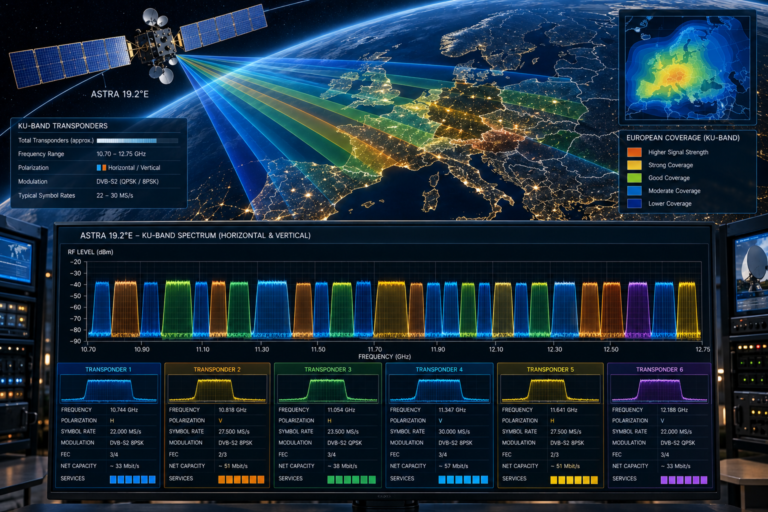
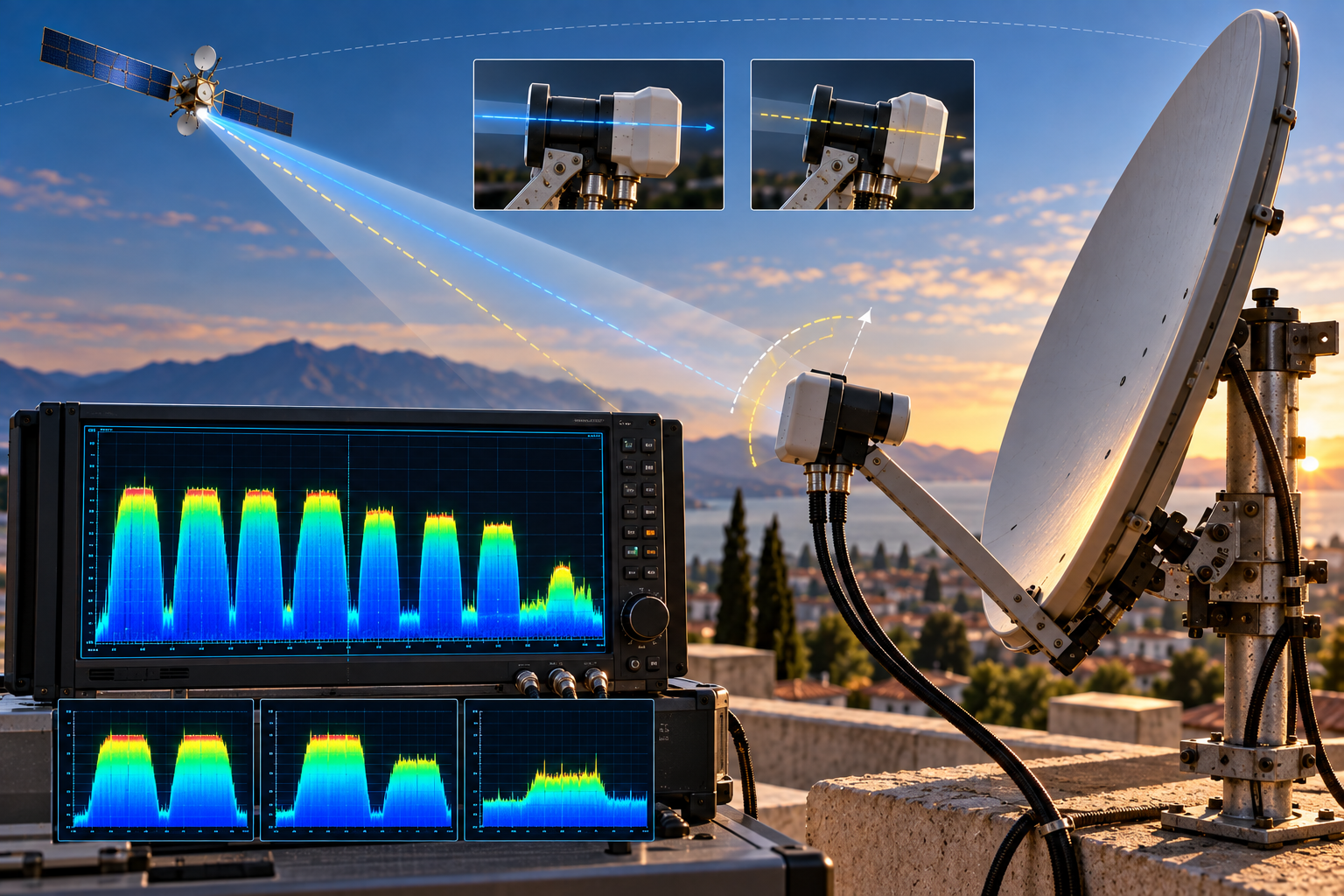
Usually, no. Astra frequencies from the same orbital neighbourhood are not individually aligned by moving the dish for every transponder. What changes is the reception margin. A small pointing error that remains invisible on a strong carrier can become obvious on a lower-margin one. This is why the transponder you use for alignment can make a major difference to the final quality of the installation.
A strong Astra carrier can hide a small dish alignment error. If another carrier has less usable margin, the same pointing error may push it much closer to the digital decoding threshold. The weaker carrier is not necessarily coming from a different direction. It may simply be revealing a problem the stronger carrier can tolerate.
- Do Different Astra Frequencies Need Different Dish Angles?
- Why a Strong Transponder Can Hide Bad Alignment
- What Reception Margin Really Means
- Dish Beamwidth Changes the Result
- Frequency Can Still Affect Reception
- Polarization Can Make the Difference Look Larger
- DVB-S2, Modulation and FEC Matter Too
- Your LNB Is Not Identical Across Every Frequency
- Cable Loss Is Frequency Dependent
- Why Receiver Signal Bars Can Mislead You
- Should You Align Using the Weakest Transponder?
- A Better Way to Fine-Tune Astra 19.2E
- Why Rain Reveals Alignment Errors
- Reality Check
- Final Verdict
- FAQ
Do Different Astra Frequencies Need Different Dish Angles?
This is the most important misconception to correct.
If one Astra transponder peaks at a high receiver reading while another appears weaker, it is tempting to assume that the second frequency needs a slightly different dish direction.
That is generally the wrong interpretation.
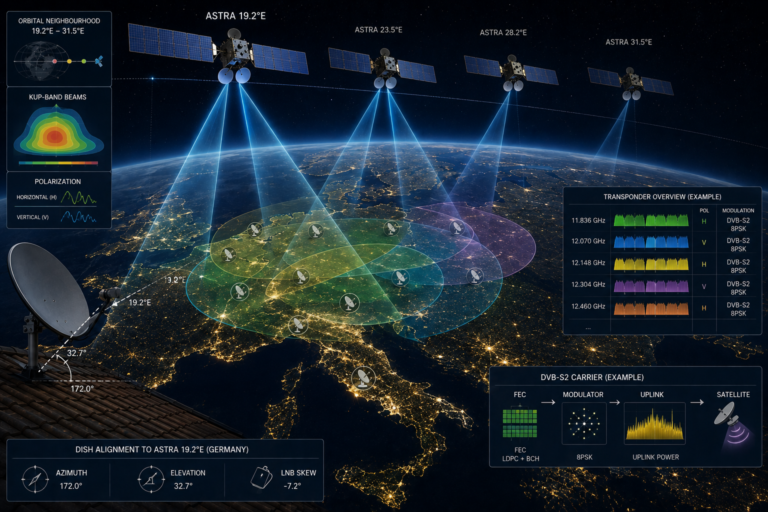
A satellite dish is aimed toward an orbital position, not individually toward each television frequency.
Astra 19.2E is an orbital neighbourhood containing colocated satellite capacity. To a normal home receiving antenna, satellites operating at that nominal orbital position appear in essentially the same direction.
You should therefore not move the dish every time you change frequency.
If different transponders show different quality, investigate the available link margin and the complete reception chain.
The difference may involve carrier conditions, polarization, modulation, LNB response, cable loss or a small general pointing error that affects lower-margin signals first.
Why a Strong Transponder Can Hide Bad Alignment
Imagine the ideal dish position as the centre of the antenna’s reception beam.
If the reflector is moved slightly away from that optimum direction, antenna gain toward the satellite decreases.
But digital television does not immediately disappear.
A carrier with substantial reception margin can tolerate the loss and continue producing a perfect picture.
You may even see a high quality reading on the receiver.
This creates a dangerous assumption:
“This transponder is perfect, so the dish must be perfectly aligned.”
Not necessarily.
Switch to a carrier with less margin and the hidden pointing error becomes visible. Quality may fall sharply, BER can increase and bad weather may cause pixelation much earlier.
| Dish Condition | High-Margin Carrier | Lower-Margin Carrier |
|---|---|---|
| Correctly peaked | Stable | Stable with useful reserve |
| Slightly off peak | May still look perfect | Quality noticeably reduced |
| Further off peak | May still lock | Pixelation or intermittent lock |
| Insufficient margin | May become unstable | No reliable lock |
What Reception Margin Really Means
A digital carrier needs sufficient signal quality for the receiver’s demodulator and forward error correction system to recover the transmitted data reliably.
There is therefore an important difference between working and working with margin.
A carrier can decode perfectly while sitting only slightly above its failure threshold.
The viewer sees a clean picture and assumes reception is excellent.
Then rain arrives, the dish moves slightly in the wind, the LNB temperature changes or a small additional loss appears in the cable.
The remaining margin disappears and the carrier suddenly breaks up.
Another transponder with greater margin remains completely unaffected.
This behaviour is one of the defining characteristics of digital satellite reception. Picture quality does not gradually become snowy as margin falls. Error correction can maintain a clean digital picture until the system approaches the digital cliff.
Dish Beamwidth Changes the Result
Satellite dishes are directional antennas.
Their ability to reject signals away from the intended direction is one reason they can receive a specific geostationary orbital position.
Dish diameter and operating frequency influence beamwidth.
In general, a larger reflector provides more gain but also produces a narrower main beam at a given frequency.
That creates an interesting tradeoff.
A larger dish can provide greater reception margin when correctly aligned, but its narrower beam also makes accurate pointing more important.
This is why upgrading from a small reflector to a larger one does not remove the need for careful alignment.
A poorly peaked large dish can waste part of the additional gain you expected to gain from its larger aperture.
Bigger does not mean easier to align. A larger dish can improve link margin, but the narrower beam can make small pointing errors more significant.
Frequency Can Still Affect Reception
Saying that Astra frequencies do not normally require separate pointing does not mean frequency has no effect on reception.
Antenna behaviour changes with wavelength. LNB gain and noise performance are not perfectly flat across the entire operating range. Coaxial cable attenuation also changes with frequency.
Therefore, two transponders can produce different measurements even when they arrive from essentially the same direction.
The correct conclusion is not:
“This frequency comes from a different angle.”
The better question is:
“Why does this carrier have less usable margin through my complete reception system?”
That distinction prevents unnecessary dish movement and leads to much more accurate troubleshooting.
Polarization Can Make the Difference Look Larger
Before blaming alignment, compare the polarization of the strong and weak transponders.
If the strongest carriers are mostly horizontal while the weak carriers are vertical, or the opposite, you may not have a pure alignment problem.
LNB skew can reduce polarization isolation when it is poorly adjusted.
Receiver voltage, cable resistance, LNB switching or multiswitch problems can also create polarization-specific faults.
A useful test is therefore to compare carriers across both horizontal and vertical polarization rather than selecting frequencies randomly.
If one complete polarization consistently underperforms, investigate that pattern separately.
This is covered in more detail in Why Astra 19.2E Signal Drops on One Polarization.
DVB-S2, Modulation and FEC Matter Too
Two Astra transponders can use different physical-layer configurations.
One may use DVB-S with QPSK while another may use DVB-S2 and a different modulation and coding configuration.
Even two DVB-S2 carriers do not necessarily have identical decoding requirements.
Modulation and forward error correction determine how efficiently data can be transmitted and how much signal quality the receiver needs for reliable recovery.
DVB-S2 uses LDPC and BCH forward error correction, allowing the receiver to correct substantial transmission errors before they reach the television picture.
However, every modulation and coding combination has practical reception requirements.
This means a transponder can expose a marginal dish setup earlier than another even though both are being received from Astra 19.2E.
It is also why saying that “HD frequencies need better alignment” is technically inaccurate.
HD resolution itself does not determine the RF threshold. The physical transmission parameters carrying those services do.
Your LNB Is Not Identical Across Every Frequency
A universal LNB operates across a wide range of Ku-band frequencies.
Its gain, noise performance and frequency-conversion behaviour are designed to work across that range, but real hardware is never mathematically identical at every point.
An ageing or low-quality LNB can make frequency-dependent differences more visible.
Local oscillator stability also matters because the receiver needs to acquire the downconverted carrier correctly.
A marginal LNB can therefore contribute to a situation where most Astra frequencies work but a particular part of the spectrum becomes troublesome.
This does not mean the LNB should automatically be replaced whenever one frequency is weak.
Instead, look for a pattern across multiple carriers.
If performance gradually worsens across one frequency region, or the behaviour changes strongly with temperature, the LNB becomes more interesting diagnostically.
Cable Loss Is Frequency Dependent
The coaxial cable between the LNB and receiver is another reason different transponders can behave differently.
The LNB converts the received Ku-band signal to a lower intermediate-frequency range for transport through the coax.
Cable attenuation generally increases as frequency rises.
With a short, high-quality cable run, the difference may be relatively unimportant.
With a long cable, multiple connectors, wall outlets, splitters or distribution equipment, frequency-dependent loss can become more noticeable.
Water-damaged coax can make the behaviour much worse.
This can create an apparent “weak Astra frequency” even when dish alignment is not the only problem.
If several troublesome transponders occupy a similar part of the receiver’s IF range, inspect the cable and distribution path as well as the dish and LNB.
Why Receiver Signal Bars Can Mislead You
Many users align dishes by maximizing the receiver’s signal-strength percentage.
This is convenient but technically limited.
Consumer receiver percentages are not standardized measurements. One receiver may show 95% while another shows 78% on the same cable and carrier.
Signal strength can also remain high while digital quality is poor.
For alignment, the important question is not simply how much RF energy reaches the tuner. It is how cleanly the wanted carrier can be demodulated.
MER is particularly useful because it describes modulation quality. BER provides additional information about transmission errors, although the measurement point relative to FEC must be understood.
This is why signal quality matters more than signal strength when fine-tuning an Astra dish.
Should You Align Using the Weakest Transponder?
Using only the strongest carrier is not ideal, but blindly choosing the weakest carrier is not always the correct solution either.
An unusually weak transponder could be affected by something other than dish pointing.
It may use a different polarization, sit in a frequency range affected by the LNB or cable, or simply have different received conditions at your location.
A better strategy is to use several representative transponders.
Choose carriers across different parts of the spectrum and, where practical, across both polarizations.
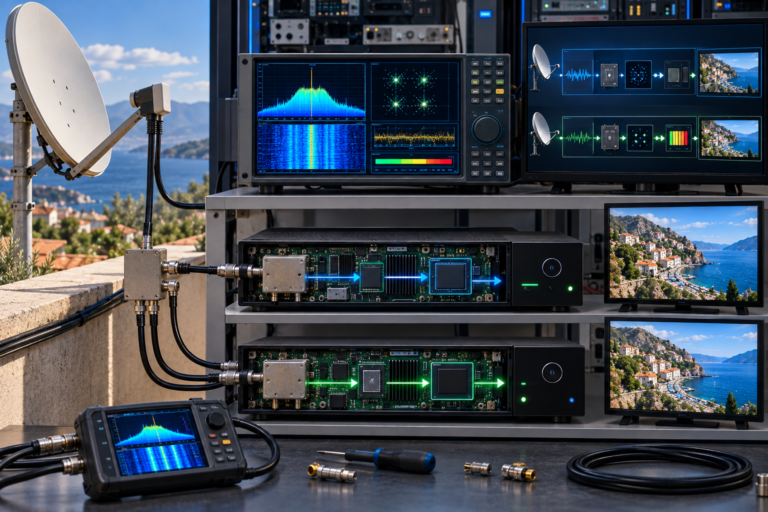
First obtain reliable lock on a suitable reference carrier. Then fine-tune azimuth and elevation while checking whether the adjustment improves the overall group rather than just one frequency.
This helps avoid optimizing the complete antenna around an abnormal single result.
A Better Way to Fine-Tune Astra 19.2E
Good alignment is a controlled measurement process, not repeated random movement.
1. Confirm that you are actually receiving Astra 19.2E using a known active carrier.
2. Select several representative transponders rather than one unusually strong signal.
3. Record their starting quality or MER values.
4. Move azimuth slightly in one direction and allow the receiver or meter time to settle.
5. Identify both sides of the quality peak, then place the dish near the centre of the best region.
6. Repeat the process for elevation.
7. Fine-tune LNB skew while watching quality, especially on polarization-sensitive carriers.
8. Recheck all representative transponders.
9. Tighten mounting bolts carefully while monitoring quality so the reflector does not move.
10. Perform a final cross-check across different frequencies and polarizations.
This approach gives the installation balanced margin instead of simply producing an impressive percentage on one strong transponder.
Why Rain Reveals Alignment Errors
A dish can appear perfectly adequate in clear weather while having very little reserve margin.
Rain introduces additional attenuation into Ku-band satellite links.
If the antenna is slightly off peak, part of the available margin has already been lost before the weather changes.
The lower-margin Astra transponder then reaches its decoding threshold sooner.
A stronger carrier may continue working normally.
This is why a user can report that only certain frequencies disappear in rain.
The rain is real, but it may be exposing an installation that was already marginal.
Fine alignment, correct skew, appropriate dish size and a healthy low-loss signal path all contribute to the margin available before rain fade becomes visible.
Reality Check
A weak Astra frequency does not normally mean you should point the dish in a different direction for that frequency.
Carriers associated with the same 19.2E orbital neighbourhood are received from essentially the same direction by a normal domestic antenna. Different readings usually reflect differences in carrier margin, transmission configuration, polarization, LNB response, cable loss or other parts of the RF chain.
A small general alignment error can still be responsible. The important distinction is that the lower-margin carrier is revealing the pointing error rather than requiring its own unique dish position.
If improving alignment raises quality across several representative carriers, you have increased overall system margin. If only one narrow group remains abnormal, investigate the LNB, polarization and distribution path before moving the reflector again.
Final Verdict
Some Astra frequencies appear to need better alignment because they expose weaknesses that stronger carriers can hide.
A dish can be slightly off peak while strong transponders continue to decode perfectly. Switch to a lower-margin carrier and the same alignment error may suddenly become obvious.
But alignment is only part of the diagnosis. Frequency-dependent cable loss, LNB performance, polarization, modulation and coding can also create large differences between transponders.
The best approach is therefore not to chase every weak frequency by moving the dish. Confirm Astra 19.2E, compare several representative carriers, optimize azimuth and elevation around the real quality peak, fine-tune LNB skew and then check whether the improvement is consistent across the system.
A well-aligned dish is not the one that produces the highest percentage on the strongest Astra transponder. It is the one that provides useful reception margin across the carriers you actually need.
Frequently Asked Questions
| Question | Answer |
|---|---|
| Why are some Astra 19.2E frequencies weaker than others? | Different carriers can have different reception margins and transmission configurations. LNB response, polarization, cable loss and local reception conditions can also create differences. |
| Do I need to move my dish for each Astra frequency? | No. Astra carriers from the same orbital neighbourhood are not normally individually aimed. The dish should be optimized toward the orbital position while maintaining good quality across representative carriers. |
| Can a strong transponder hide bad dish alignment? | Yes. A high-margin carrier may remain stable despite a small pointing error, while a lower-margin carrier reveals the lost antenna gain. |
| Should I align Astra using the strongest transponder? | Do not rely on the strongest carrier alone. Use several representative transponders and compare quality across frequencies and polarizations. |
| Should I use the weakest Astra frequency for alignment? | Not automatically. An unusually weak carrier may be affected by polarization, LNB response or cable loss. Use a group of representative carriers instead. |
| Does a larger dish need more accurate alignment? | Generally, a larger reflector has a narrower beam at the same frequency. It can provide more gain when correctly aligned but can also make pointing accuracy more important. |
| Can my LNB make only some frequencies weak? | Yes. LNB performance is not perfectly identical across its entire operating range, and ageing or faults can make frequency-dependent differences more noticeable. |
| Can coaxial cable affect some Astra frequencies more? | Yes. Cable attenuation varies with frequency. Long, poor-quality or water-damaged cable can make frequency-dependent losses more significant. |
| Why do weak Astra frequencies disappear first in rain? | They may have less reception margin before the rain begins. Additional atmospheric attenuation then pushes them below the decoding threshold sooner. |
| What is better for alignment: strength or quality? | Digital quality is more useful than an arbitrary strength percentage. Professional measurements such as MER and BER provide even better information about the usable carrier. |