Why Astra Uses Multiple Transponders
Estimated Reading Time: 12 minutes
Astra does not transmit all of its television services through one enormous carrier. Instead, the available satellite spectrum is divided across many transponders, each operating as a separate RF path with its own frequency, polarization, bandwidth, symbol rate, modulation, coding, power allocation, and multiplex of services. This is one of the main reasons Astra 19.2E can support such a large number of television and radio channels.
Using multiple transponders allows satellite operators and broadcasters to divide capacity into manageable blocks. One transponder may carry a group of public HD channels, another may carry commercial services, and another may be configured for a different symbol rate or DVB-S2 mode. The system is therefore modular rather than monolithic, which improves flexibility, spectrum use, traffic management, and fault isolation.
A satellite transponder is not the same thing as one television channel. One transponder usually carries a digital multiplex containing several channels and services. Astra uses many transponders because each RF carrier can be engineered independently for different broadcasters, capacities, frequencies, polarizations, and transmission standards.
- What a Satellite Transponder Is
- Why One Transponder Is Not Enough
- How Astra Divides Satellite Spectrum
- Why Frequency Separation Matters
- How Polarization Doubles Spectrum Efficiency
- How One Transponder Carries Many Channels
- Why Different Transponders Use Different Symbol Rates
- Why DVB-S and DVB-S2 Can Coexist
- How Modulation and FEC Change Capacity
- Why Broadcasters Lease Separate Capacity
- Why Different Transponders Can Have Different Reception Quality
- How Power Is Shared Across the Satellite Payload
- Why One Transponder Failure Does Not Kill Everything
- How Multiple Satellites Can Share Astra 19.2E
- Why Channel Groups Often Fail Together
- How to Troubleshoot a Transponder Problem
- Reality Check
- Final Verdict
- FAQ
What a Satellite Transponder Is
A satellite transponder is part of the spacecraft payload that receives an uplinked RF signal, processes or frequency-translates it, amplifies it, and retransmits it back toward Earth.
In a conventional bent-pipe satellite architecture, the spacecraft does not need to understand the television programme itself. It mainly handles RF energy.
The uplink from the ground station reaches the satellite at one frequency range. The payload then converts that signal to a downlink frequency and sends it toward the target coverage region.
In digital television, that downlink carrier normally contains a complete multiplex rather than a single television service.
Why One Transponder Is Not Enough
One carrier has limited RF bandwidth and limited useful data capacity.
Even with efficient DVB-S2 modulation and video compression, it cannot carry every television and radio service required across a major European television platform.
Trying to place everything into one carrier would also create major operational problems.
All broadcasters would have to share one physical configuration, one symbol rate, one modulation system, one coding profile, and one capacity pool.
A single technical fault could potentially affect an enormous number of services at the same time.
Multiple transponders avoid this by splitting the system into independent capacity blocks.
How Astra Divides Satellite Spectrum
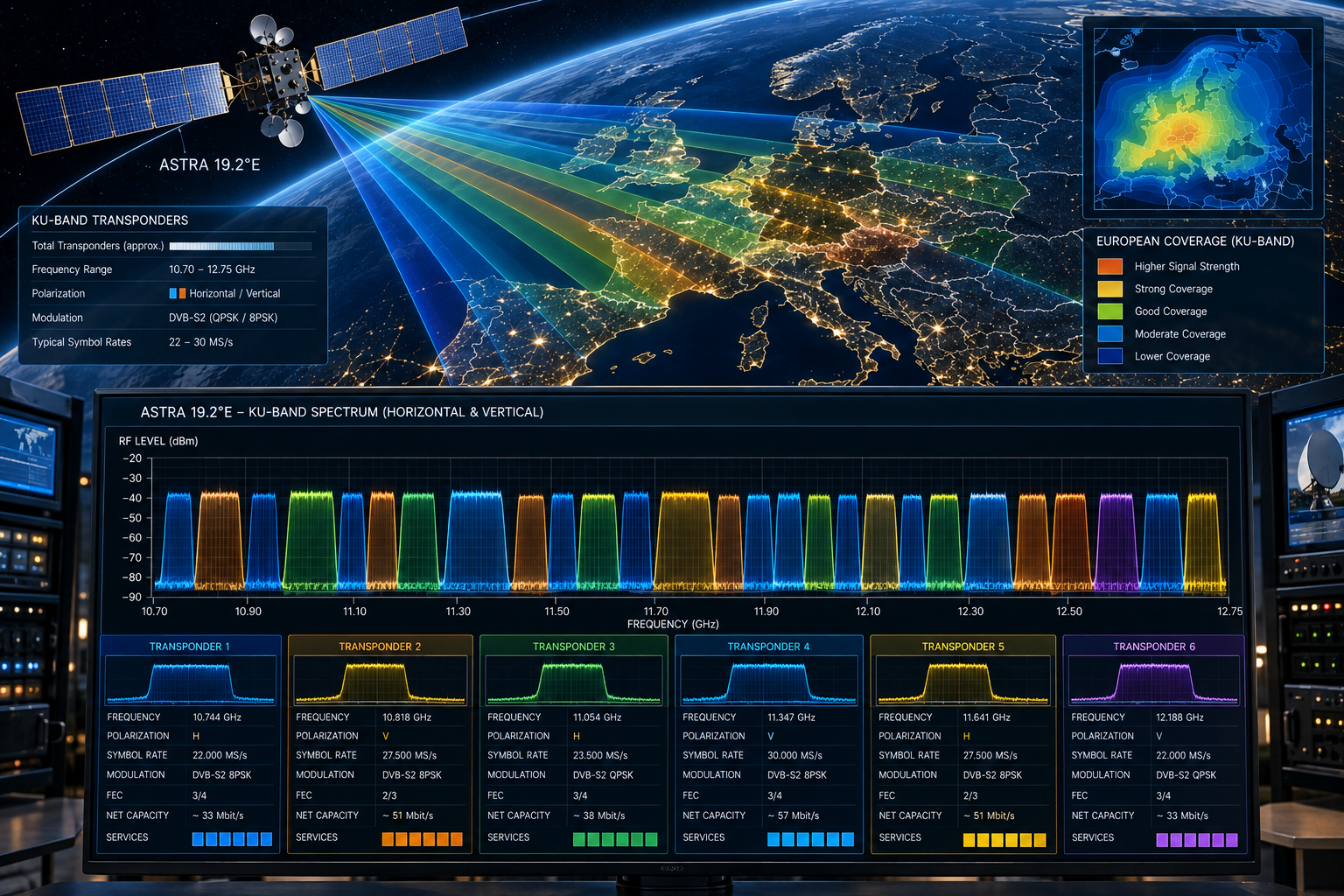
The Ku-band spectrum used for direct-to-home television is divided into many frequency slots.
Each transponder or digital carrier occupies part of that available bandwidth.
Operators can then assign these capacity blocks to broadcasters or platform operators.
One transponder might be configured with a 22000 ksym/s symbol rate, while another could use 27500 or another suitable value.
Different carriers can also use different modulation and FEC combinations.
This allows Astra to support a large mixture of services without forcing every broadcaster into one identical engineering configuration.
| Parameter | Why It Can Differ Between Transponders |
|---|---|
| Frequency | Each transponder occupies a separate part of the satellite RF spectrum. |
| Polarization | Horizontal and vertical polarization allow additional frequency reuse. |
| Symbol Rate | Chosen according to carrier bandwidth and capacity requirements. |
| Modulation | QPSK or 8PSK may be selected depending on required efficiency and reception margin. |
| FEC | Different coding rates trade payload capacity against robustness. |
| DVB Standard | Legacy DVB-S and newer DVB-S2 services can coexist. |
| Service Mix | Different multiplexes can contain different television, radio, and data services. |
| Power Allocation | Payload resources can be managed according to operational requirements. |
Why Frequency Separation Matters
Two carriers cannot occupy the same frequency, polarization, and coverage region without interfering unless a more advanced frequency-reuse architecture is used.
Astra therefore separates carriers in frequency so receivers can isolate one transponder from its neighbours.
Each carrier occupies a finite amount of bandwidth determined partly by symbol rate and roll-off filtering.
Enough spectral planning is required so adjacent carriers do not overlap excessively.
This is why transponder frequencies are carefully coordinated rather than chosen randomly.
How Polarization Doubles Spectrum Efficiency
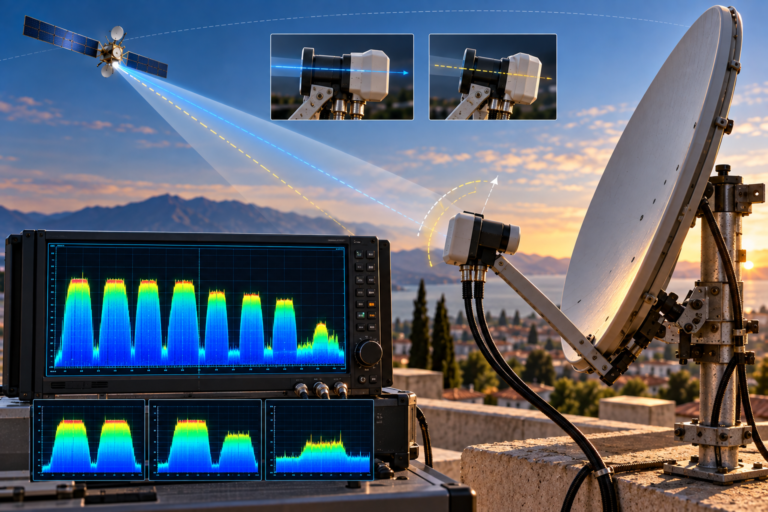
Satellite systems commonly use horizontal and vertical polarization as another way to reuse spectrum.
Two carriers can operate at similar or even corresponding frequency regions if they use orthogonal polarization and sufficient isolation.
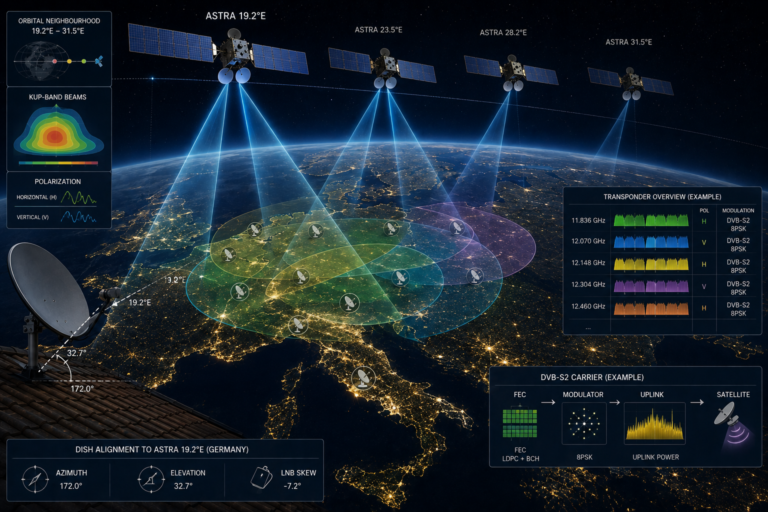
At the receiver, the LNB selects polarization according to the control voltage supplied by the receiver.
Typically, one voltage range selects vertical polarization and another selects horizontal polarization.
This effectively allows the satellite system to use the available frequency range more efficiently.
Good LNB skew is important because poor polarization alignment reduces isolation and can allow unwanted energy from the opposite polarization to degrade MER.
How One Transponder Carries Many Channels
A digital satellite transponder normally carries an MPEG transport stream or another structured digital multiplex.
Inside that multiplex are several programme services.
Each television channel has its own video, audio, subtitles, service information, and related data, but all of them share the same physical satellite carrier.
This is why several channels can disappear at the same time when one transponder fails.
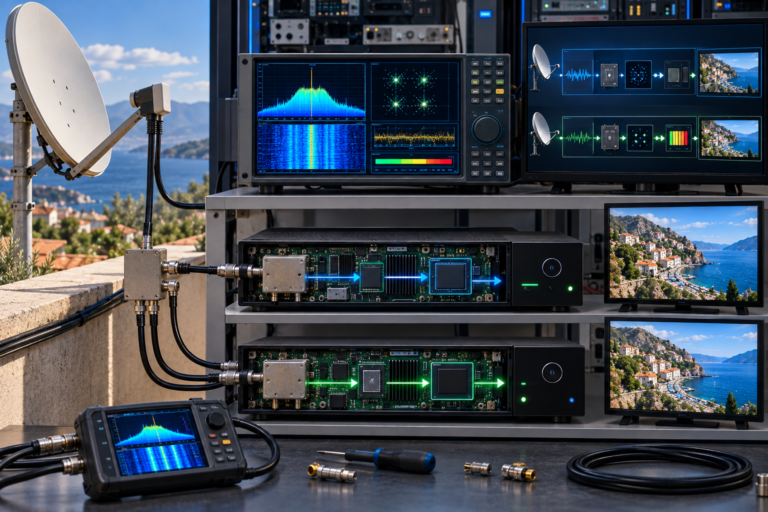
From the receiver’s point of view, the RF carrier must first be locked and demodulated. Only then can the receiver separate the individual services contained inside the transport stream.
Why Different Transponders Use Different Symbol Rates
Symbol rate describes how many modulation symbols are transmitted every second.
Different transponders can use different symbol rates because they may have different available bandwidths and different capacity requirements.
A higher symbol rate generally occupies more RF bandwidth when the roll-off factor is comparable.
But it does not automatically mean better picture quality or stronger signal.
A 22000 ksym/s DVB-S2 8PSK carrier can potentially transport a large amount of useful data, while a 27500 ksym/s legacy DVB-S QPSK carrier may be less spectrally efficient depending on the coding configuration.
The symbol rate is therefore part of the transponder design, not a quality score.
Why DVB-S and DVB-S2 Can Coexist
Satellite networks evolve over time.
Older transponders may have been created when DVB-S and QPSK were the normal standard for digital satellite television.
Newer services often use DVB-S2 because it provides more efficient modulation, stronger Forward Error Correction, and greater flexibility.
There is no requirement to migrate every carrier at the same moment.
Operators can therefore run DVB-S and DVB-S2 transponders side by side during long transition periods.
This modularity is another major advantage of having multiple independent transponders.
How Modulation and FEC Change Capacity
The useful data capacity of a transponder depends on more than its symbol rate.
QPSK represents two raw bits per symbol, while 8PSK represents three before coding overhead is considered.
Forward Error Correction then adds redundancy so the receiver can reconstruct damaged data.
A stronger coding scheme improves robustness but reduces the proportion of transmitted data available for television payload.
The operator therefore chooses a complete modulation and coding combination, often called the MODCOD, based on the desired balance between capacity and reception reliability.
Why Broadcasters Lease Separate Capacity
Satellite capacity is a commercial resource as well as an engineering resource.
Broadcasters and platform operators can lease transponder capacity according to their distribution needs.
One broadcaster may require enough capacity for several HD channels. Another may operate a larger multiplex containing many television and radio services.
Using separate transponders lets each customer manage its own encoding, service lineup, bitrate allocation, statistical multiplexing, and transmission parameters within the contracted capacity.
This would be much more difficult if all services had to share one giant carrier.
Why Different Transponders Can Have Different Reception Quality
Not every Astra transponder produces identical reception conditions at the same home.
Different carriers can use different frequencies, polarizations, symbol rates, modulation, FEC, payload paths, and possibly different colocated spacecraft.
The domestic receiving system can also behave differently across frequency.
LNB gain, coaxial loss, multiswitch performance, and interference can all vary across the band.
This is why one channel group may be perfectly stable while another group from the same orbital position experiences lower MER or more frequent errors.
How Power Is Shared Across the Satellite Payload
A communications satellite has finite electrical and RF amplifier resources.
Payload engineering therefore includes careful power management.
Each transponder must operate within limits that protect linearity, efficiency, and the overall performance of the satellite.
Amplifier back-off can be important when multiple carriers share high-power amplification resources because excessive operation near saturation can create distortion and intermodulation.
The exact payload architecture varies between spacecraft, but the general principle remains the same: many transponders share finite satellite power and spectrum resources.
Why One Transponder Failure Does Not Kill Everything
Multiple transponders provide useful fault isolation.
If one RF chain develops a problem, the effect may be limited to the services using that capacity rather than the entire satellite platform.
Modern communications satellites also include redundancy in key payload and spacecraft systems.
Operators may be able to switch to backup hardware, reconfigure routing, or move traffic depending on the satellite design and operational situation.
This does not mean every failure can be corrected without interruption, but modular architecture reduces the risk of a single fault disabling the entire television neighbourhood.
How Multiple Satellites Can Share Astra 19.2E
Astra 19.2E is an orbital neighbourhood rather than one single spacecraft.
Multiple satellites can be colocated close enough to the same nominal geostationary longitude that a normal domestic dish sees them as one orbital position.
This allows SES to distribute transponders across different spacecraft while maintaining one stable reception direction for viewers.
It also supports fleet replacement and long-term continuity.
A new satellite can be introduced at the same orbital neighbourhood while older capacity is gradually transferred or replaced.
For viewers, the dish does not normally need to move because the new spacecraft occupies essentially the same pointing direction.
Why Channel Groups Often Fail Together
If several channels disappear simultaneously, one of the first questions should be whether they share the same transponder.
Channels on one multiplex depend on the same physical RF carrier.
If that carrier cannot be demodulated, every service inside it becomes unavailable.
Possible causes include poor reception on that frequency, polarization switching problems, incorrect symbol rate, transponder maintenance, an uplink problem, or an issue inside the distribution network.
This grouping behaviour is one of the most useful diagnostic clues in satellite troubleshooting.
How to Troubleshoot a Transponder Problem
Start by identifying the exact frequency, polarization, symbol rate, DVB standard, modulation, and FEC of the missing services.
Then determine whether all affected channels share the same transponder.
Compare the problem carrier with other transponders in the same frequency range and polarization.
If several carriers on one polarization fail, investigate LNB control voltage, switches, multiswitches, cabling, or polarization selection.
If only one frequency is weak, inspect MER and BER on that carrier and compare them with neighbouring transponders.
Do not rely only on receiver signal-strength percentages. A high strength reading can still coexist with poor modulation quality or no valid lock.
For a deeper explanation of why Astra carriers use different physical parameters, see why German channels use different symbol rates, including the relationship between symbol rate, modulation, FEC, bandwidth, and useful data capacity.
A transponder is not simply another name for a television channel.
In modern digital satellite broadcasting, one transponder usually carries a multiplex containing several television, radio, and data services.
Likewise, the fact that two channels come from Astra 19.2E does not mean they share the same frequency, polarization, modulation, symbol rate, or even the same physical spacecraft.
The orbital position is the common viewing direction. The underlying RF infrastructure is divided across many independently engineered carriers.
Astra uses multiple transponders because one satellite television platform must distribute far more data than a single RF carrier can handle efficiently.
By dividing spectrum into many independent carriers, Astra can support different frequencies, polarizations, symbol rates, modulation systems, FEC configurations, broadcasters, and service multiplexes at the same orbital neighbourhood.
This architecture improves spectrum efficiency, commercial flexibility, capacity planning, fault isolation, and long-term fleet management.
For the viewer, the practical result is that Astra 19.2E behaves like one television position in the sky while actually containing many separate RF channels underneath. Each transponder has its own engineering characteristics, and that is why one group of channels can behave differently from another even though the dish never moves.
| Question | Answer |
|---|---|
| What is an Astra transponder? | It is part of the satellite payload used to receive, process or frequency-translate, amplify, and retransmit an RF carrier toward Earth. |
| Does one transponder carry one TV channel? | Usually no. A digital transponder normally carries a multiplex containing several television, radio, and data services. |
| Why does Astra need many transponders? | Because one RF carrier cannot provide enough capacity or flexibility for all the services distributed from the orbital position. |
| Why do transponders use different frequencies? | Separate frequencies allow multiple independent carriers to coexist without excessive interference. |
| Why are horizontal and vertical polarization used? | Polarization allows additional spectrum reuse and increases total available satellite capacity. |
| Can two transponders use different symbol rates? | Yes. Symbol rate is selected according to carrier bandwidth, service capacity, and transmission design. |
| Can DVB-S and DVB-S2 transponders exist together? | Yes. Legacy and newer transmission standards can operate side by side on the same orbital neighbourhood. |
| Why can one transponder be weaker than another? | Differences in frequency, polarization, modulation, FEC, payload path, reception equipment, and local RF conditions can change the available margin. |
| Why do several channels disappear together? | They may share the same transponder and therefore depend on the same physical satellite carrier. |
| Does Astra 19.2E mean one satellite? | No. It is an orbital neighbourhood that can contain multiple colocated Astra spacecraft. |
| Can a receiver show strong signal but fail one transponder? | Yes. RF power can be present while the receiver lacks sufficient MER or cannot lock the correct modulation and symbol timing. |
| What should I check when one channel group fails? | Verify the shared transponder frequency, polarization, symbol rate, DVB mode, modulation, FEC, MER, BER, LNB switching, and cabling. |