What Happens When Your Phone Switches From 5G to Satellite
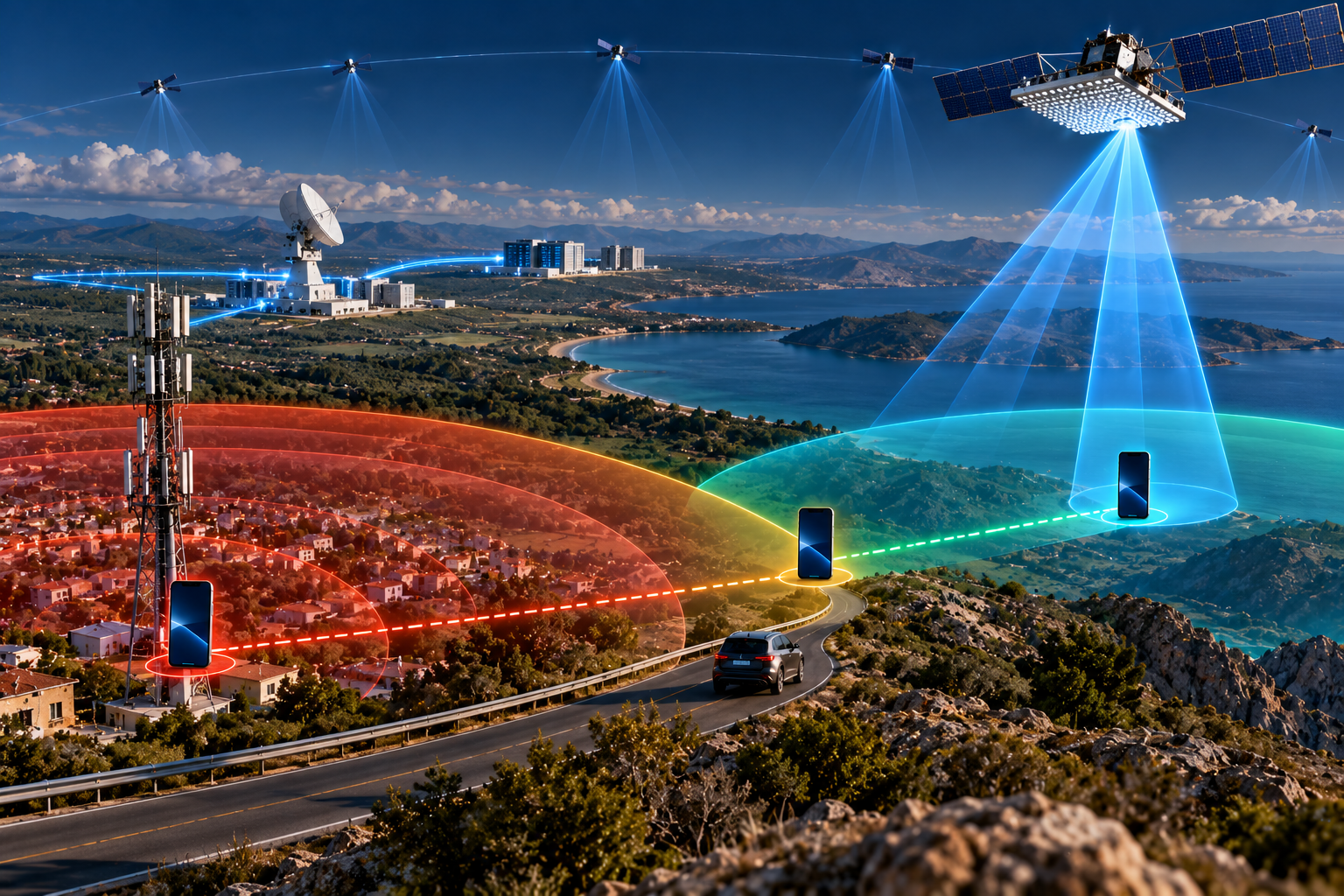
Imagine driving beyond the last 5G tower. The familiar mobile network disappears, but instead of your phone becoming completely disconnected, another radio access network becomes available from hundreds of kilometers above Earth. That is one of the goals behind the growing integration of terrestrial 5G and satellite non-terrestrial networks.
But the phone does not simply point upward and instantly turn into a satellite phone. Network discovery, authentication, spectrum, timing, Doppler compensation, moving satellite cells, gateways and the mobile core can all be involved. Even the word “switch” needs care: depending on the technology and deployment, the transition may involve handover, reselection or a separate satellite service rather than one perfectly invisible transfer.
3GPP introduced standardized 5G New Radio Non-Terrestrial Network support in Release 17. Later work strengthened mobility between terrestrial and non-terrestrial networks. At the same time, other direct-to-device architectures use terrestrial cellular technology such as LTE to reach existing smartphones. These approaches can look similar to the user while working differently underneath.
- What Happens at the Edge of 5G Coverage?
- How Does the Phone Find a Satellite Network?
- Why This Is Not Just a Normal Tower Handover
- What 5G NTN Changes
- The Phone Must Correct Its Timing
- Why Doppler Becomes a Major Problem
- How Handover Works When the Cell Is Moving
- Does Your SIM Still Matter?
- Where Does Your Data Go Next?
- What Happens to Latency?
- Will Voice, Text and Data All Work?
- What Happens When 5G Coverage Returns?
- Is the Switch Really Seamless?
- Reality Check
- Final Verdict
- FAQ
What Happens at the Edge of 5G Coverage?
Your phone continuously deals with changing radio conditions.
On a terrestrial network, it measures available cells and follows network-controlled mobility procedures. As you move away from a base station, the serving signal can weaken while another cell becomes more suitable.
Normally, the next usable cell belongs to another terrestrial base station.
Satellite connectivity changes that assumption.
In an integrated terrestrial and non-terrestrial architecture, a satellite access layer may extend coverage into an area where conventional towers cannot provide service.
This is particularly attractive for remote roads, mountains, maritime areas, sparsely populated regions and locations where terrestrial infrastructure has been damaged.
The European Space Agency describes D2D as an increasingly important part of integrating terrestrial and non-terrestrial networks into a broader connectivity architecture. :chatgpt-content-reference{index=”0″}
But losing a terrestrial signal does not mean every phone automatically searches every satellite overhead.
The device, operator, satellite system, spectrum and network technology all have to be compatible.
How Does the Phone Find a Satellite Network?
Before a phone can communicate through a satellite, it needs to discover an appropriate radio access network and establish synchronization.
The exact process depends on the D2D architecture.
One approach uses satellite systems engineered to present a terrestrial-style cellular interface to existing smartphones. Another uses standardized 3GPP NTN capabilities built specifically to account for satellite communication.
Ericsson identifies these as two important current paths: an approach using an unmodified terrestrial cellular interface for broad compatibility with existing phones, and the standardized NTN approach introduced in 3GPP Release 17 for compatible devices. :chatgpt-content-reference{index=”1″}
This distinction matters because the phone may need satellite-specific capabilities in one architecture while much of the compensation is pushed into the network in another.
Why This Is Not Just a Normal Tower Handover
A terrestrial base station normally stays in one place.
A low Earth orbit satellite does not.
It moves rapidly across the sky while its coverage pattern moves across Earth’s surface. The radio path length changes continuously, and the relative motion creates substantial Doppler shift.
That creates three major differences:
| Terrestrial Mobile Cell | LEO Satellite Cell |
|---|---|
| Base station is geographically fixed | Satellite moves rapidly relative to Earth |
| Relatively short radio path | Radio path can extend hundreds of kilometers |
| Lower propagation delay | Greater propagation delay |
| Conventional cellular Doppler environment | Large predictable Doppler component from orbital motion |
| Mobility largely follows the user | User and satellite coverage geometry can both change |
So satellite mobility cannot simply copy every terrestrial handover assumption unchanged.
What 5G NTN Changes
3GPP Release 17 was a major step because it adapted 5G New Radio to non-terrestrial networks.
The standard introduced mechanisms that allow compatible user equipment and networks to account for the much longer distances and rapid satellite motion found in NTN environments. :chatgpt-content-reference{index=”2″}
Release 18 continued that development. Ericsson notes that the later release strengthened mobility procedures between terrestrial and non-terrestrial network topologies, alongside other NTN improvements. :chatgpt-content-reference{index=”3″}
The long-term objective is important: satellite should become another component of the mobile network architecture rather than an entirely separate communications world.
That does not mean every current 5G phone supports NR-NTN. Release 17 NTN capabilities require suitable chipset and device support, and deployment remains dependent on operators and satellite networks.
The Phone Must Correct Its Timing
Timing is one of the hidden reasons satellite connectivity is difficult.
A terrestrial phone is normally much closer to its base station than a handset communicating with a satellite.
Radio waves travel at approximately the speed of light, but the additional path still creates meaningful propagation delay for a cellular protocol.
In 3GPP NR-NTN, a compatible phone can use its position together with information describing the satellite’s position and velocity to calculate timing corrections for its uplink transmissions. :chatgpt-content-reference{index=”4″}
Without sufficient correction, transmissions from different users could arrive outside the timing tolerances expected by the network.
This is not something the person holding the phone sees.
The device and network perform the synchronization work underneath the normal user interface.
Why Doppler Becomes a Major Problem
Timing is only half of the orbital-motion problem.
The other major effect is Doppler shift.
When a satellite approaches a user at high relative speed, the received radio frequency is shifted in one direction. As the satellite moves away, the shift changes in the other direction.
Terrestrial cellular networks already deal with mobility, but orbital velocities create a much larger and more predictable Doppler component.
In standardized NR-NTN, satellite position and velocity information can help compatible devices calculate frequency corrections before transmitting. :chatgpt-content-reference{index=”5″}
Other D2D architectures can move more of that compensation into the network so that existing handsets do not need the same satellite-specific behavior.
Either way, somebody has to solve the problem.
The fact that the user sees familiar signal bars does not mean the underlying RF environment resembles an ordinary terrestrial tower.
How Handover Works When the Cell Is Moving
This is where satellite mobility becomes particularly interesting.
Terrestrial handover algorithms can rely heavily on measured signal conditions between neighboring cells. A user physically moves from one coverage area toward another, and the relative signal levels provide useful evidence about when to transfer the connection.
LEO satellite geometry can behave differently.
Because the satellite is far above the coverage area, differences in path loss across neighboring satellite cells may not provide the same clear signal-strength gradient used by conventional terrestrial mobility algorithms.
3GPP therefore enhanced conditional handover for NTN.
Ericsson describes two particularly useful mechanisms: time-based and location-based conditional handover. :chatgpt-content-reference{index=”6″}
Time-based handover can exploit something satellite networks know very well: orbital motion is predictable. The network can prepare a transition to occur during a particular time window as one satellite moves out and another becomes available.
Location-based handover can use the device’s position relative to reference points associated with source and target cells.
On Earth, a network often reacts to the user’s movement between fixed cells. In LEO NTN, mobility management may also need to react to the predictable movement of the satellite infrastructure itself.
Does Your SIM Still Matter?
Yes, in operator-integrated D2D architectures the mobile subscription remains an important part of the service.
The satellite radio link is not necessarily a completely separate network identity.
One of the central goals of D2D integration is to allow satellite coverage to complement an existing mobile operator’s terrestrial network.
This can allow the operator to manage subscribers, service permissions, roaming relationships, policy and billing through established mobile-network infrastructure.
However, commercial implementation varies.
A user may require a particular operator, plan, device or enabled service before satellite connectivity becomes available.
Having a technically compatible smartphone alone does not guarantee access to every satellite network.
Where Does Your Data Go Next?
Direct-to-device does not mean the satellite is the final destination for your message, call or data session.
The satellite is part of the access path.
Depending on the architecture, traffic can be relayed through terrestrial gateway infrastructure and then into the operator’s network and wider internet or telephone system.
Phone → Satellite → Ground/Network Infrastructure → Mobile Core → Internet or Destination
More advanced satellite architectures can also include onboard processing and inter-satellite networking, so not every deployment follows an identical path.
ESA’s ongoing D2SAT project, for example, is developing processing technology for direct satellite-to-device 5G/6G communication with advanced NTN and digital beamforming capabilities. :chatgpt-content-reference{index=”7″}
The broader direction is toward tighter integration between the space segment and conventional telecom infrastructure.
What Happens to Latency?
A satellite connection introduces a longer physical radio path than a nearby terrestrial tower.
That naturally adds propagation delay.
LEO helps because it operates much closer to Earth than geostationary orbit, but the radio path is still longer than a typical terrestrial cellular connection.
Additional network routing, gateway processing and protocol behavior can contribute further delay.
This is why satellite D2D should not automatically be assumed to behave exactly like terrestrial 5G simply because the same phone can use both.
For messaging, the difference may be relatively unimportant to the user. Interactive voice, gaming or high-performance data applications can be more sensitive to latency and network conditions.
The actual experience depends on the satellite architecture, orbit, routing and service implementation.
Will Voice, Text and Data All Work?
Not necessarily.
“Satellite connectivity” describes the access method, not a guaranteed set of services.
One deployment may begin with emergency messaging. Another may offer SMS. More capable networks may add voice and packet data as coverage, spectrum and capacity expand.
This is particularly important when comparing current D2D services.
A successful satellite connection icon does not tell you whether the network supports only a small messaging payload or a full broadband data session.
Ericsson noted in late 2025 that commercial NTN adoption was still at an early stage, with satellite-enabled smartphones and wearables primarily associated with emergency messaging, while broader D2D architectures were continuing to develop. :chatgpt-content-reference{index=”8″}
Service capability therefore needs to be checked network by network rather than assumed from the term “5G satellite.”
What Happens When 5G Coverage Returns?
Satellite D2D is generally most valuable where terrestrial coverage is unavailable or impractical.
When a strong terrestrial network becomes available again, the mobile system can prefer the terrestrial access path according to operator policy, network configuration and mobility procedures.
That makes engineering sense.
Terrestrial cells can provide far greater local capacity, reuse spectrum intensively and serve users without routing every radio connection through orbit.
Satellite networks are therefore better understood as a complementary coverage layer rather than a replacement for dense terrestrial mobile infrastructure.
ESA similarly describes D2D development as part of greater integration between terrestrial and non-terrestrial networks rather than two isolated systems. :chatgpt-content-reference{index=”9″}
Is the Switch Really Seamless?
This is where marketing language and engineering terminology need to be separated.
A future integrated network can aim to make satellite access feel seamless to the user, but that does not mean every current D2D implementation performs an uninterrupted active-session handover from a terrestrial 5G cell directly into a satellite cell.
There are several possible mobility events.
A phone that has already lost terrestrial service may discover and select a satellite network. An idle device may reselect between available access networks. A connected device in a suitable NTN architecture may use more advanced handover procedures.
3GPP has explicitly developed controls and mobility mechanisms for terrestrial and satellite access, demonstrating that this transition is a real network-engineering problem rather than a simple signal-strength switch. :chatgpt-content-reference{index=”10″}
ESA has demonstrated standardized 5G NTN technology and describes seamless terrestrial-satellite switching as a goal of integrated connectivity, but deployment capability still depends on the specific network and device. :chatgpt-content-reference{index=”11″}
Reality Check
Your phone does not necessarily jump directly from a normal 5G tower to a satellite the instant the last signal bar disappears.
There are multiple D2D architectures. Some are designed to work with existing terrestrial cellular devices by adapting the satellite network around them. Others use standardized 3GPP NTN features that require compatible devices and networks.
Even within 5G NTN, mobility involves satellite-specific complications such as longer propagation delays, high Doppler, moving coverage geometry and different handover triggers. 3GPP Release 17 established NR-NTN, while subsequent work has continued improving terrestrial-to-non-terrestrial mobility. :chatgpt-content-reference{index=”12″}
The long-term user experience may become increasingly transparent, but underneath that simple experience is a very different radio network.
Final Verdict
When your phone moves from terrestrial 5G toward satellite coverage, the biggest change is not what happens on the screen. It is what happens behind the radio connection.
The terrestrial cell disappears. A compatible satellite access network must become available. The phone and network need to discover each other, establish synchronization and authenticate the subscriber.
Then satellite physics enters the process.
The radio system must account for a much longer path. Doppler from orbital motion has to be controlled. Timing needs correction. Moving satellites and beams complicate mobility. Traffic must still reach the mobile core and its final destination.
And when terrestrial coverage returns, the network can again use the far denser and higher-capacity infrastructure available on the ground.
This is the real promise of satellite-to-phone technology: not replacing 5G towers with satellites, but eventually making terrestrial and non-terrestrial access behave like complementary layers of the same mobile network.
Frequently Asked Questions
| Question | Answer |
|---|---|
| Does a phone automatically switch from 5G to satellite? | Not universally. The behavior depends on device support, operator configuration, satellite coverage, spectrum and the D2D technology being used. |
| Is satellite-to-phone part of 5G? | It can be. 3GPP Release 17 introduced standardized 5G NR Non-Terrestrial Networks, but other D2D systems can use different cellular approaches. |
| What is 5G NTN? | 5G NTN is the 3GPP framework that adapts 5G New Radio for non-terrestrial access such as satellite networks. |
| Why does a satellite connection need timing correction? | The much longer radio path creates greater propagation delay than a typical terrestrial cell, so transmissions need to remain within network timing requirements. |
| Why is Doppler important with LEO satellites? | LEO satellites move rapidly relative to the phone, shifting the apparent radio frequency and requiring compensation to maintain reliable synchronization. |
| Can a satellite hand over a phone to another satellite? | NTN mobility mechanisms can support transitions as satellite and beam coverage changes. Time-based and location-based conditional handover are among the mechanisms developed for NTN. |
| Does the phone still use its SIM? | In mobile-operator-integrated services, subscriber authentication and service access can remain tied to the user’s mobile subscription and operator network. |
| Will satellite 5G be as fast as normal 5G? | Not necessarily. Available spectrum, satellite capacity, signal conditions, latency, beam loading and service design can produce a different experience from terrestrial 5G. |
| Will satellite replace cell towers? | Satellite D2D is better suited to complement terrestrial networks by filling coverage gaps. Dense terrestrial infrastructure remains much better suited to providing large amounts of capacity in populated areas. |
| Can every 5G smartphone use 5G NTN? | No. Standardized NTN capabilities require compatible device hardware, software, frequency support and an available operator and satellite service. |