Why Tring Satellite TV Works Better on Some Receivers
Estimated Reading Time: 8 minutes
Connect two satellite receivers to the same Tring antenna system and they may not behave exactly the same. One receiver can hold a DVB-S2 carrier without interruption while another occasionally freezes, takes longer to lock or loses the channel when reception conditions deteriorate slightly.
The satellite signal reaching the house has not changed between those tests. What changed is the hardware attempting to recover it. Tuner design, demodulator performance, frequency-error tolerance, error correction, firmware and decoding architecture can all influence how a receiver behaves, especially when the incoming carrier is already close to its reliable operating threshold.
A receiver that performs better on a marginal Tring carrier does not create extra satellite signal. It may simply recover usable data under slightly more difficult RF conditions. If the dish, LNB or cabling provides inadequate margin, changing receivers can hide the weakness rather than correct the installation.
- How Can the Same Signal Produce Different Results?
- The RF Tuner Is the First Difference
- Why the DVB-S2 Demodulator Matters
- 8PSK and Operation Near the Threshold
- How FEC Performance Affects Stability
- Frequency Drift and Carrier Acquisition
- Symbol Rate and Carrier Acquisition
- Why Firmware Can Change Receiver Behaviour
- Reception and Video Decoding Are Different Problems
- Why Signal Percentages Differ Between Receivers
- Receiver Temperature Can Matter
- How to Compare Two Receivers Properly
- Reality Check
- Final Verdict
- FAQ
How Can the Same Signal Produce Different Results?
A satellite receiver performs several jobs before a television picture appears.
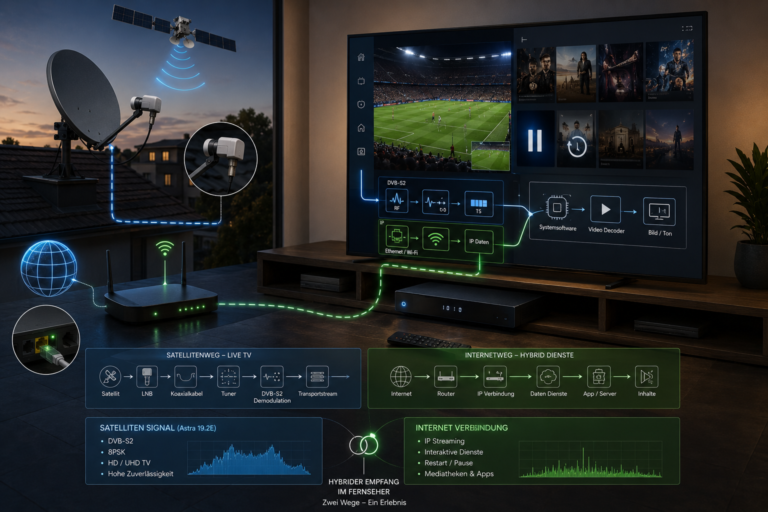
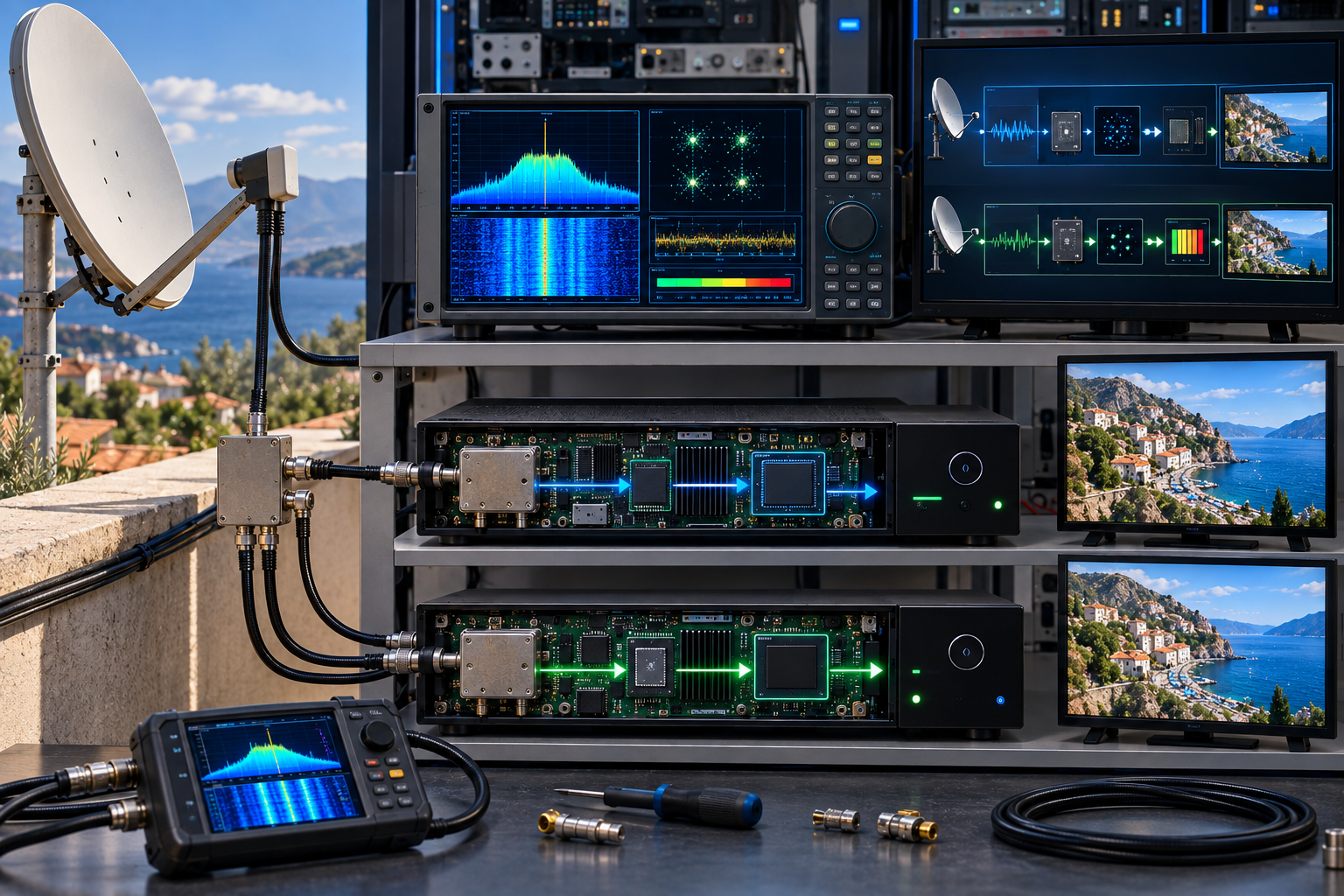
The signal arriving from the LNB first reaches the RF tuner. The tuner selects the required part of the satellite intermediate-frequency spectrum and feeds it into the demodulation system.
The demodulator must identify and lock the digital carrier, recover its symbols and process the appropriate DVB transmission structure.
Forward error correction then attempts to recover corrupted data. After that, the receiver reconstructs the transport stream, identifies the selected service and passes its compressed video and audio to the decoders.
RF input → tuner → carrier acquisition → DVB-S2 demodulation → FEC → transport stream → service selection → video/audio decoding → HDMI output.
Two receivers can implement these stages using different chipsets, hardware designs and firmware.
That creates opportunities for measurable differences even though the incoming coaxial signal is identical.
The RF Tuner Is the First Difference
The tuner is the receiver’s first active stage after the satellite signal enters the box.
Its job includes selecting the wanted frequency while operating within a spectrum containing many other carriers.
Tuners can differ in sensitivity, dynamic range, filtering, automatic gain control and tolerance of real-world RF conditions.
This does not mean that one receiver can magically recover an arbitrarily weak signal. Every tuner and demodulator combination has operating limits.
But near those limits, small differences can become visible.
Receiver A may maintain stable acquisition while Receiver B begins showing errors or loses lock.
Under strong, clean reception conditions, both boxes may behave identically. Their differences become much easier to observe when the RF margin is reduced.
Why the DVB-S2 Demodulator Matters
After tuning the wanted carrier, the receiver must demodulate it.
This is where DVB-S2 capability becomes important.
The demodulator must synchronize with the incoming waveform, recover symbol timing, handle carrier-frequency error and reconstruct the digital information represented by the modulation.
Different demodulator generations can have different acquisition and tracking behaviour.
Firmware and chipset implementation also matter.
One design may recover a marginal carrier slightly more reliably than another, even when both officially support DVB-S2.
This explains why a compatibility label such as “DVB-S2 receiver” does not prove that every DVB-S2 receiver will produce identical RF performance.
Standards define how compatible transmission and reception should work. They do not require every consumer tuner to have identical sensitivity or implementation margin.
8PSK and Operation Near the Threshold
Satellite platforms can use different modulation and coding configurations depending on capacity and robustness requirements.
QPSK represents two raw bits per modulation symbol before coding overhead, while 8PSK represents three.
That additional spectral efficiency comes with different signal-quality requirements for a given coding configuration.
The receiver must distinguish the constellation states reliably despite noise, interference, phase errors and other impairments.
When reception has healthy margin, compatible receivers should have little difficulty.
Near the decoding threshold, implementation differences can become more important.
| Reception Condition | Receiver A | Receiver B |
|---|---|---|
| Strong carrier with healthy margin | Stable | Stable |
| Moderately reduced margin | Stable | Usually stable |
| Close to threshold | May retain lock | May begin showing errors |
| Below usable threshold | Eventually fails | Fails |
The exact behaviour depends on the specific carrier and receiver. There is no universal threshold that can be assigned to all Tring services or all receiver models.
How FEC Performance Affects Stability
DVB-S2 uses powerful forward error correction based on LDPC and BCH.
Error correction is a major reason digital satellite television can continue displaying a perfect picture even when the received signal contains errors.
The demodulator and decoder recover the transmitted information as long as the incoming carrier remains within the operating region required by the selected modulation and coding configuration.
But FEC is not unlimited.
Once reception deteriorates beyond the recoverable region, uncorrectable errors begin affecting the transport stream.
The visible result can be pixelation, frozen frames, audio interruptions or complete loss of service.
Two receiver implementations may approach this transition slightly differently.
That difference is most obvious on an installation already close to the digital cliff.
Frequency Drift and Carrier Acquisition
The LNB converts Ku-band satellite frequencies to the lower intermediate frequencies sent through the coaxial cable.
This conversion depends on the LNB’s local oscillator.
The oscillator is not absolutely perfect. Its frequency can deviate slightly from its nominal value, and temperature can contribute to drift.
The receiver therefore needs some ability to search for and track a carrier that is not located exactly where an ideal frequency calculation predicts.
Different tuner and demodulator combinations can have different acquisition behaviour and frequency-error tolerance.
A modern receiver may therefore lock an unstable or ageing LNB more easily than another box.
That does not necessarily prove the first receiver is dramatically “more powerful.”
It may simply have a carrier-recovery system that handles that particular frequency error more effectively.
If large LNB drift is the real problem, replacing receivers is not the best engineering solution. The defective or unstable part of the RF chain should be corrected.
Symbol Rate and Carrier Acquisition
The receiver also needs the correct symbol-rate information or an acquisition system capable of identifying the carrier appropriately.
Symbol rate describes how many modulation symbols are transmitted each second. It is not the same as programme bitrate.
Receiver demodulators are designed to operate across specified symbol-rate ranges, but acquisition performance can vary.
Some receivers may lock certain carriers faster than others, particularly when frequency error, low margin or other impairments are present simultaneously.
This can produce an interesting symptom: both receivers eventually display the same Tring service, but one takes significantly longer after a scan or channel change.
That difference can originate in carrier acquisition rather than picture decoding.
Why Firmware Can Change Receiver Behaviour
Hardware is only part of the receiver.
Firmware controls many aspects of how the device interacts with its tuner, demodulator and transport-stream processing system.
Software can influence tuning procedures, scanning, timeout behaviour, service database handling and responses to temporary loss of lock.
A firmware problem can therefore make a receiver appear less reliable even when the underlying RF hardware is capable.
Updates can sometimes improve compatibility or correct receiver-specific bugs.
However, firmware should not be treated as a universal cure.
Software cannot normally transform fundamentally unsupported hardware into a different tuner or demodulation architecture.
Likewise, firmware cannot create missing satellite link margin.
Reception and Video Decoding Are Different Problems
A receiver can successfully recover the satellite carrier and still fail later in the chain.
This distinction is essential when comparing receivers.
Suppose Receiver A locks a Tring carrier and displays the programme normally. Receiver B also shows stable carrier quality and finds the service during a scan, but the picture remains black or behaves incorrectly.
The second receiver may not have an RF sensitivity problem at all.
It may have a decoding or service-processing limitation.
DVB-S2 describes the satellite physical layer. Video codecs such as H.264/AVC are a separate part of the system.
Audio formats are separate again.
| Symptom | Likely Area to Investigate |
|---|---|
| No RF indication | Cabling, tuner input, LNB power or RF path |
| RF present but no carrier lock | Tuning parameters, DVB compatibility, demodulator or insufficient quality |
| Carrier locks but service is not found | Transport-stream or service-database processing |
| Channel found but no picture | Video decoding, service authorization or other programme-level processing |
| Picture stable but occasional freezes occur | RF margin, transport errors, receiver processing or programme source |
Separating these stages prevents a decoding problem from being incorrectly diagnosed as a weak satellite signal.
Why Signal Percentages Differ Between Receivers
This is one of the most common sources of confusion when comparing satellite receivers.
Receiver A may display 92% signal strength while Receiver B displays 73% from exactly the same coaxial feed.
That does not prove Receiver A receives 19 percentage points more satellite power.
Consumer receiver percentages are not standardized engineering units.
Manufacturers can map tuner measurements to their user interface in different ways.
The same applies to many “quality” bars.
Never compare receiver percentages as though they were calibrated measurements. A 70% reading from one model cannot automatically be compared with 90% from another.
Professional measurements such as MER and BER provide far more useful information when comparing the actual RF condition.
This is also why receiver signal bars should not be the only basis for dish alignment.
Receiver Temperature Can Matter
Receivers themselves generate heat.
A box with poor ventilation may operate normally when first switched on but become unstable after internal temperature rises.
Tuner, demodulator, processor, memory and power-supply components can all be affected by abnormal thermal conditions.
If one receiver begins freezing only after prolonged operation while another remains stable on the same RF feed, thermal behaviour deserves investigation.
Make sure ventilation openings are clear and avoid placing the receiver in a tightly enclosed cabinet or directly on another hot device.
Temperature can also interact with the outdoor system. An LNB that drifts as it heats may be handled differently by two receiver demodulators.
That can make the problem appear receiver-specific even though the original instability begins at the LNB.
How to Compare Two Receivers Properly
If one receiver appears to work better with Tring satellite services, test the difference systematically.
The receivers should be tested from the same antenna feed under similar conditions. Comparing one receiver on a short cable with another on a long distribution path does not isolate receiver performance.
1. Use the same dish and LNB.
2. Use the same coaxial feed where practical.
3. Test the same carrier and service.
4. Use the correct tuning parameters on both devices.
5. Ignore differences in arbitrary signal percentages.
6. Compare lock stability and error behaviour.
7. Test under both good and marginal reception conditions if safe and practical.
8. Observe cold-start and warm-operation behaviour.
9. Distinguish RF lock problems from video-decoder problems.
10. Use MER and BER measurements from suitable equipment to evaluate the actual incoming carrier.
A receiver swap is therefore a useful diagnostic test, but the interpretation matters.
If Receiver A works and Receiver B does not, Receiver B may be defective or less tolerant of the specific conditions.
But if Receiver A is only barely maintaining lock, the installation may still need improvement.
For a deeper look at what occurs after the coaxial signal enters the box, see What Happens Inside a Satellite Receiver.
Reality Check
There is no universal “best Tring receiver” based only on a signal-strength percentage or anecdotal reports.
Receivers can genuinely differ in tuner, demodulator, firmware and decoding behaviour, particularly near the DVB-S2 threshold. But those differences do not remove the fundamental requirements of the satellite link.
A receiver cannot manufacture carrier-to-noise margin that the antenna system never delivered. It cannot correct severe dish misalignment, water-damaged coaxial cable or a defective LNB simply because its tuner performs slightly better near threshold.
Likewise, a black screen does not automatically prove poor RF sensitivity. The carrier may already be locked while the failure occurs later in service processing or video decoding.
Final Verdict
Tring satellite TV can genuinely appear more stable on some receivers because not every receiver processes the same RF carrier in exactly the same way.
Tuner architecture, DVB-S2 demodulation, carrier acquisition, frequency-error tolerance, FEC implementation, firmware and thermal behaviour can all affect performance. Differences become most visible when the incoming carrier is close to its reliable decoding threshold.
But better receiver performance should not be confused with better satellite signal. The dish, LNB and coaxial network determine what RF conditions reach the receiver in the first place.
If changing receivers solves repeated freezing, use that result as diagnostic evidence. Then determine whether the original receiver is defective or whether the installation itself has so little margin that small differences between receivers decide whether the programme remains locked.
The strongest system is not one that depends on an unusually tolerant receiver. It is one that delivers sufficient RF quality and margin for compatible receivers to operate reliably.
Frequently Asked Questions
| Question | Answer |
|---|---|
| Can two satellite receivers really have different sensitivity? | Yes. Tuner and demodulator designs can differ, especially in their behaviour near the usable reception threshold. The difference may be invisible when the incoming carrier has healthy margin. |
| Why does Tring freeze on one receiver but not another? | The receivers may differ in carrier acquisition, demodulation, error correction, firmware or decoding. The incoming signal may also be marginal enough that small receiver differences become visible. |
| Does a higher signal percentage mean a better receiver? | No. Consumer signal percentages are not standardized and cannot reliably be compared between different receiver models. |
| Can a receiver compensate for a poorly aligned dish? | Only to a limited extent. A receiver with good marginal-signal performance may maintain lock slightly longer, but it cannot replace the antenna gain and margin lost through poor alignment. |
| Why does one receiver find a channel faster? | Differences in tuner control, carrier acquisition, frequency tolerance, demodulator design and firmware can affect tuning and scanning speed. |
| Can an ageing LNB make receivers behave differently? | Yes. Excessive oscillator drift or other LNB instability may be handled better by one receiver’s carrier-recovery system than another, particularly under changing temperature conditions. |
| Can a receiver lock the satellite signal but still show no picture? | Yes. Successful DVB-S2 demodulation only proves that the RF carrier can be recovered. Video decoding, audio decoding, service processing and authorization are later stages. |
| Will updating receiver firmware improve Tring reception? | It can fix receiver-specific software or compatibility problems, but firmware cannot create missing RF margin or add physical capabilities absent from the hardware. |
| Should I replace my receiver if another one works better? | First determine whether the original receiver is actually faulty or whether the installation has marginal RF quality. Testing MER, BER, dish alignment, LNB stability and cabling can reveal the underlying cause. |