Why Netflix Sometimes Looks Better After Midnight
Estimated reading time: 18 to 24 minutes.
Many Netflix users notice a strange pattern late at night. The image suddenly looks cleaner, sharper, and more stable after midnight. Motion appears smoother, dark scenes contain more detail, and buffering becomes less common. The exact same show that looked soft earlier in the evening suddenly feels more cinematic.
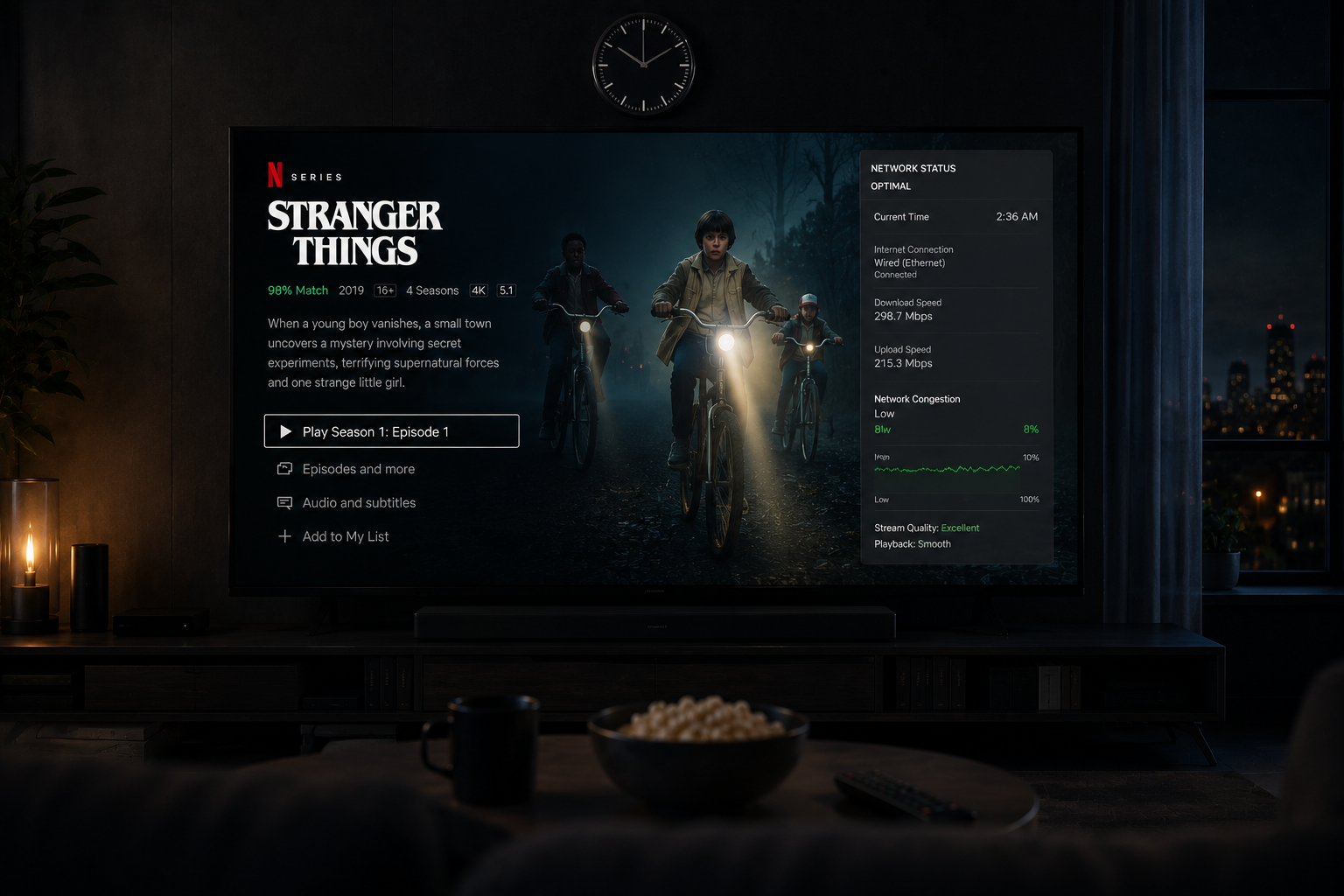
This is not imagination. Streaming quality often improves after midnight because internet traffic patterns change dramatically. Network congestion decreases, packet timing becomes more stable, and Netflix adaptive streaming systems can maintain higher bitrate levels for longer periods.
Quick Context. Netflix often looks better after midnight because network congestion decreases significantly, allowing more stable bandwidth delivery and higher sustained bitrate streaming.
Table of Contents
Why evening streaming hours are difficult
Internet infrastructure is shared
How congestion affects Netflix quality
Higher bitrate stability at night
Adaptive streaming and quality recovery
Packet timing becomes more stable
Lower jitter after peak traffic hours
WiFi congestion decreases late at night
Why dark scenes improve after midnight
Action scenes and bitrate recovery
Netflix server pressure decreases
Why evening streaming hours are difficult
Evening hours create enormous pressure on internet infrastructure.
Millions of people simultaneously begin:
- Streaming movies
- Watching live sports
- Gaming online
- Joining video calls
- Downloading updates
This creates heavy traffic across:
- ISP networks
- Regional infrastructure
- WiFi environments
- Streaming delivery systems
Netflix quality often suffers because streaming systems must compete for stable bandwidth during these busy hours.
Internet infrastructure is shared
Many users imagine their internet connection as a private dedicated line.
In reality, internet infrastructure is heavily shared.
Your ISP distributes network capacity across:
- Buildings
- Neighborhoods
- Regional nodes
- Large traffic exchanges
When too many users become active simultaneously, congestion increases.
Streaming quality becomes less stable even on fast internet plans.
How congestion affects Netflix quality
Netflix depends heavily on stable data delivery.
Congestion disrupts:
- Packet timing
- Bandwidth consistency
- Latency stability
- Buffer reliability
The adaptive streaming system reacts automatically by lowering bitrate.
This reduces image quality to maintain playback continuity.
During busy evening hours, Netflix often becomes:
- Softer
- More compressed
- Less stable
- More prone to buffering
The image quality changes because the network environment changes.
What changes after midnight
After midnight, internet traffic patterns shift dramatically.
Many users stop streaming and disconnect from heavy network activity.
This reduces:
- Bandwidth competition
- Network congestion
- WiFi interference
- Server load pressure
The result is a calmer and more predictable delivery environment.
Netflix adaptive streaming systems immediately benefit from these improved conditions.
Higher bitrate stability at night
Stable networks allow Netflix to maintain higher bitrate streams.
Higher bitrate improves:
- Texture detail
- Motion clarity
- Shadow precision
- Compression stability
When evening congestion disappears, the stream can sustain these higher quality levels more consistently.
This is one reason Netflix often appears dramatically sharper after midnight.
Adaptive streaming and quality recovery
Netflix constantly adjusts playback quality dynamically.
During busy hours, the adaptive system may aggressively reduce bitrate to protect playback.
Later at night:
- Buffer stability improves
- Packet timing becomes cleaner
- Bandwidth consistency increases
Netflix detects these improvements and gradually restores higher quality levels.
Users often notice:
- Cleaner image detail
- Reduced blur
- Better motion handling
- Less visible compression
Packet timing becomes more stable
Streaming systems depend heavily on predictable packet delivery timing.
Busy networks create unstable timing patterns.
After midnight:
- Packets arrive more consistently
- Retransmissions decrease
- Delivery rhythm stabilizes
This allows the Netflix player to maintain smoother buffering behavior.
Playback becomes calmer and more stable overall.
Lower jitter after peak traffic hours
Jitter refers to fluctuations in packet arrival timing.
High jitter destabilizes streaming playback.
During evenings:
- Network congestion increases jitter
- WiFi interference becomes heavier
- Routing instability grows
After midnight, jitter often decreases substantially.
Netflix can therefore maintain:
- More stable bitrate
- Cleaner playback timing
- More reliable motion quality
This directly improves image consistency.
WiFi congestion decreases late at night
Apartment buildings and crowded neighborhoods create highly congested WiFi environments during evenings.
Dozens of nearby routers compete simultaneously.
This causes:
- Interference
- Packet collisions
- Channel overlap
- Timing instability
After midnight, many nearby devices become inactive.
Wireless conditions improve naturally.
Streaming stability often improves immediately as a result.
Why dark scenes improve after midnight
Dark scenes are extremely difficult for compressed streaming systems.
When bitrate drops during congestion:
- Shadow detail disappears
- Banding increases
- Compression artifacts become visible
Higher stable bitrate after midnight restores:
- Better gradients
- Cleaner shadows
- Improved texture detail
This is why nighttime movie scenes often look dramatically cleaner late at night.
Action scenes and bitrate recovery
Action scenes require enormous amounts of data.
Fast movement creates huge compression pressure.
During evening congestion, Netflix may reduce bitrate aggressively during action scenes.
This creates:
- Motion blur
- Smearing
- Macroblocking
- Loss of detail
After midnight, stable delivery allows Netflix to sustain higher motion bitrate.
Action scenes look cleaner and smoother.
Netflix server pressure decreases
Netflix infrastructure handles enormous global traffic.
Peak evening demand places heavy pressure on:
- Content delivery systems
- Regional streaming nodes
- Traffic balancing infrastructure
After midnight, traffic demand decreases.
This reduces stress on the delivery network.
Playback stability improves as a result.
ISP routing conditions improve
Your ISP constantly routes traffic across large network infrastructure.
Busy evening conditions create:
- Routing pressure
- Congestion points
- Latency fluctuations
Late at night:
- Routing becomes cleaner
- Packet delivery stabilizes
- Congestion decreases
This improves the overall streaming path between Netflix servers and your device.
A real world viewing example
Imagine someone watching Netflix at 8 PM.
The network environment is extremely busy.
Netflix reacts by:
- Lowering bitrate
- Increasing compression
- Protecting playback stability
The image looks softer and less detailed.
Later at 1 AM:
- WiFi congestion decreases
- ISP traffic pressure drops
- Packet timing stabilizes
- Adaptive streaming raises bitrate
Suddenly:
- Dark scenes improve
- Motion becomes cleaner
- Textures look sharper
- Compression artifacts decrease
The exact same content now looks noticeably better.
| Factor | Evening Conditions | After Midnight |
|---|---|---|
| Network congestion | Heavy | Reduced |
| Bitrate stability | Variable | Stable |
| WiFi interference | High | Lower |
| Packet timing | Irregular | Consistent |
| Compression pressure | Aggressive | Reduced |
| Motion clarity | Weaker | Improved |
| Dark scene quality | Compressed | Cleaner |
Reality Check
Netflix often looks better after midnight because internet infrastructure becomes less congested. Streaming systems depend heavily on stable timing and consistent bandwidth, both of which improve significantly during quieter network hours.
Final Verdict
Netflix sometimes looks noticeably better after midnight because the entire network environment becomes more stable. Lower congestion, reduced WiFi interference, cleaner routing conditions, and more predictable packet timing allow Netflix adaptive streaming systems to maintain higher bitrate levels for longer periods. The improvement is not imaginary. It is the direct result of streaming systems finally operating under calmer and more stable network conditions.
FAQ
| Question | Answer |
|---|---|
| Why does Netflix look better after midnight | Because network congestion decreases and bitrate stability improves |
| Does internet traffic affect Netflix quality | Yes heavily because streaming depends on stable bandwidth delivery |
| Why are dark scenes cleaner late at night | Higher stable bitrate reduces compression artifacts in shadows |
| Can WiFi improve after midnight | Yes because fewer nearby devices create less interference |
| Does Netflix change quality automatically | Yes adaptive streaming constantly adjusts bitrate based on conditions |