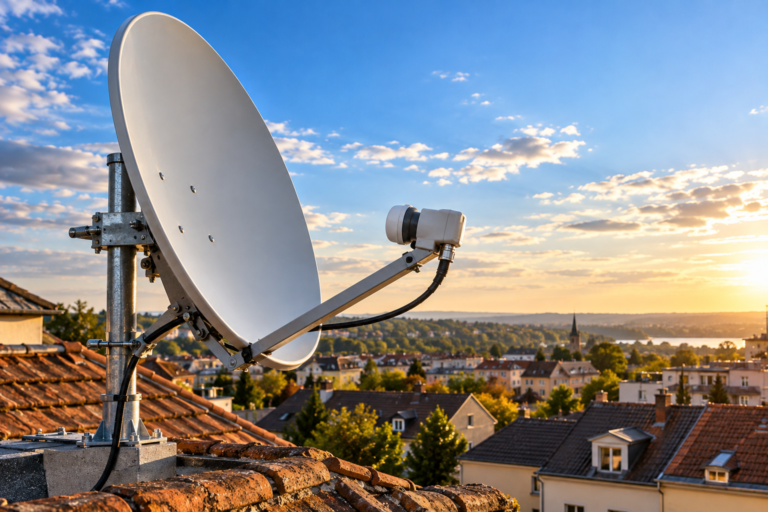
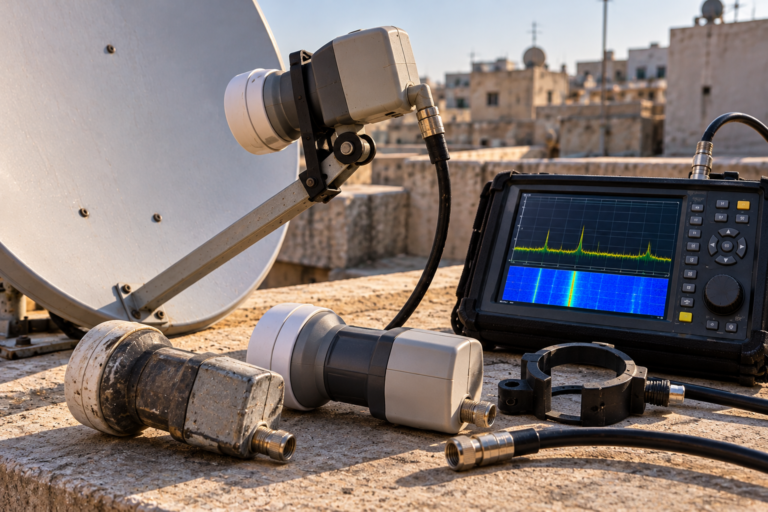
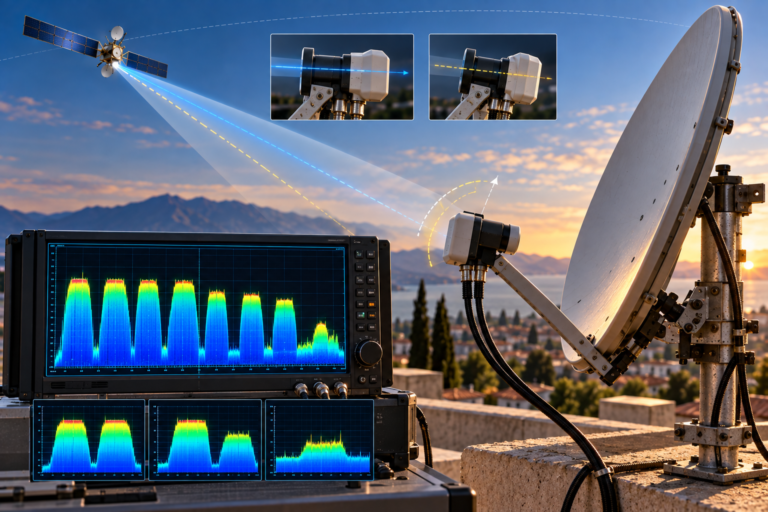
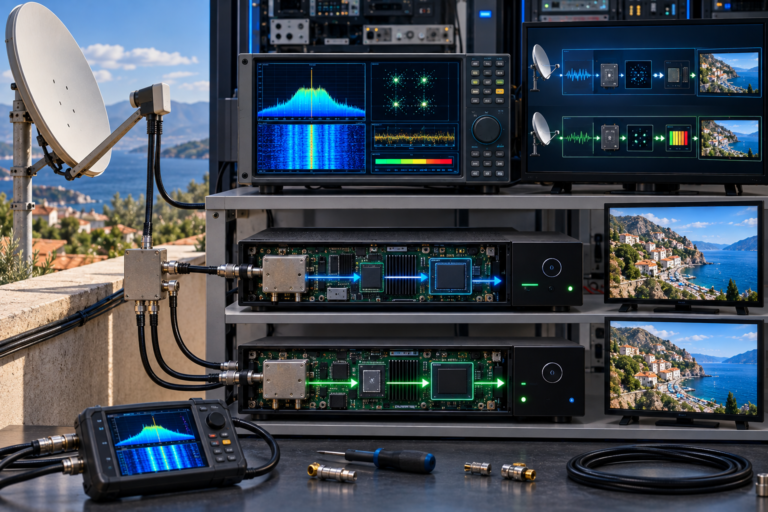
Why Hot Bird Works on One LNB but Not Another
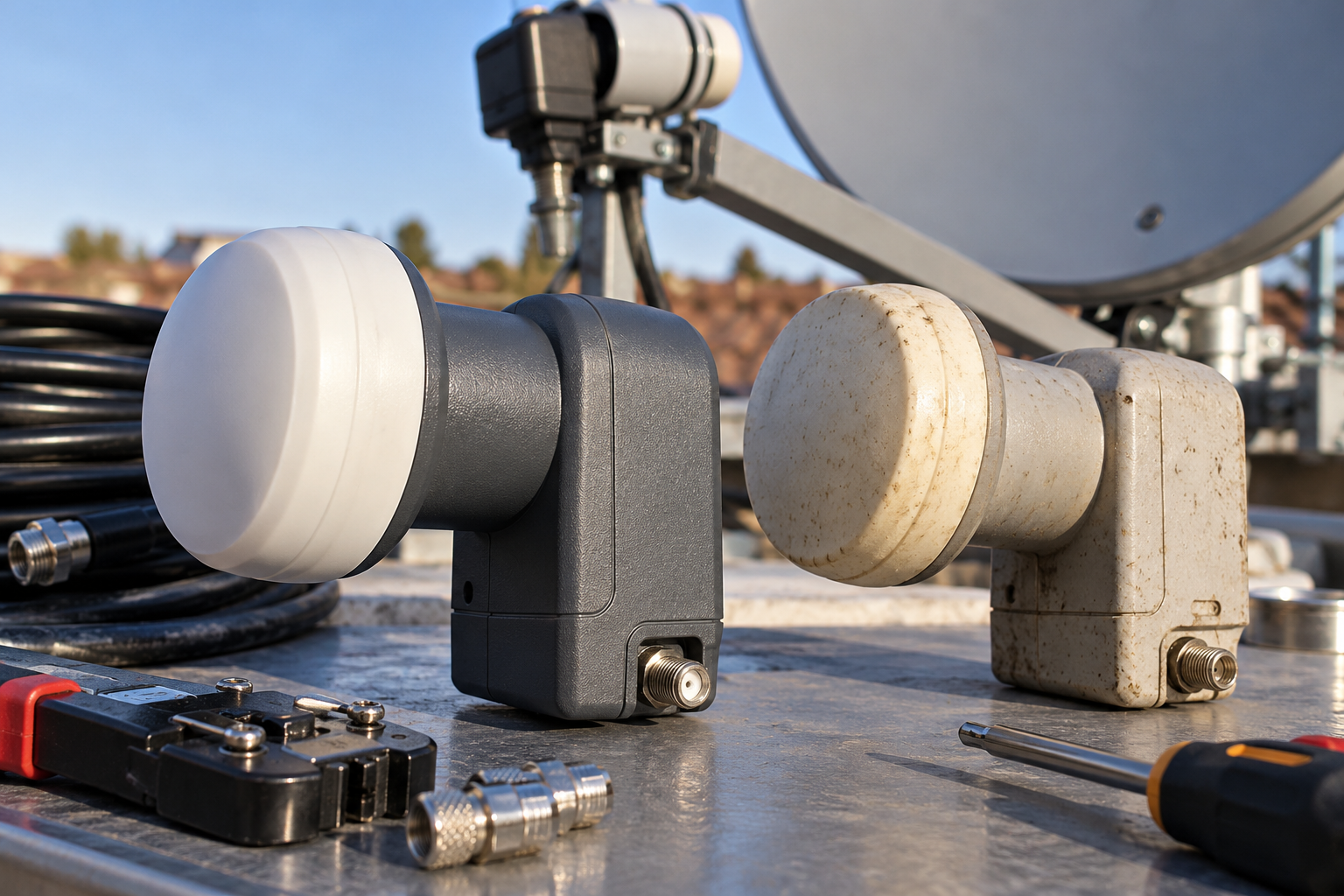
Your Hot Bird 13°E dish works perfectly with one LNB, but changing to another LNB leaves you with missing channels, weak transponders, or no signal at all. The replacement may be newer and advertise better performance, yet the original unit still receives more reliably. Does that automatically mean the new LNB is defective?
Not necessarily. Two LNBs can behave differently because of their output design, local oscillator configuration, receiver control signals, feed position, and connection to the distribution system. Even comparing two outputs of the same Twin or Quad LNB can produce misleading results if the cables and receivers are not tested separately. The key is to establish whether the failure follows the LNB hardware, its installation position, or the signal path connected to it.
Hot Bird 13°E is served by Eutelsat’s HOTBIRD 13F and 13G satellites. Receiving this orbital position requires a suitable antenna, correctly positioned feed, compatible frequency conversion, and a properly configured receiver or distribution system. An LNB that works in one installation is not necessarily configured or designed to work in another.
Why Two LNBs Can Produce Different Hot Bird Reception Results
An LNB is not simply an amplifier mounted in front of the satellite dish. It receives the focused Ku-band signal, amplifies it with low-noise circuitry, and converts it to an intermediate frequency suitable for transmission through coaxial cable.
Depending on its design, it may also select frequency bands and polarization states in response to receiver control signals.
Two LNBs may therefore differ in several important ways:
- Supported input frequency ranges and local oscillator frequencies.
- Output configuration and switching behavior.
- Noise performance, gain and frequency response.
- Local oscillator accuracy and stability.
- Feedhorn geometry and mechanical mounting position.
- Compatibility with multiswitch or single-cable distribution equipment.
Any of these differences can affect reception, but not all of them indicate defective hardware.
For example, a Quattro LNB connected directly to a conventional receiver may provide only a fixed group of transponders. A compatible universal LNB on the same dish can appear to work normally because it responds to the receiver’s polarization and band-selection commands.
The comparison is meaningful only when the equipment types and connection methods are understood.
Universal, Twin, Quad, Quattro and Unicable LNBs Are Not Interchangeable
One of the most important checks is identifying the LNB’s actual output architecture.
Similar-looking units can serve very different installation requirements.
| LNB Type | Typical Output Behavior | Key Compatibility Issue |
|---|---|---|
| Universal Single | One independently controlled output | Requires suitable receiver band and polarization configuration |
| Universal Twin | Two independently controlled outputs | Each tuner requires a suitable independent signal path |
| Universal Quad | Four independently controlled outputs | Should not be confused with fixed-output Quattro designs |
| Quattro | Four fixed band/polarization outputs | Normally requires a compatible multiswitch |
| Unicable / SCR / dCSS | Controlled distribution using assigned user bands | Requires compatible commands and user-band settings |
Why Quad and Quattro Cause Confusion
A conventional Quad LNB generally provides four independent outputs capable of selecting the required polarization and frequency band for each connected receiver.
A Quattro LNB works differently. It provides four fixed signal groups:
- Vertical Low (VL)
- Horizontal Low (HL)
- Vertical High (VH)
- Horizontal High (HH)
These outputs are normally connected to the corresponding inputs of a compatible multiswitch.
If a receiver is connected directly to one fixed Quattro output, it cannot select all four groups through that connection.
Some Hot Bird transponders may work while others remain unavailable, making a compatibility problem look like an unusual reception fault.
What Changes With Unicable and dCSS?
Single-cable distribution systems allow multiple compatible tuners to request selected satellite transponders over shared infrastructure.
They use assigned user bands and supported control protocols, such as those associated with EN 50494 or EN 50607.
Incorrect user-band assignments, incompatible equipment, or conflicting tuner configurations can prevent reliable reception.
Do not assume that a conventional universal-LNB setup procedure is appropriate for an SCR or dCSS output.
Why Hot Bird Can Fail Immediately After Replacing an LNB
If Hot Bird reception changes immediately after replacing an LNB, begin by identifying exactly what changed.
Was the old unit replaced with the same type? Was the mounting position preserved? Were the original coaxial connections reused? Did the receiver’s LNB configuration remain appropriate?
Each answer narrows the investigation.
Incorrect Local Oscillator Settings
A typical European universal Ku-band LNB uses nominal local oscillator frequencies of 9,750 MHz and 10,600 MHz.
The receiver needs matching settings to calculate the correct intermediate frequency for the selected downlink carrier.
If the replacement uses a different conversion scheme, retaining the previous settings can cause tuning failures.
A wrong oscillator configuration may leave some transponders accessible while others become difficult or impossible to acquire.
Missing Band Switching
Conventional universal LNBs normally use a 22 kHz tone to select the upper frequency band, while polarization selection uses the relevant DC control voltage.
If the receiver configuration or switching path does not provide the appropriate control signals, an entire band or polarization group may become unavailable.
This type of selective failure is also discussed in Why Astra Channels Vanish After an LNB Change, which examines how replacement hardware can alter frequency conversion, switching behavior, and channel availability. The underlying installation principles apply to Hot Bird as well.
If a replacement causes channels to disappear, do not start with a blind scan. First determine whether the receiver can lock the affected transponders using verified current parameters. Scanning cannot correct incompatible LNB hardware or a failed switching path.
When One LNB Output Works but Another Fails
A different problem occurs when two receivers or cable runs use separate outputs of the same Twin or Quad LNB.
One television may receive Hot Bird normally while another loses certain frequencies or displays no signal.
This does not automatically prove that one output is defective.
Each path may contain different cable lengths, connectors, switches, wall outlets, and tuner settings.
How to Separate an Output Fault From a Cable Fault
Suppose Output A works through Cable A, while Output B fails through Cable B.
That observation alone cannot identify the failing component.
After disconnecting the relevant equipment from power, a controlled test can compare the same known-good receiver and cable path against each LNB output, using manufacturer-approved connections.
If the problem consistently follows one output under otherwise equivalent conditions, an LNB output fault becomes more plausible.
If the problem instead follows a particular cable or receiver, investigate that path before replacing the LNB.
Why Cable Connections Matter
A partially loose F-connector, damaged center conductor, or moisture-contaminated cable can cause attenuation, impedance mismatch, or unreliable DC control.
Depending on the failure, the receiver may lose all transponders or only certain bands and polarizations.
Excessive resistance may also interfere with voltage delivery to the LNB.
Inspect the connection physically and electrically using appropriate equipment rather than relying exclusively on the receiver’s signal percentage.
Feed Position, Focus and LNB Skew Can Change the Result
Even when two universal LNBs are electrically compatible, replacing one can alter the receiving geometry.
The location of the feed relative to the reflector affects how efficiently satellite energy is collected.
Feedhorn Geometry and Focal Position
Different LNB housings and feedhorn designs may position their effective phase centers differently relative to the mounting collar.
The physical size and shape of the feed assembly can also affect reflector illumination.
An apparently minor change in mounting depth can influence reception performance, especially when the original installation has limited margin.
This is one reason why simply pushing every LNB to the same mechanical stop does not guarantee identical RF performance.
LNB Skew and Polarization Isolation
Hot Bird uses linear polarization. The LNB must be oriented appropriately for the received horizontal and vertical signals.
If the replacement is installed at a different rotation angle, unwanted polarization leakage may increase.
This can affect particular transponders more severely than others.
However, skew alignment should be evaluated separately from electrical polarization switching. Rotating the LNB cannot repair a receiver that fails to supply the required switching command.
Multi-Feed Installations
In systems receiving both Hot Bird 13°E and Astra 19.2°E, the LNBs may occupy different positions along a multi-feed bracket.
These positions are not optically equivalent.
An offset feed receives a different portion of the reflector’s effective antenna pattern than a feed positioned near the primary focal region.
Swapping LNB units without preserving their intended locations can therefore change reception even when the electronics are functioning correctly.
Receiver Power and Switching Problems
A conventional universal LNB receives its operating power and selection signals through the coaxial cable.
Receivers commonly use nominal voltages around 13V for vertical polarization and 18V for horizontal polarization, with 22 kHz signaling used for band selection.
Actual electrical tolerances depend on the equipment and installation.
Why Supply Conditions Matter
Excessive resistance, a defective switch, damaged connectors, or inadequate receiver power delivery can interfere with correct LNB operation.
A replacement unit may expose an existing weakness if its electrical requirements differ from those of the previous model.
This does not necessarily mean the replacement consumes excessive power or that its design is faulty.
Measurements must be interpreted against the specifications of the actual devices.
DiSEqC and External Switching
Where multiple LNBs are connected through a DiSEqC switch, incorrect port selection can route the receiver to the wrong satellite feed.
Some installations also include cascaded switches, multiswitches, or other distribution components.
If one LNB works when directly connected but fails through the switching network, test the network configuration before blaming the LNB.
Switch off and disconnect receiver power before changing coaxial connections. Never join two powered LNB outputs together or short the coaxial center conductor to its shield. Use suitable satellite test equipment for voltage measurements, and follow the installation manufacturer’s instructions.
Do LNB Gain and Noise Figure Explain the Difference?
Not every reception difference is caused by configuration or wiring.
Two compatible LNBs can have different RF performance because of their component design, manufacturing tolerances, and operating condition.
Noise Performance
An LNB’s noise contribution affects the receiving system’s overall carrier-to-noise performance.
However, an advertised noise figure does not independently determine the quality delivered to the receiver.
Feed efficiency, conversion characteristics, local oscillator noise, antenna gain, and downstream signal conditions also matter.
Higher Gain Is Not Always Better
More conversion gain can raise the signal level at the receiver input, but it does not automatically improve MER or C/N.
In some systems, excessive signal levels may even create overload or distortion in downstream equipment.
A well-matched receiving system is more important than choosing an LNB purely because it advertises the highest gain.
Oscillator Stability and Temperature
Frequency accuracy and phase-noise performance can influence carrier acquisition and demodulation.
An aging or damaged LNB may show unstable behavior as its temperature changes.
When the effect is repeatable, measurements taken under comparable operating conditions can help establish whether oscillator behavior is involved.
What the Failure Pattern Reveals
Before replacing another component, examine which parts of Hot Bird reception are actually affected.
| Observed Pattern | Possible Explanation | First Useful Check |
|---|---|---|
| Old LNB works, replacement finds no transponders | Wrong type, incorrect settings, missing power, or installation issue | Verify model, connections, LNB configuration and RF lock |
| Only high-band transponders fail | Band switching or oscillator configuration | Check applicable 22 kHz control and LO settings |
| Only one polarization is affected | Voltage switching, feed skew, or distribution fault | Compare verified H and V carriers |
| One Twin or Quad output consistently fails | Possible output fault or unequal signal path | Repeat controlled tests with equivalent cabling |
| Reception changes after repositioning the LNB | Focus, feed alignment, or polarization adjustment | Compare MER before and after controlled adjustments |
| One LNB works directly but not through a switch | Routing, compatibility, power or switch issue | Verify the switch configuration and signal path |
| All frequencies work but some remain marginal | Insufficient link margin or equipment performance difference | Measure carrier quality and check antenna alignment |
These patterns identify possible areas of investigation. They do not establish a definitive diagnosis without repeatable measurements.
How to Compare Two LNBs Correctly
The most reliable approach is a controlled comparison that changes one variable at a time.
Step 1: Identify Both LNB Models
Record the manufacturer, model, output type, local oscillator frequencies, and any special distribution requirements.
Confirm that both units are compatible with the intended receiver and installation architecture.
Do not begin with a direct substitution if one model requires a multiswitch or SCR/dCSS configuration that the other does not.
Step 2: Record the Working Configuration
Before removing the original LNB, record its mounting depth, rotation angle, cable connections, and receiver settings.
Where possible, record baseline measurements from several current Hot Bird transponders.
Include both polarizations and applicable frequency bands.
Step 3: Measure Signal Quality, Not Just Strength
A satellite analyzer capable of reporting MER, C/N, and relevant error measurements is preferable to relying only on receiver percentage indicators.
Compare the same carrier under comparable conditions.
Record the transmission parameters because decoding requirements differ between modulation and coding configurations.
Step 4: Install the Second LNB Without Changing Other Variables
Preserve the antenna position, receiver, and cable route wherever practical.
Check that the new feed is mechanically positioned correctly and adjust skew where required.
Do not assume that identical collar positions guarantee identical electrical phase-center locations.
Step 5: Repeat the Measurements
Test the same verified transponders using the same measurement device and record the results.
Look for consistent differences across bands and polarizations rather than relying on a single channel.
Step 6: Reinstall the Original LNB When Practical
If the original unit restores the previous measurements, repeat the test to confirm that the result is reproducible.
This A/B/A approach helps distinguish an actual equipment difference from temporary weather changes, disturbed connectors, or mounting adjustments.
A: Measure the original working LNB.
B: Install the compatible alternative and repeat the same tests.
A: Reinstall the original and verify whether the baseline returns.
A repeatable difference, after accounting for installation geometry and receiver configuration, provides stronger evidence than a one-time signal reading.
When Dish Size Is the Real Limitation
Sometimes one LNB provides reliable Hot Bird reception while another appears marginal because the entire antenna system is operating close to the required decoding threshold.
A small difference in feed efficiency or receiver-side signal quality may then determine whether a particular transponder remains usable.
This does not prove that the weaker-performing LNB is defective.
The broader link budget also depends on the satellite beam’s available EIRP at the installation location, antenna gain, receiving-system noise performance, atmospheric attenuation, and the transmission’s required carrier quality.
Our related guide, Why a 60cm Dish Works for Astra in Some Countries, explains why dish diameter and reliable reception depend on beam coverage and available link margin rather than a universal antenna size. The same link-budget principles apply when evaluating Hot Bird reception.
If the installation has insufficient margin, a suitable larger or more efficient reflector may help. But replacing the dish will not correct incompatible LNB wiring, incorrect switching settings, or a defective coaxial connection.
Reality Check: A Different Result Does Not Automatically Mean a Bad LNB
Two LNBs can produce different Hot Bird reception results without either unit being defective.
The units may use different output architectures, require different receiver settings, or occupy slightly different feed positions. Their connections may also introduce unequal signal losses or control-voltage problems.
Even a higher advertised gain or lower advertised noise figure does not guarantee better performance in every installation.
Do not declare an LNB faulty until the comparison uses compatible hardware, equivalent signal paths, and repeatable measurements.
Final Verdict
If Hot Bird 13°E works on one LNB but not another, identify the LNB type and signal path before replacing equipment or adjusting the dish.
Start with compatibility and switching configuration. Then examine cable connections, supply conditions, feed position, polarization alignment, and actual RF performance.
For Twin and Quad installations, determine whether the failure follows an individual output, receiver, or cable. For replacement comparisons, use the same transponders and repeatable A/B/A measurements wherever possible.
The goal is not simply to find which LNB produces the highest signal percentage. It is to determine which configuration provides reliable carrier quality and why the alternative fails.
Frequently Asked Questions
Why does Hot Bird work with my old LNB but not a new one?
The replacement may use a different output architecture, local oscillator configuration, or switching method. Feed position, skew, cabling, and hardware defects are additional possibilities. Verify compatibility and repeat the reception measurements before assuming the new unit is faulty.
Can a Twin LNB have one working output and one faulty output?
Yes. An individual output can fail, but different cables, connectors, and tuner settings can produce similar symptoms. Compare the outputs through an equivalent known-good signal path before reaching a conclusion.
Can I replace a Quad LNB with a Quattro LNB?
Not as a direct equivalent in a conventional receiver installation. A Quad generally provides independently switched outputs, while a Quattro supplies fixed band and polarization groups for compatible multiswitch distribution.
Why do some frequencies disappear after changing the LNB?
Possible explanations include incorrect oscillator settings, missing band or polarization switching, altered feed alignment, or frequency-dependent equipment problems. Identify the affected transponder pattern before rescanning.
Does a more expensive LNB always receive Hot Bird better?
No. Price and advertised specifications alone do not establish installed performance. Compatibility, feed geometry, noise behavior, oscillator stability, and overall system conditions determine the practical result.
Can incorrect LNB skew make one LNB appear worse?
Yes. Improper feed rotation can reduce polarization isolation and affect reception quality. Skew should be checked independently of electrical switching faults.
Will a larger dish fix problems caused by changing an LNB?
Only when insufficient antenna gain or link margin is a significant limitation. A larger reflector will not correct incompatible LNB types, failed switching, incorrect receiver settings, or damaged cables.