The Real Reason Eutelsat 16E Reception Changes Daily
Estimated reading time: 18 minutes.
- Why reception varies from day to day.
- Signal margin fluctuations.
- Temperature and hardware stability.
- LNB frequency drift.
- Atmospheric influences.
- Receiver synchronization behavior.
- Environmental signal losses.
- How to achieve more consistent reception.
- Why Daily Signal Changes Happen
- Signal Margin Is Never Constant
- Temperature Changes Affect Reception
- LNB Stability Changes Throughout The Day
- Weather Influences Signal Quality
- Atmospheric Conditions Matter More Than Expected
- Receiver Behavior And Synchronization
- Marginal Alignment Amplifies Daily Changes
- Technical Comparison Table
- How To Reduce Daily Reception Variations
- Reality Check
- Final Verdict
- FAQ
Why Daily Signal Changes Happen
Satellite reception is not a fixed value.
Many users imagine that once a dish is aligned, reception should remain identical every day.
In practice, satellite systems operate within a constantly changing environment.
Small changes in temperature, humidity, atmospheric conditions, and hardware performance influence signal quality.
A strong installation absorbs these changes easily.
A marginal installation reveals them through visible fluctuations.
This explains why reception quality can vary even when the satellite itself remains unchanged.
Signal Margin Is Never Constant
Signal margin is the reserve above the minimum decoding threshold.
Every installation depends on this reserve.
The larger the reserve, the more stable reception becomes.
The smaller the reserve, the more sensitive the system becomes to environmental changes.
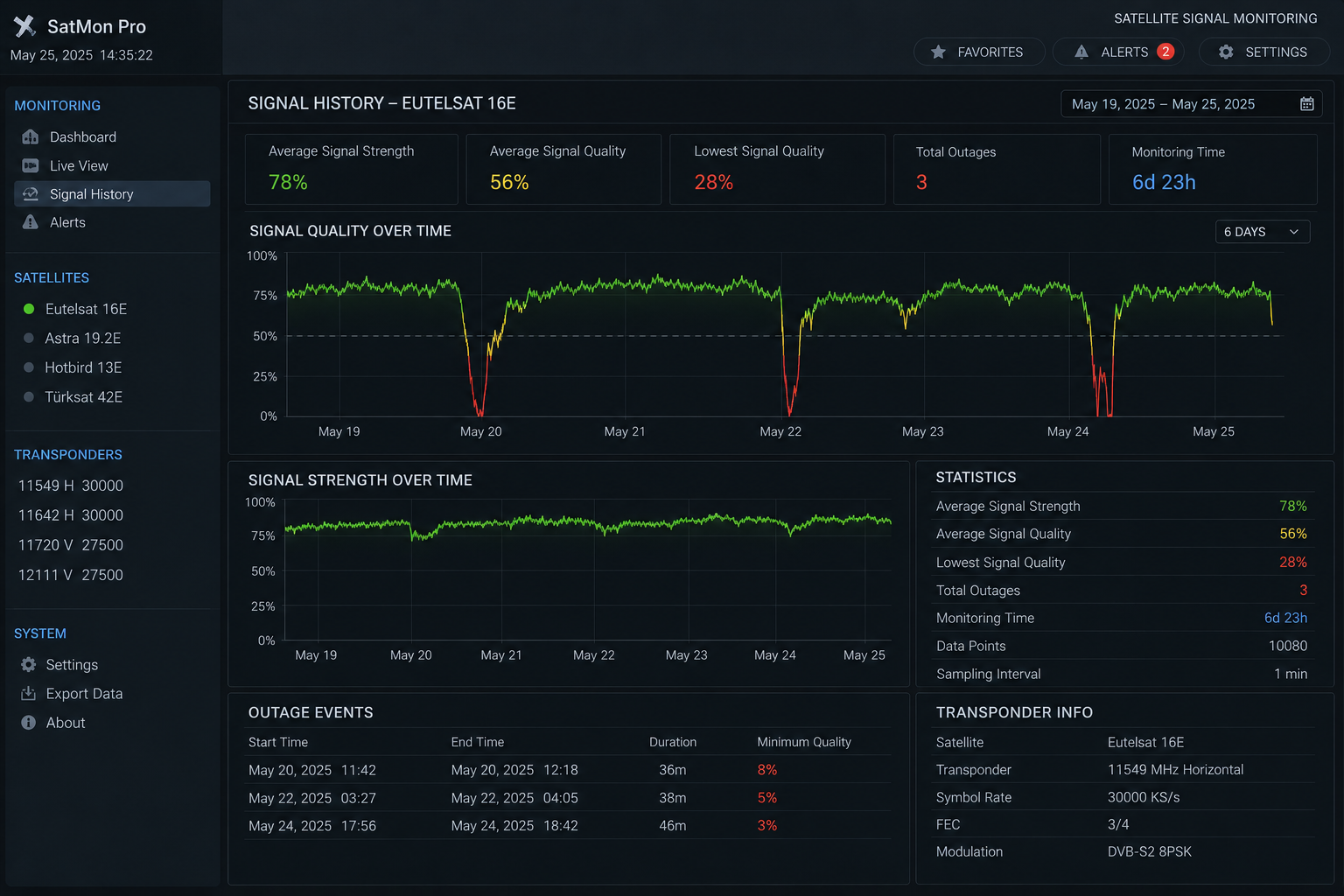
Signal margin naturally increases and decreases throughout the day.
Most users never notice this because strong systems maintain enough reserve to remain stable.
Weak installations reveal these fluctuations through freezing, pixelation, and inconsistent scanning results.
Temperature Changes Affect Reception
Outdoor satellite equipment experiences constant temperature variation.
The dish heats during daylight and cools after sunset.
The LNB operates under different thermal conditions throughout the day.
Electronic components respond to these changes.
Small thermal variations can influence oscillator stability and signal processing accuracy.
Most modern systems handle this well.
However, installations with limited signal margin often reveal these changes through varying quality readings.
LNB Stability Changes Throughout The Day
The LNB plays a critical role in reception stability.
Its internal oscillator must maintain accurate frequency conversion.
As temperature changes, oscillator behavior may change slightly.
This phenomenon is known as frequency drift.
Even small amounts of drift can influence difficult DVB-S2 transponders.
A transponder that locks perfectly one day may become slightly harder to decode the next.
The satellite remains identical.
The receiving hardware behaves differently.
Weather Influences Signal Quality
Weather affects satellite reception more than many viewers realize.
Humidity levels vary daily.
Cloud density changes.
Atmospheric moisture fluctuates.
Rain may not be present, yet environmental attenuation still changes.
These effects are usually small.
However, when signal margin is limited, even small losses become visible through quality fluctuations.
Atmospheric Conditions Matter More Than Expected
Microwave signals travel through the atmosphere before reaching the dish.
Changes in air density, humidity, and temperature layers affect propagation characteristics.
Strong installations absorb these variations with little visible effect.
Marginal systems often reveal them through changing signal quality measurements.
Daily atmospheric variation is one reason identical installations may perform differently from one day to the next.
Receiver Behavior And Synchronization
Receivers constantly synchronize with incoming digital streams.
When signal quality remains high, synchronization is easy.
When quality fluctuates, the receiver works harder.
BER may increase temporarily.
Channels may freeze briefly.
Synchronization may recover moments later.
These short interruptions often create the impression of unstable satellite transmission even though the real issue is local reception variation.
Marginal Alignment Amplifies Daily Changes
A perfectly optimized dish alignment provides maximum signal margin.
A dish that is slightly off target may still work normally.
However, the reduced reserve makes the system more sensitive to daily environmental changes.
What appears to be a satellite problem is often an alignment problem that only becomes visible under changing conditions.
Many reception issues disappear completely after precise alignment optimization.
Technical Comparison Table
| Factor | Stable Day | Unstable Day |
|---|---|---|
| Signal margin | Comfortable reserve | Reduced reserve |
| LNB stability | Consistent | Possible drift |
| Atmospheric conditions | Favorable | Less favorable |
| BER | Low | Elevated |
| DVB-S2 decoding | Reliable | More difficult |
| Reception quality | Stable | Variable |
How To Reduce Daily Reception Variations
The most effective solution is increasing signal margin.
Fine-tune dish alignment carefully.
Verify LNB skew accuracy.
Replace aging LNBs if frequency stability becomes questionable.
Inspect connectors and cables for degradation.
Monitor quality rather than strength when evaluating performance.
A strong installation should remain stable despite normal daily environmental changes.
For additional insight into seasonal reception differences, read Why Eutelsat 16E Works Better In Winter Than Summer.
Daily reception changes rarely mean the satellite is behaving differently. Most fluctuations originate from the receiving environment. Temperature shifts, signal margin changes, atmospheric conditions, and hardware stability all influence reception quality from one day to the next.
The real reason Eutelsat 16E reception changes daily is that satellite reception depends on a dynamic environment. Signal margin, temperature, LNB stability, atmospheric conditions, and receiver synchronization constantly fluctuate. A strong installation absorbs these variations while a marginal system exposes them through changing reception quality. Maximizing signal margin remains the most effective way to achieve consistent performance.
FAQ
| Question | Answer |
|---|---|
| Why does reception change even when the dish never moves? | Because environmental and hardware conditions change continuously. |
| Can temperature affect signal quality? | Yes. Temperature influences electronic stability and frequency accuracy. |
| What is signal margin? | The reserve above the minimum decoding threshold required for stable reception. |
| Does weather affect satellite reception every day? | Yes. Humidity and atmospheric conditions vary continuously. |
| Can an old LNB create daily reception changes? | Yes. Frequency drift often becomes more visible as components age. |
| How can I make reception more consistent? | Improve alignment, maximize signal margin, and maintain stable hardware. |