Why Eutelsat 16E Works Better In Winter Than Summer
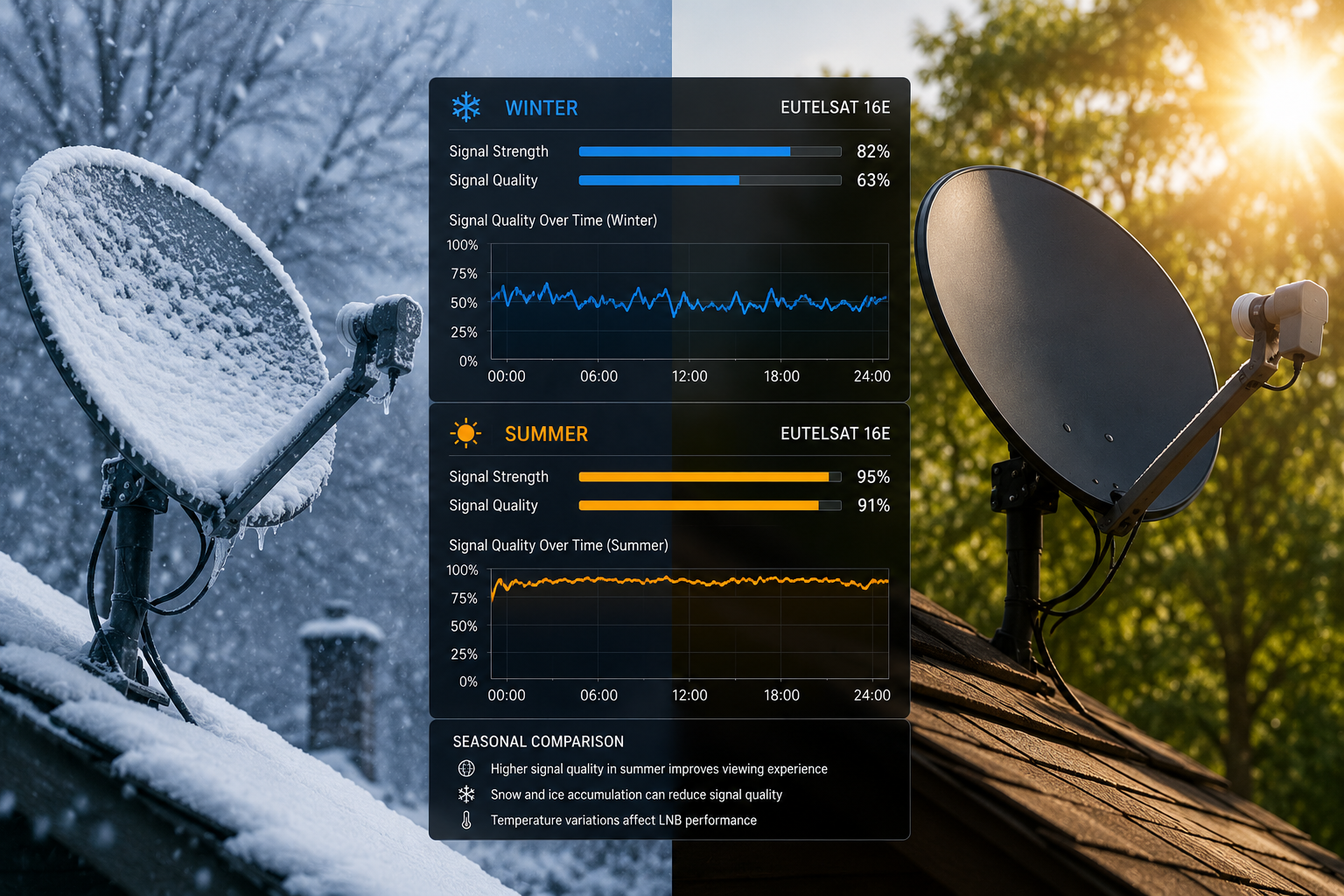
Estimated reading time: 18 minutes.
- Why winter reception often feels stronger.
- How temperature affects LNB performance.
- Signal margin changes throughout the year.
- Dish behavior in extreme heat.
- DVB-S2 sensitivity to seasonal conditions.
- Receiver synchronization stability.
- Atmospheric influences on signal quality.
- Practical ways to improve summer reception.
- Why Winter Often Improves Reception
- The Role Of Temperature In Satellite Systems
- How LNB Performance Changes With Heat
- Signal Margin During Summer And Winter
- Dish Expansion And Mechanical Stability
- Why HD Channels Benefit Most
- Receiver Synchronization And Seasonal Stability
- Atmospheric Conditions Throughout The Year
- Technical Comparison Table
- How To Improve Summer Performance
- Reality Check
- Final Verdict
- FAQ
Why Winter Often Improves Reception
The satellite itself does not suddenly become stronger during winter.
What changes is the environment surrounding the receiving equipment.
Lower temperatures generally create more stable operating conditions for electronic components.
LNB oscillators behave more consistently.
Thermal stress decreases.
Mechanical expansion becomes less significant.
As a result, the receiver often receives a cleaner signal with fewer decoding challenges.
The improvement is usually not dramatic, but even small gains in signal quality can make a major difference on demanding DVB-S2 transponders.
The Role Of Temperature In Satellite Systems
Temperature affects nearly every component in a satellite installation.
The dish sits outdoors all year.
The LNB operates continuously in sunlight.
Cables experience daily heating and cooling cycles.
During summer, rooftop temperatures can become extremely high.
Electronic components operate under greater thermal stress.
In winter, lower temperatures often help those components remain closer to their optimal operating conditions.
The result is improved stability across the entire signal chain.
How LNB Performance Changes With Heat
The LNB is one of the most temperature-sensitive components in the system.
Inside the LNB, an oscillator converts high satellite frequencies into lower frequencies that the receiver can process.
As temperature rises, oscillator stability can decrease.
Frequency drift becomes more likely.
Even small amounts of drift can affect modern DVB-S2 signals.
During winter, lower temperatures help the oscillator maintain greater frequency accuracy.
This improves synchronization and reduces the likelihood of decoding errors.
Signal Margin During Summer And Winter
Signal margin is the reserve above the minimum decoding threshold.
Strong installations maintain a comfortable reserve.
Marginal installations operate much closer to the edge.
Summer heat can slightly reduce effective margin through thermal instability and increased hardware stress.
Winter conditions often restore some of that lost reserve.
The receiver gains additional room to handle small fluctuations without losing synchronization.
This is why channels that struggle during hot weather often become stable once temperatures fall.
Dish Expansion And Mechanical Stability
Metal structures expand when heated and contract when cooled.
Although dish movement caused by thermal expansion is extremely small, satellite reception depends on precise geometry.
A dish that is already slightly misaligned may lose additional quality during intense summer heat.
As temperatures drop, the structure returns closer to its original shape.
This can improve signal quality by a small but meaningful amount.
On difficult Eutelsat 16E transponders, that improvement may be enough to eliminate freezing and lock problems.
Why HD Channels Benefit Most
HD channels usually operate using DVB-S2 transmission.
DVB-S2 provides excellent bandwidth efficiency but requires cleaner signal conditions.
Small changes in BER and signal quality affect HD services more aggressively.
Because winter often improves overall signal stability, HD channels tend to benefit first.
Viewers may notice fewer freezes, faster lock times, and improved channel reliability.
The satellite signal has not changed.
The receiving environment has become more favorable.
Receiver Synchronization And Seasonal Stability
Receivers continuously synchronize with incoming data streams.
When BER remains low, synchronization is easy to maintain.
When BER increases, the receiver works harder to rebuild the transport stream.
Summer conditions sometimes increase the frequency of small decoding errors.
Winter conditions often reduce those errors.
The result is more consistent receiver behavior and fewer interruptions.
Atmospheric Conditions Throughout The Year
The atmosphere affects microwave propagation in subtle ways.
Humidity, temperature gradients, and environmental conditions vary throughout the year.
While seasonal atmospheric effects are usually smaller than hardware-related factors, they still contribute to overall signal behavior.
Strong installations absorb these changes easily.
Marginal installations often reveal them through changing signal quality readings.
This is why seasonal performance differences become more visible on weaker systems.
Technical Comparison Table
| Factor | Winter Conditions | Summer Conditions |
|---|---|---|
| LNB stability | Generally better | More thermal stress |
| Frequency drift | Lower risk | Higher risk |
| Signal margin | Often slightly higher | May shrink |
| Dish stability | More consistent | Thermal expansion possible |
| DVB-S2 reliability | Improved | More sensitive to weaknesses |
| HD channel stability | Usually better | More likely to show issues |
How To Improve Summer Performance
The best solution is increasing signal margin.
Fine-tune dish alignment to maximize quality rather than strength.
Verify correct LNB skew.
Replace aging or unstable LNB units.
Inspect connectors for corrosion and weather damage.
Ensure cables remain in good condition.
A strong installation usually remains stable throughout the year regardless of seasonal temperature changes.
For additional insight into why certain frequencies require more margin than others, read Why Some 16E Channels Need More Signal Than Others.
Winter does not magically strengthen Eutelsat 16E. Instead, lower temperatures often improve the behavior of the receiving system itself. Better LNB stability, reduced thermal stress, and slightly improved signal margin create the impression of a stronger satellite signal.
Eutelsat 16E often works better in winter because the receiving equipment performs more efficiently under cooler conditions. LNB oscillators become more stable, thermal expansion decreases, signal margin improves, and DVB-S2 synchronization becomes easier to maintain. While the satellite remains unchanged, the local reception environment becomes far more favorable for reliable HD reception.
FAQ
| Question | Answer |
|---|---|
| Does Eutelsat 16E transmit a stronger signal in winter? | No. The improvement usually comes from the receiving system, not the satellite. |
| Why do HD channels improve during winter? | Lower temperatures often improve LNB stability and signal margin. |
| Can heat affect satellite reception? | Yes. Heat can increase thermal stress, frequency drift, and alignment sensitivity. |
| Does an LNB perform differently in summer? | Yes. High temperatures may reduce oscillator stability and increase drift. |
| Can dish expansion affect reception? | Small thermal expansion effects can influence signal quality on marginal installations. |
| How can I improve summer stability? | Optimize alignment, improve signal margin, and use stable high-quality hardware. |