Why Some 16E Channels Need More Signal Than Others
Estimated reading time: 17 minutes.
- Why some Eutelsat 16E channels need stronger signal.
- DVB-S2 sensitivity differences.
- Modulation density and decoding thresholds.
- Signal margin behavior.
- BER and receiver lock stability.
- Why HD channels often fail first.
- Transponder configuration differences.
- How to improve difficult frequency reception.
- Why The Same Satellite Can Behave Differently
- Every Transponder Has Different Requirements
- Modulation Density Changes Signal Sensitivity
- DVB-S2 Requires Cleaner Reception
- Signal Margin Explains Most Differences
- Why HD Channels Usually Need Better Signal
- BER And Decoding Stability
- Receiver Lock Behavior Across Frequencies
- Technical Comparison Table
- How To Improve Weak 16E Frequencies
- Reality Check
- Final Verdict
- FAQ
Why The Same Satellite Can Behave Differently
Many users imagine Eutelsat 16E as one single signal source.
In reality, the satellite carries multiple transponders operating under different technical conditions.
Each transponder has its own configuration.
Different frequencies may use different symbol rates, modulation systems, bitrate allocation strategies, and correction parameters.
Because of this, two channels on the same satellite can react very differently under identical reception conditions.
One channel may continue working perfectly.
Another may begin freezing or disappear completely.
The difference often comes from decoding requirements rather than signal presence alone.
Every Transponder Has Different Requirements
A transponder acts like a digital carrier transporting multiple television services.
Some transponders are configured conservatively.
Others are optimized for maximum efficiency.
The more aggressively bandwidth is used, the more demanding reception becomes.
This means certain transponders naturally require cleaner signal quality.
Users often notice that the same frequencies repeatedly become unstable.
That pattern usually indicates transponder sensitivity rather than random signal behavior.
The transponder is exposing weaknesses already present in the reception system.
Modulation Density Changes Signal Sensitivity
One major factor is modulation density.
Modern satellite broadcasting often uses advanced modulation methods such as 8PSK.
These systems allow more data to fit into the same bandwidth.
The advantage is greater transmission efficiency.
The disadvantage is lower tolerance for signal degradation.
Higher-density modulation requires cleaner reception conditions.
Small quality losses affect these signals much faster.
This is one reason some channels disappear first when signal quality begins falling.
DVB-S2 Requires Cleaner Reception
Many Eutelsat 16E HD channels use DVB-S2 technology.
DVB-S2 dramatically improves bandwidth efficiency compared to older DVB-S systems.
However, improved efficiency comes with stricter synchronization requirements.
The receiver must maintain more accurate lock conditions.
Small BER increases become more important.
Weak signal margin becomes more visible.
This explains why DVB-S2 frequencies often reveal installation weaknesses before older services do.
The transponder is not weaker.
Its decoding requirements are simply more demanding.
Signal Margin Explains Most Differences
Signal margin is the reserve above the minimum decoding threshold.
Every transponder effectively requires its own quality reserve.
Some frequencies continue working with relatively small margin.
Others need additional reserve to remain stable.
A dish installation operating close to the threshold may appear fine until difficult transponders begin exposing the weakness.
Users often think those channels are defective.
The reality is that those channels simply demand better reception conditions.
They reveal problems that stronger frequencies can hide.
Why HD Channels Usually Need Better Signal
HD channels often combine several demanding factors.
They typically use DVB-S2.
They often rely on higher-density modulation.
They usually carry larger amounts of video data.
All of these elements increase decoding sensitivity.
When signal quality begins dropping, HD channels frequently show problems before SD services.
Freezing, pixelation, and lock loss appear first on the channels requiring cleaner synchronization.
This is why users sometimes believe HD frequencies are weaker.
In most cases, they simply require better signal quality.
BER And Decoding Stability
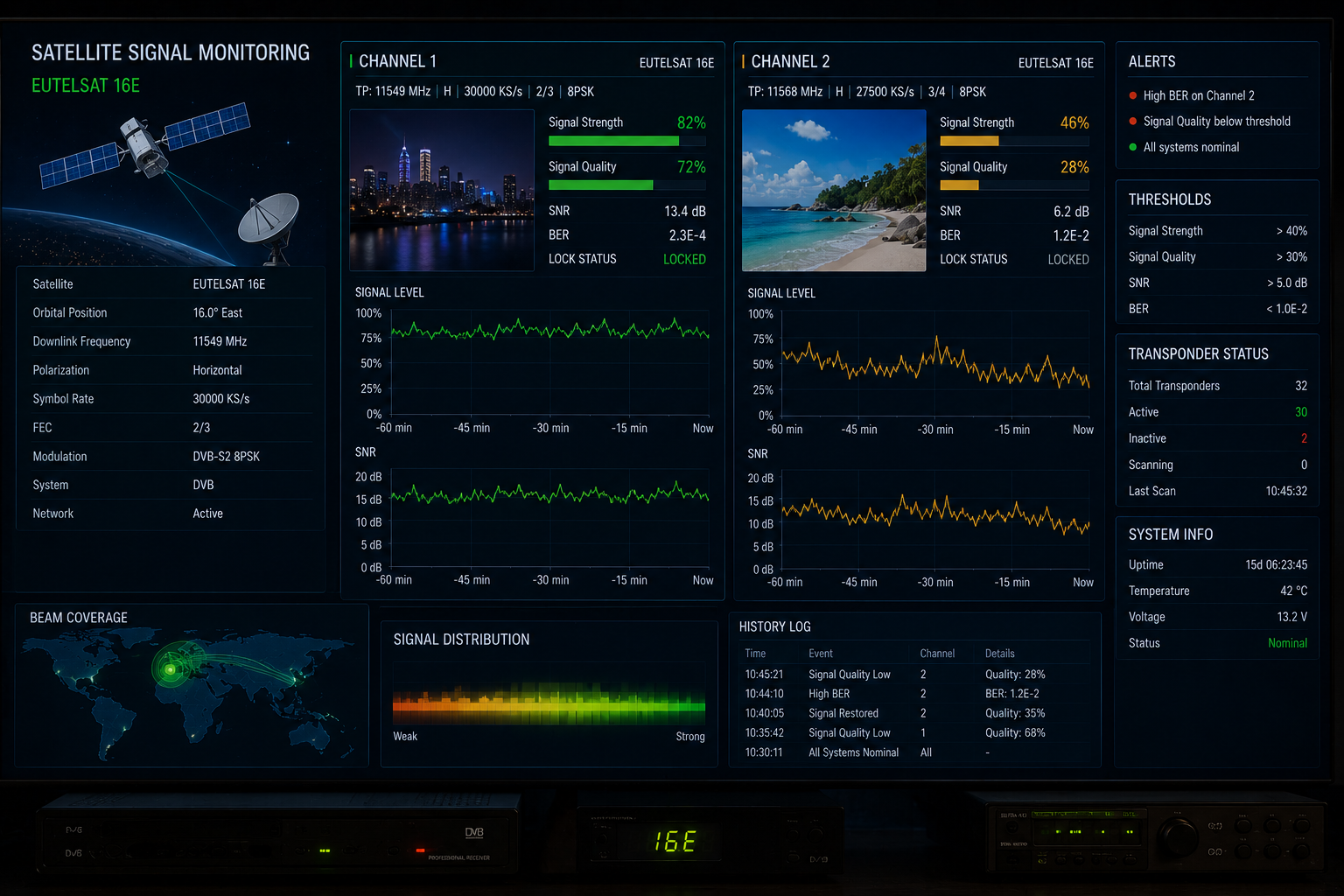
BER plays a critical role in determining which channels remain stable.
Receivers constantly repair transmission errors.
As BER increases, correction systems work harder.
Sensitive transponders reach their correction limits sooner.
One channel may continue decoding successfully while another collapses completely.
This difference often comes from how much BER reserve each transponder can tolerate before synchronization breaks down.
The signal is still present physically.
The decoding process is what fails first.
Receiver Lock Behavior Across Frequencies
Receivers do not lock every transponder equally.
Some frequencies synchronize quickly.
Others require more accurate timing and cleaner signal conditions.
When signal quality fluctuates, the receiver may repeatedly gain and lose lock on sensitive frequencies.
Users often interpret this as random instability.
The real issue is that the receiver is operating too close to the decoding threshold.
Small changes in signal quality become enough to break synchronization temporarily.
Technical Comparison Table
| Factor | Less Demanding Channel | More Demanding Channel |
|---|---|---|
| Signal margin requirement | Lower | Higher |
| BER tolerance | More forgiving | Less forgiving |
| DVB-S2 sensitivity | Moderate | Higher |
| HD decoding stability | More resilient | Requires cleaner signal |
| Reaction to weak alignment | Less visible | More visible |
| Receiver lock reliability | Easier | More demanding |
How To Improve Weak 16E Frequencies
The first step is maximizing signal quality rather than chasing strength percentages.
Fine dish alignment becomes extremely important on sensitive transponders.
Even small improvements can create meaningful signal margin gains.
Check LNB quality and frequency stability.
Weak LNB performance often affects demanding frequencies first.
Inspect cables and connectors carefully.
Small losses become much more visible on difficult DVB-S2 transponders.
Monitor BER rather than relying only on strength indicators.
Stable low BER usually matters more than high strength readings.
For a deeper explanation of why Eutelsat 16E often feels more demanding than other orbital positions, read Why Eutelsat 16E Feels Harder Than Hotbird In 2026.
Some 16E channels need more signal because they use more demanding transmission settings. The satellite is not treating channels differently on purpose. Differences in modulation, DVB-S2 requirements, BER tolerance, and signal margin determine how easily each frequency can be decoded under real reception conditions.
The real reason some Eutelsat 16E channels need more signal than others comes from their technical transmission requirements. Higher-density modulation, DVB-S2 sensitivity, HD decoding demands, and smaller BER tolerance make certain frequencies much less forgiving. Strong alignment, stable hardware, and healthy signal margin are what allow difficult transponders to remain stable while weaker installations struggle.
FAQ
| Question | Answer |
|---|---|
| Why do some channels disappear before others? | Because some transponders require cleaner signal quality and stronger synchronization. |
| Are HD channels weaker than SD channels? | Usually no. They are simply more demanding to decode. |
| Does DVB-S2 require better signal? | Yes. DVB-S2 improves efficiency but often needs cleaner reception conditions. |
| Can a weak LNB affect only certain frequencies? | Yes. Sensitive transponders usually reveal LNB weaknesses first. |
| Why does signal strength look normal? | Because decoding stability depends more on signal quality and BER than strength alone. |
| What is the best fix for difficult frequencies? | Improve alignment, signal margin, LNB stability, and cable quality. |