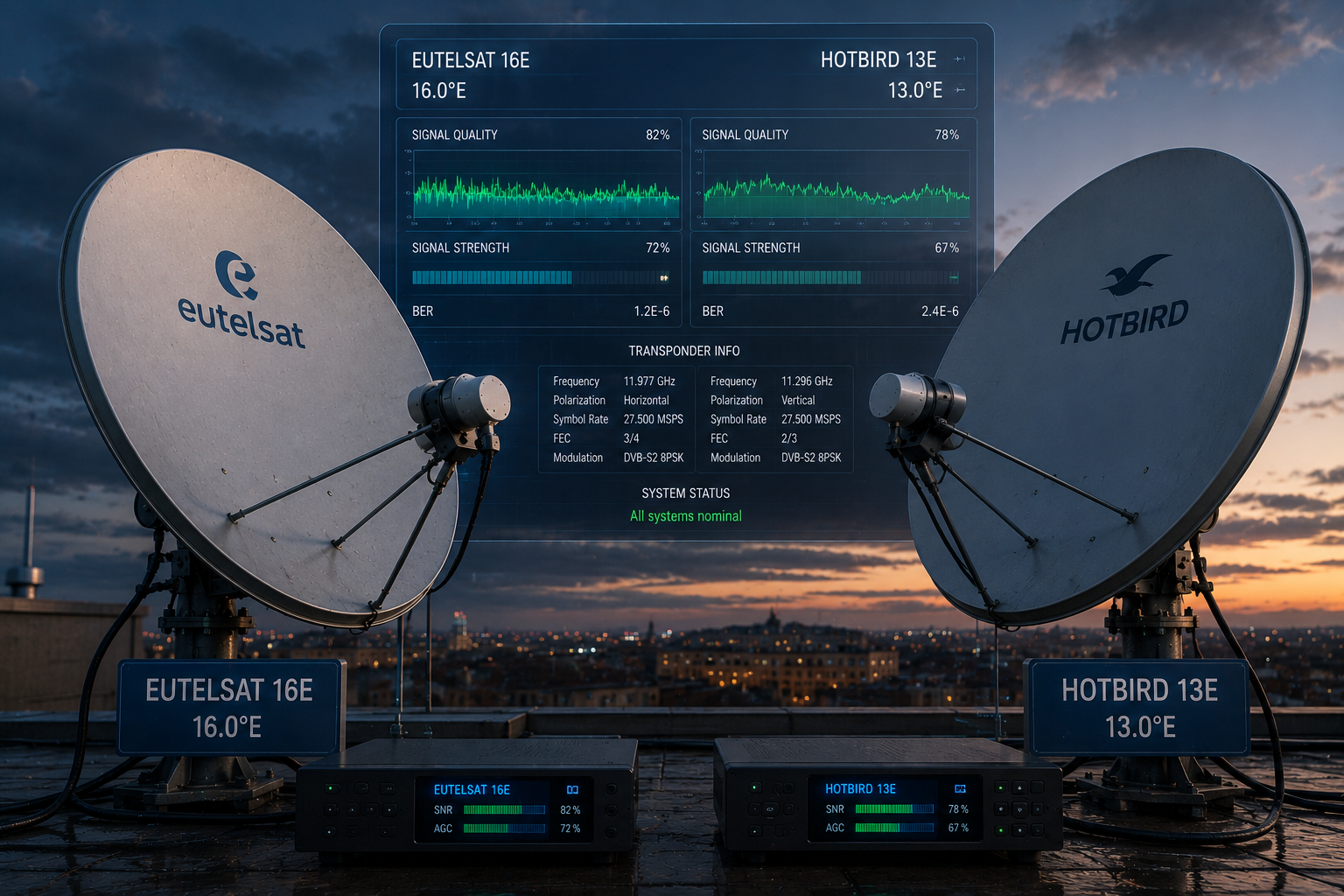
Why Eutelsat 16E Feels Harder Than Hotbird In 2026
Estimated reading time: 18 minutes.
This article explains:
- Why Eutelsat 16E feels harder than Hotbird.
- Beam coverage and footprint behavior.
- Signal margin differences.
- Dish alignment sensitivity.
- DVB-S2 transponder requirements.
- Weather resistance and rain fade.
- LNB precision and polarization accuracy.
- Why modern 16E reception often requires better optimization.
- Why Many Users Notice The Difference Immediately
- Beam Coverage and Footprint Behavior
- Signal Margin Makes Everything Easier
- Why Eutelsat 16E Is Less Forgiving During Alignment
- Modern DVB-S2 Density Changes Everything
- Weather Resistance and Rain Fade
- LNB Accuracy and Polarization Sensitivity
- Receiver Behavior On Difficult Transponders
- Technical Comparison Table
- How To Make Eutelsat 16E Feel Easier
- Reality Check
- Final Verdict
- FAQ
Why Many Users Notice The Difference Immediately
The comparison often starts during installation.
A user points a dish toward Hotbird and quickly receives stable channels with relatively comfortable signal readings.
Then the same user moves toward Eutelsat 16E and suddenly notices that certain frequencies appear weaker, more sensitive, or less stable.
This experience is common because not all satellite positions provide identical reception conditions.
Different orbital slots use different beam designs, transponder strategies, and coverage priorities.
Some systems provide stronger margin across wider regions.
Others require more accurate reception conditions to achieve the same stability.
Beam Coverage and Footprint Behavior
One major factor is beam coverage design.
Satellite beams are not distributed equally across all geographic regions.
Every transponder operates within a defined footprint that determines how much signal power reaches different locations on Earth. :contentReference[oaicite:1]{index=1}
Hotbird traditionally serves a very large European audience and often maintains strong reception margins across broad coverage areas.
Many Eutelsat 16E transponders focus more heavily on specific regional markets.
As a result, some users receive slightly less margin depending on their location.
That difference may only be a few decibels, but in satellite reception a few decibels can completely change long-term stability.
Signal Margin Makes Everything Easier
Signal margin is the hidden factor behind easy reception.
A strong signal margin means the receiver has extra reserve above the minimum decoding threshold.
When margin is large, the system tolerates alignment errors, humidity changes, and light rain much more easily.
When margin is small, every weakness becomes visible.
Many Eutelsat 16E installations operate closer to the decoding edge than comparable Hotbird systems.
This does not mean channels cannot be received properly.
It means the installation often requires greater optimization to maintain the same reliability.
Users frequently interpret this as the satellite being harder.
In reality, the available margin is simply less forgiving.
Why Eutelsat 16E Is Less Forgiving During Alignment
Dish alignment precision becomes more important when signal margin decreases.
A small alignment error on a strong system may remain invisible.
The same error on a marginal system may immediately create instability.
Many users discover that Eutelsat 16E reacts strongly to very small alignment changes.
A tiny movement sometimes improves quality dramatically.
This happens because the quality peak often exists inside a narrow adjustment window.
When the dish misses that peak slightly, weak transponders begin showing problems first.
Professional installers often spend more time optimizing Eutelsat 16E because maximizing quality reserve becomes critical.
Even satellite hobbyist discussions frequently highlight how specific 16E transponders reveal alignment weaknesses faster than stronger orbital positions. :contentReference[oaicite:2]{index=2}
Modern DVB-S2 Density Changes Everything
Modern satellite broadcasting depends heavily on DVB-S2 technology.
DVB-S2 allows broadcasters to fit more data into the same transponder bandwidth.
The advantage is better efficiency.
The disadvantage is lower tolerance for weak signal conditions.
Many modern Eutelsat 16E HD services rely on DVB-S2 with higher-order modulation systems such as 8PSK. :contentReference[oaicite:3]{index=3}
These systems require cleaner synchronization and stronger signal quality.
Small BER increases affect them much faster.
As broadcasting becomes more bandwidth-efficient in 2026, installation precision becomes more important than ever.
This trend makes Eutelsat 16E feel harder for users who previously relied on older, more forgiving reception conditions.
Weather Resistance and Rain Fade
Weather reveals signal margin problems very quickly.
Rain fade removes part of the available signal reserve.
A strong installation survives without visible changes.
A weaker installation begins showing freezing, blocking, or complete signal loss.
Research on DVB-S and DVB-S2 downlink behavior confirms that atmospheric attenuation directly affects decoding stability, especially when reserve margin becomes limited. :contentReference[oaicite:4]{index=4}
Many users notice that Hotbird appears more stable during rain.
The reason is often not magical satellite superiority.
The system simply starts with more usable margin in many locations.
Once weather removes part of that reserve, enough quality still remains available.
LNB Accuracy and Polarization Sensitivity
LNB quality matters much more when reception conditions become demanding.
Low-noise LNB units with stable oscillators maintain better synchronization on sensitive DVB-S2 transponders.
LNB skew adjustment is equally important.
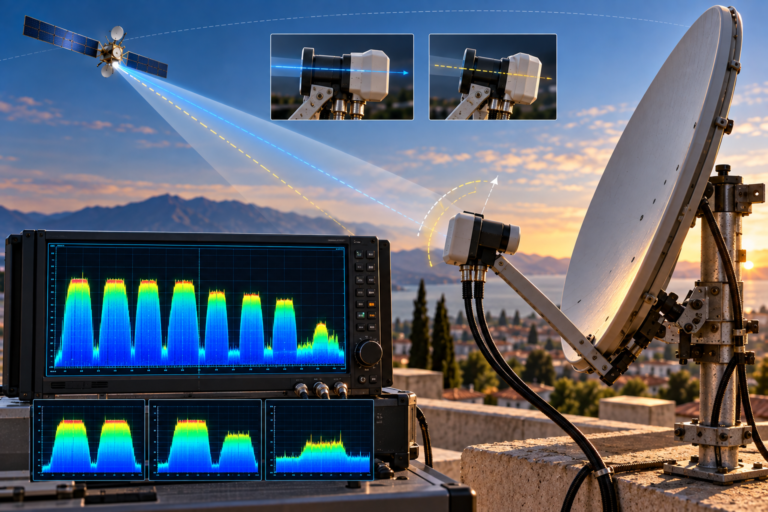
Incorrect polarization angle reduces isolation between horizontal and vertical frequencies.
Some Eutelsat 16E frequencies react very strongly to skew errors.
The user may believe the satellite is difficult while the real issue comes from polarization contamination.
A small skew correction sometimes improves quality more than moving the dish itself.
Receiver Behavior On Difficult Transponders
Receivers do not simply display signal.
They continuously reconstruct digital transport streams while correcting transmission errors.
Some tuners handle difficult DVB-S2 signals much better than others.
Higher-quality receivers usually maintain synchronization longer when BER begins increasing.
Cheap tuners may lose lock quickly.
This creates situations where one receiver handles Eutelsat 16E comfortably while another struggles on the same installation.
The receiver often exposes underlying signal margin weaknesses rather than creating them directly.
Technical Comparison Table
| Factor | Typical Hotbird Experience | Typical Eutelsat 16E Experience |
|---|---|---|
| Alignment tolerance | More forgiving | Requires greater precision |
| Signal margin | Often higher | Can be tighter |
| Weak transponder behavior | Less visible | More noticeable |
| Rain fade resistance | Usually stronger reserve | Margin becomes critical |
| DVB-S2 sensitivity | Moderate | Often more demanding |
| Installation optimization importance | Important | Extremely important |
How To Make Eutelsat 16E Feel Easier
The first step is maximizing signal quality instead of focusing only on signal strength.
Fine dish alignment should be performed using quality readings and BER stability whenever possible.
LNB skew must be optimized carefully.
Old LNB units should be replaced if thermal drift or synchronization instability appears.
Cable condition also matters.
Moisture damage, weak shielding, and connector oxidation reduce quality reserve.
In weaker coverage areas, a larger dish often improves long-term stability significantly. Larger reflector gain directly increases available signal margin and weather resistance. :contentReference[oaicite:5]{index=5}
For deeper analysis of weather-related signal collapse on Eutelsat 16E, read Why HD Channels On Eutelsat 16E Break First During Rain.
Eutelsat 16E is not necessarily harder because the satellite itself is weaker. The real difference often comes from tighter signal margins, more demanding DVB-S2 transponders, beam coverage variations, and the fact that modern broadcasting systems expose installation weaknesses much faster. Small alignment errors that remain invisible on stronger systems become obvious on sensitive frequencies. :contentReference[oaicite:6]{index=6}
In 2026, Eutelsat 16E often feels harder than Hotbird because it leaves less room for installation mistakes. Signal margin, alignment precision, LNB stability, and transponder sensitivity all play a larger role. Users who optimize their systems carefully usually achieve excellent results, but Eutelsat 16E tends to reward precision and punish small weaknesses much more aggressively than more forgiving orbital positions.
FAQ
| Question | Answer |
|---|---|
| Is Eutelsat 16E weaker than Hotbird? | Not necessarily. Reception difficulty often depends on location and signal margin. |
| Why does alignment feel harder on 16E? | Because some transponders react more strongly to small alignment errors. |
| Can a larger dish help Eutelsat 16E? | Yes. Additional gain improves signal reserve and weather resistance. |
| Why do weak frequencies appear first on 16E? | Because sensitive transponders expose installation weaknesses more quickly. |
| Does DVB-S2 make reception harder? | It improves efficiency but requires cleaner signal quality and stronger synchronization. |
| What is the best way to improve 16E stability? | Maximize signal quality through precise alignment, stable LNB performance, and healthy cabling. |