What Satellite Do Germans Use for TV?
Estimated Reading Time: 11 minutes
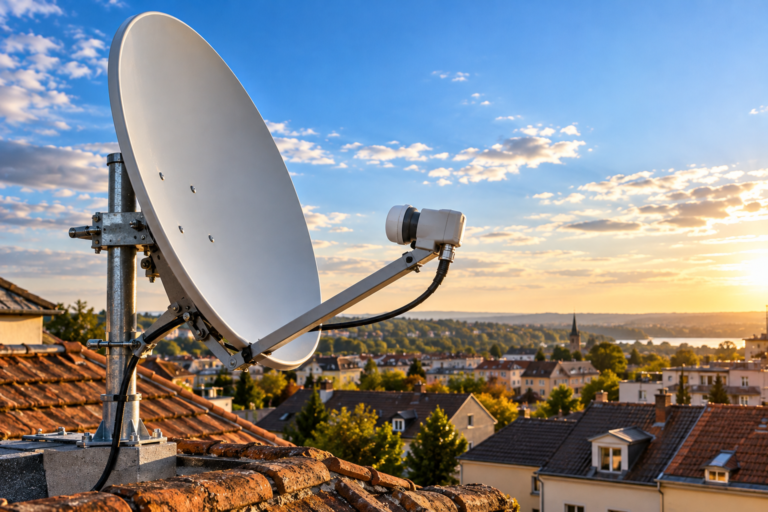
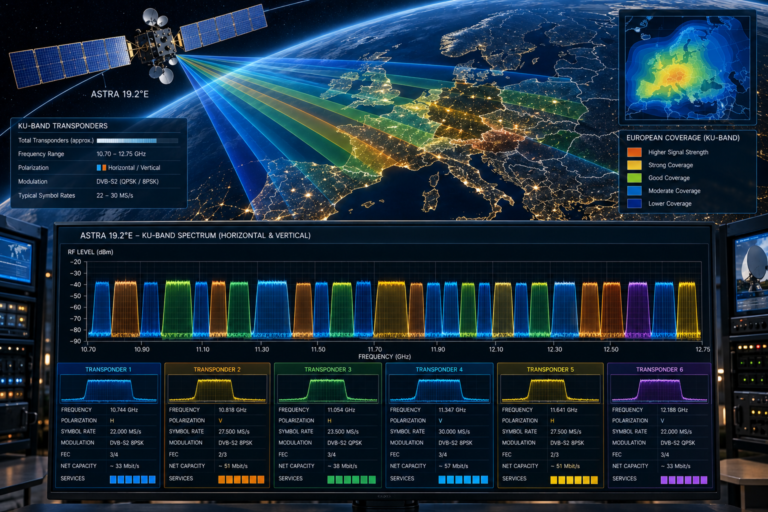
For mainstream German satellite television, the most important orbital position is Astra 19.2 degrees East. This is where a very large part of Germany’s public, commercial, HD, radio, and subscription television ecosystem is concentrated. A correctly aligned fixed dish can therefore receive many German services without moving between different orbital positions.
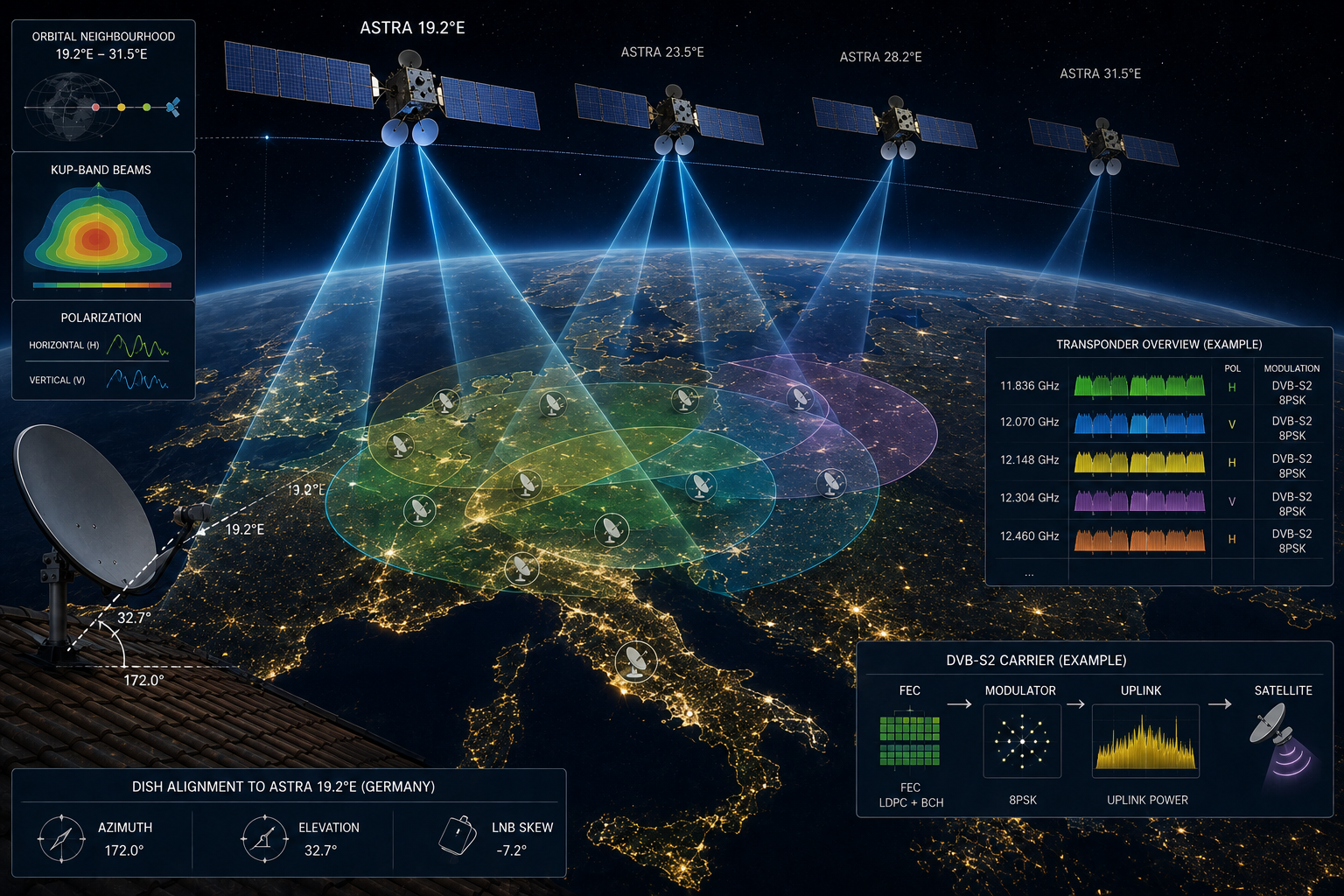
Astra 19.2E should not be thought of as one single satellite. It is an orbital neighbourhood where several Astra spacecraft can operate around the same nominal longitude. German viewers point one dish toward that position, while the receiver electronically selects different transponders, frequencies, polarizations, and DVB-S2 services from the same general direction.
The short answer is Astra 19.2E. For most German satellite households, this is the central television position because it combines strong European coverage with a very dense German channel lineup. The dish position stays fixed, while the LNB and receiver select the required carrier electronically.
- Why Astra 19.2E Is the Main German TV Position
- What 19.2 Degrees East Actually Means
- Why It Is an Orbital Neighbourhood, Not One Satellite
- Which Astra Satellites Serve the Position
- Why Germany Gets Strong Coverage
- What Types of German Channels Are There
- How Public Broadcasters Use Astra
- How Private and HD+ Services Fit In
- Why One Fixed Dish Is Enough
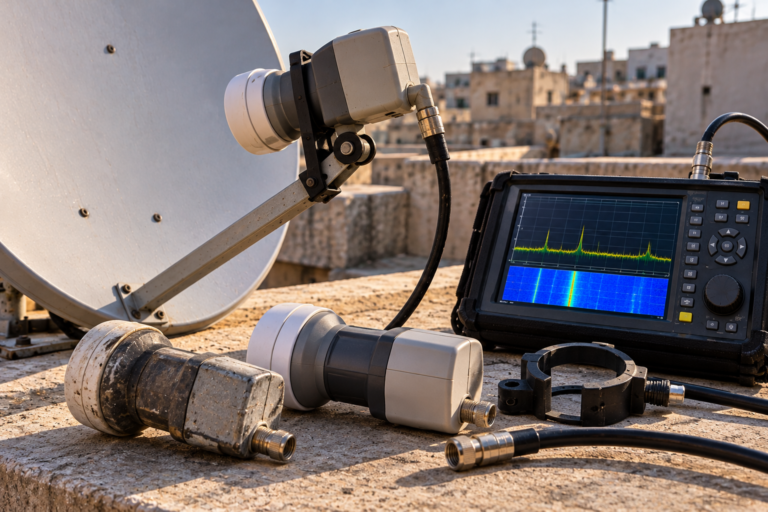
- How the LNB Selects Different German Channels
- Why DVB-S2 Matters
- Why Symbol Rates and Transponders Differ
- Why Signal Quality Can Vary Between Channels
- What Dish Size and Alignment Matter
- Why Not Every German Channel Must Be on Astra
- How to Set Up German Satellite TV Correctly
- Reality Check
- Final Verdict
- FAQ
Why Astra 19.2E Is the Main German TV Position
Astra 19.2E became the central German satellite television position because broadcasters and viewers built around the same orbital location over many years.
Once large numbers of households had dishes pointed toward 19.2E, broadcasters had a strong reason to distribute their services there. As more broadcasters joined, the position became even more attractive to viewers.
This created a mature television neighbourhood containing public services, commercial channels, HD platforms, radio, and specialist programming.
For the viewer, the benefit is simple. One dish can reach a large part of the German satellite television market without mechanical movement.
What 19.2 Degrees East Actually Means
Geostationary satellites orbit above the equator at roughly 35,786 kilometres altitude.
They travel around Earth at the same angular rate that Earth rotates, so from the ground they appear to remain almost fixed in the sky.
The number 19.2 degrees East refers to the orbital longitude of the satellite neighbourhood above the equator.
A dish in Germany must be aimed at the correct local azimuth and elevation corresponding to that orbital position.
The exact physical pointing angles change depending on where the household is located within Germany.
Why It Is an Orbital Neighbourhood, Not One Satellite
Astra 19.2E is a shared orbital slot rather than one spacecraft carrying every channel.
Several Astra satellites can be colocated within a controlled region around the same nominal longitude.
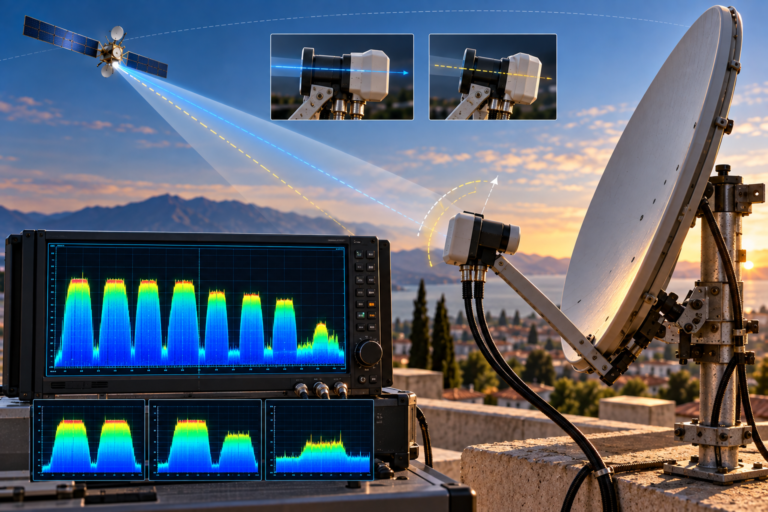
From the viewpoint of a normal domestic dish, these spacecraft appear close enough together that the same fixed antenna can receive services from all of them.
Different satellites can carry different groups of transponders, while the viewer experiences the result as one Astra 19.2E television position.
This architecture also allows satellite operators to renew ageing spacecraft without requiring millions of households to move their dishes.
Which Astra Satellites Serve the Position
The exact fleet at 19.2E changes over time as satellites enter or leave service.
Recent German channel listings have included services carried through spacecraft such as Astra 1N and Astra 1P.
The important point for the viewer is not normally the individual spacecraft name but the orbital position itself.
The receiver stores transponder frequencies and service data, while the dish remains pointed toward 19.2E.
Why Germany Gets Strong Coverage
Satellite antennas in orbit are designed to distribute RF power through specific beam patterns.
The Astra system has strong coverage across Germany and much of central Europe, which is one reason domestic satellite reception is practical with relatively modest dish sizes.
Good coverage provides stronger carrier-to-noise performance and more margin before weather or equipment problems push the receiver toward its DVB-S2 threshold.
Coverage is not completely identical on every transponder, however. Different spacecraft, beams, frequencies, and transmission parameters can still create measurable differences.
| Feature | What It Means | Why It Matters in Germany |
|---|---|---|
| Astra 19.2E | Main orbital neighbourhood for German satellite TV | One fixed dish reaches a large German channel ecosystem |
| Geostationary orbit | Satellite appears nearly fixed in the sky | No tracking system is needed for a normal fixed dish |
| Multiple colocated satellites | Several spacecraft can serve the same position | Capacity and infrastructure can be renewed over time |
| Ku-band | Primary frequency range for many DTH services | Allows practical domestic dish sizes |
| DVB-S2 | Modern satellite transmission standard | Supports efficient HD distribution |
| HD+ | German commercial HD ecosystem | Adds private HD services and hybrid functions |
| Horizontal and vertical polarization | Reuses satellite spectrum efficiently | Allows more transponders within the same band |
What Types of German Channels Are There
The German channel ecosystem at Astra 19.2E includes several different categories of television service.
Public broadcasters include major national and regional services. Commercial groups provide entertainment, news, sports, films, and specialist channels. Subscription and platform services add another layer.
Radio services and data applications also share the orbital position.
This density is one of the main reasons Astra 19.2E remains important. It is not valuable because of one famous channel but because many services coexist within the same receiving direction.
How Public Broadcasters Use Astra
German public broadcasters use satellite as an important one-to-many distribution path.
Services from groups such as ARD and ZDF are distributed in HD through Astra, allowing households across the coverage area to receive the same broadcast simultaneously.
This distribution model is especially efficient for large national audiences because the satellite transmits one carrier regardless of how many households are watching.
The move away from SD has not removed satellite distribution. It has simply reduced duplication by keeping modern HD services while older parallel SD versions are retired.
How Private and HD+ Services Fit In
Private German broadcasters also use Astra 19.2E extensively.
HD+ is an important part of that ecosystem because it provides access to a range of private HD services on compatible receiving equipment.
The satellite remains responsible for efficient linear broadcasting, while newer HD+ functions can also use the internet for interactive and on-demand features.
This makes Astra part of a hybrid television environment rather than an isolated legacy system.
Why One Fixed Dish Is Enough
A fixed satellite dish receives a relatively narrow angular region around the selected orbital position.
Because the Astra spacecraft at 19.2E are colocated closely enough, the dish does not need to move when the viewer changes from one Astra transponder to another.
The receiver selects channels electronically.
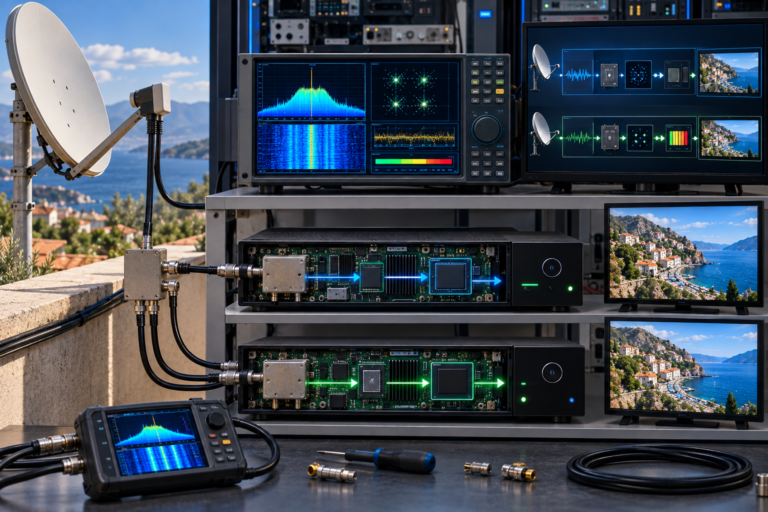
It changes tuner frequency, commands the LNB to select the required polarization and frequency band, and then demodulates the selected carrier.
Channel changes therefore happen inside the RF and digital electronics rather than through physical movement of the antenna.
How the LNB Selects Different German Channels
The LNB receives a broad section of the satellite Ku-band spectrum but converts only the requested operating band into the intermediate-frequency range sent through the coaxial cable.
A common Universal LNB uses different local oscillator frequencies for low and high bands.
The receiver sends a 22 kHz tone to select the high band when needed.
It also changes the DC voltage supplied through the coaxial cable to select the required polarization state.
This is why a fault in LNB switching can affect one group of German channels while other Astra services continue working normally.
Why DVB-S2 Matters
Modern German HD television relies heavily on DVB-S2.
DVB-S2 provides strong Forward Error Correction and flexible modulation choices such as QPSK and 8PSK.
This allows broadcasters to make more efficient use of limited satellite transponder capacity while still maintaining practical reception margins.
The receiver must support the actual transmission standard and modulation being used.
A very old DVB-S-only receiver may therefore show RF strength from a modern German transponder while remaining unable to decode it.
Why Symbol Rates and Transponders Differ
German channels on Astra 19.2E do not all use one symbol rate or one transponder configuration.
Different carriers may use symbol rates such as 22 MS/s or 27.5 MS/s depending on transponder bandwidth, modulation, roll-off, and capacity planning.
Symbol rate describes how many modulation symbols are transmitted each second.
It is not the same as video bitrate and it does not directly describe signal strength.
The receiver must know or correctly detect the symbol rate before it can recover the carrier reliably.
Why Signal Quality Can Vary Between Channels
Astra 19.2E should not be treated as one identical signal condition across every channel.
Different transponders can use different frequencies, polarizations, modulation, Forward Error Correction, beam characteristics, and power levels.
The receiving system also behaves differently across frequency.
LNB gain, oscillator quality, cable attenuation, local interference, and polarization isolation can all affect one transponder more than another.
This is why one German HD channel may show excellent MER while another operates closer to its decoding threshold.
What Dish Size and Alignment Matter
Dish size determines antenna gain and therefore contributes directly to available signal margin.
A larger reflector collects more microwave energy, but it also generally has a narrower beam and requires more precise alignment.
In Germany, ordinary domestic installations usually benefit from strong Astra coverage, but dish size should still match local conditions and installation requirements.
Accurate azimuth, elevation, and LNB skew are more important than simply achieving a high signal-strength percentage.
Fine alignment should use quality, MER, BER, or another meaningful digital measurement.
Why Not Every German Channel Must Be on Astra
Astra 19.2E is the main satellite television position for Germany, but that does not mean every German-language service must exist there.
Some channels may be distributed through cable, terrestrial television, internet platforms, other satellites, or direct streaming services.
Specialist, regional, international, and temporary services can also use other distribution paths.
The accurate statement is therefore that Astra 19.2E is the dominant mainstream satellite neighbourhood for German television, not that it is the only possible source of German programming.
How to Set Up German Satellite TV Correctly
Start with a clear line of sight toward Astra 19.2E and use the correct local azimuth and elevation for the installation location.
Align the dish using a known active transponder and optimize digital quality rather than signal strength alone.
Adjust LNB skew carefully to improve polarization isolation.
Verify both horizontal and vertical services and test low-band and high-band transponders so that LNB switching and distribution faults are not overlooked.
The receiver should support DVB-S2 and the video codecs used by the required German channels.
A complete channel scan should then populate the current service list.
For the deeper reason this orbital position became so dominant, see our guide to why Astra 19.2E is Germany’s most important satellite, which explains the broadcaster ecosystem, coverage, fleet design, and long-term infrastructure behind the position.
The simple answer is Astra 19.2E, but satellite television in Germany is not one satellite sending one giant television signal.
It is a complex orbital neighbourhood containing many transponders and multiple satellite spacecraft, each carrying different services and RF configurations.
Reception also depends on the household installation. A correctly pointed dish, healthy LNB, suitable receiver, good MER, low BER, and sufficient signal margin are all required for reliable modern German HD television.
For mainstream German satellite television, Astra 19.2E is the key orbital position.
Its importance comes from the concentration of German public, private, HD, radio, and platform services around one geostationary neighbourhood with strong coverage across Germany and central Europe.
The dish remains fixed because several Astra spacecraft can operate around the same nominal orbital longitude, while the LNB and receiver electronically select the required frequency, polarization, band, and DVB-S2 transponder.
The result is a mature and efficient television ecosystem. One properly installed dish can provide access to a large part of Germany’s satellite broadcast market, while modern DVB-S2 transmission and hybrid services allow that infrastructure to continue evolving alongside internet television.
| Question | Answer |
|---|---|
| What satellite do Germans mainly use for TV? | Astra 19.2E is the main orbital neighbourhood for mainstream German satellite television. |
| Is Astra 19.2E one satellite? | No. Multiple Astra spacecraft can operate around the same nominal orbital position. |
| Why can one fixed dish receive several Astra satellites? | The spacecraft are colocated closely enough that they appear in essentially the same direction to a domestic dish. |
| Does Astra carry German public channels? | Yes. Major German public services use Astra for satellite distribution. |
| Does Astra carry private German channels? | Yes. A large commercial television ecosystem also uses the position, including services associated with HD+. |
| Does every German channel use Astra 19.2E? | No. Some services can use cable, terrestrial, internet, other satellites, or specialist distribution paths. |
| What receiver do I need for modern German satellite TV? | A DVB-S2 capable receiver or television is important for many modern German HD services, along with support for the required video codecs. |
| Why do German Astra channels use different symbol rates? | Different transponders are engineered with different bandwidth, modulation, coding, and capacity requirements. |
| Can signal quality vary between Astra channels? | Yes. Transponder power, frequency, polarization, MODCOD, LNB response, cable loss, and interference can create different signal margins. |
| Does changing channel move the satellite dish? | No. The dish remains fixed. The receiver and LNB electronically select the required transponder. |
| Why is LNB skew important for German channels? | Correct skew improves isolation between differently polarized transponders and helps maintain MER and decoding margin. |
| Is Astra 19.2E still relevant despite streaming? | Yes. Satellite remains an efficient one-to-many distribution method for linear television, while internet services increasingly add interactive and on-demand functions. |